THE CLASSIC COLLECTION✦A lovers’ taleCLASSIC FREE BOOKS
A lovers’ tale
Maurice Hewlett
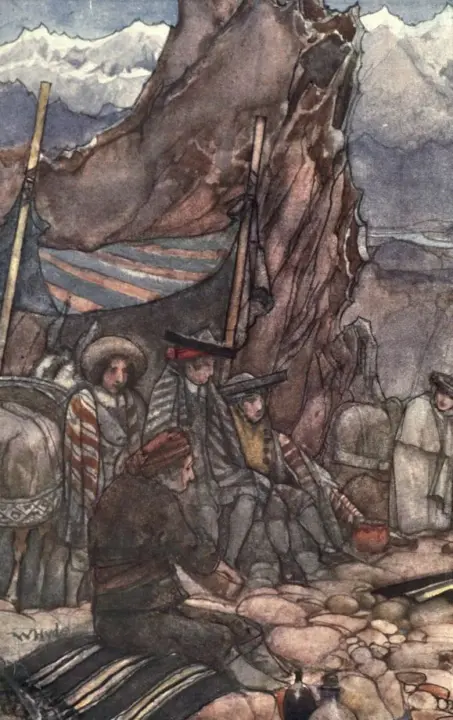
THE CLASSIC COLLECTION · 1908
"The Spanish Jade" by Maurice Hewlett is a novel written in the early 20th century. The story elements suggest a historical adventure set in 19th-century Spain, weaving through themes of love, revenge, and cultural identity. The narrative begins with two contrasting protagonists: Estéban, a young, impetuous Spanish man on a quest fueled by vengeance, and Osmund Manvers, an English gentleman exploring the Spanish landscape for pleasure. At the start of the novel, the reader is introduced to Estéban, who rides through the sunlit plains of Castile, contemplating a dark mission to find and confront a young woman named Manuela. He feels a mixture of anger and longing for her after she abandoned him at a fair. Shortly after, the point of view shifts to Osmund Manvers, an English traveller enjoying the sights and sounds of Spain. As the two characters' paths begin to intertwine, the tension builds, suggesting a tale rich with conflict and emotional depth, set against the backdrop of a vivid Spanish landscape. The stage is set for a story that explores the complexities of human relationships against societal and personal struggles, promising both romance and drama.
Introduction adapted from the source catalogue; source summaries may be automatically generated.
Free to read · English · 38,843 words · No account needed
MAKE TIME FOR A GOOD BOOK
On by default. Untick to stop anonymous reading totals. Each page counts after 10 seconds in view. How this works.
Anonymous counting is on unless you have switched it off.
"High Heaven!" he had cried, sitting up in bed, "what the deuce am I doing here? Nothing. Nothing on earth. Let's get out of it." So out he had got, and could not ask for breakfast at four in the morning.
He rode fast, desiring to make way before the heat began, and by six o'clock, with the sun above the horizon, was not sorry to see towers and pinnacles, or to hear across the emptiness the clangorous notes of a deep-toned bell. "The muezzin calls the faithful, but for me another summons must be sounded. That town will be Palencia. There I breakfast, by the grace of God. Coffee and eggs."
Palencia it was, a town of pretence, if such a word can be applied to anything Spanish, where things either are or are not, and there's an end. It was as drab as the landscape, as weatherworn and austere; but it had a squat officer sitting at the receipt of custom, which Sahagun had not, and a file of anxious peasants before him, bargaining for their chickens and hay.
Upon the horseman's approach the functionary raised himself, looking over the heads of the crowd as at a greater thing, saluted, and inquired for gate-dues with his patient eyes. "I have here," said Manvers, who loved to be didactic in a foreign language, "a shirt and a comb, the New Testament, the History of the Ingenious Gentleman, Don Quixote de la Mancha, and a toothbrush."
Much of this was Greek to the doganero, who, however, understood that the stranger was referring in tolerable Castilian to a provincial gentleman of degree. The name and Manvers' twisted smile together won him the entry. The officer just eased his peaked cap. "Go with God, sir," he directed.
"Assuredly," said Manvers, "but pray assist me to the inn."
The Providencia was named, indicated, and found. There was an elderly man in the yard of it, placidly plucking a live fowl, a barbarity with which our traveller had now ceased to quarrel.
"Leave your horrid task, my friend," he said. "Take my horse, and feed
him."
The bird was released, and after shaking, by force of habit, what no longer, or only partially existed, rejoined its companions. They received it coldly, but it soon showed that it could pick as well as be picked.
"Now," said Manvers to the ostler, "give this horse half a feed of corn, then some water, then the other half feed; but give him nothing until you have cooled him down. Do these things, and I present you with one peseta. Omit any of them, and I give you nothing at all. Is that a bargain?"
Your reading position is saved on this browser. Take it to another device with a library code. Reading pages adapt to text, rather than matching a printed edition.
Maurice Hewlett
Maurice Hewlett
Maurice Hewlett
Maurice Hewlett
BEHIND THE BOOK
This eBook is for the use of anyone anywhere in the United States and most other parts of the world at no cost and with almost no restrictions whatsoever. You may copy it, give it away or re-use it under the terms of the Project Gutenberg License included with this eBook or online at www.gutenberg.org. If you are not located in the United States, you will have to check the laws of the country where you are located before using this eBook. Read the source licence.
The original source file, including credits and licence, is retained by this library. Request an original-format copy at no charge. Please include the book title and Project Gutenberg identifier #29545.
KEEP YOUR CURIOSITY GOING
Cécile Tormay

Moritz Busch
Coulson Kernahan
John L. Ransom

Maurice Baring
Frances Wright