THE CLASSIC COLLECTION✦Industrial and commercial South AmericaCLASSIC FREE BOOKS
Industrial and commercial South America
Annie S. (Annie Smith) Peck
THE CLASSIC COLLECTION · 1913
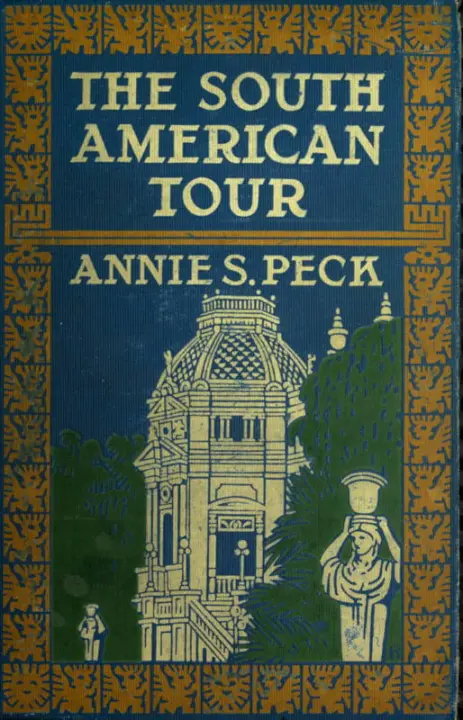
"The South American Tour" by Annie S. Peck is a travelogue written in the early 20th century. The book serves as a guide for tourists interested in exploring South America, detailing itineraries, locations of interest, and various practicalities for traveling through the continent. With rich descriptions and insightful observations, it aims to both encourage travel and inform readers of the cultural and natural wonders awaiting them in Latin America. At the start of the travelogue, the author emphasizes the increasing popularity and accessibility of a South American tour. She lays out an enticing overview of the diverse attractions, from breathtaking natural landscapes to vibrant cities rich in history. Peck discusses the logistics of embarking on such a journey, providing essential information about routes, costs, and timing. She sets the stage for a comprehensive exploration of several countries, including Panama, Peru, Bolivia, and Chile, inviting readers to experience the regions' distinct characteristics and cultural treasures firsthand.
Introduction adapted from the source catalogue; source summaries may be automatically generated.
Free to read · English · 149,540 words · No account needed
MAKE TIME FOR A GOOD BOOK
On by default. Untick to stop anonymous reading totals. Each page counts after 10 seconds in view. How this works.
Anonymous counting is on unless you have switched it off.
Notable churches are Santa Anna, built in 1761, and Our Lady of the Carmo, about the same date, and Our Lady of Nazareth, built in 1802, where seamen especially bring offerings, wax miniatures of boats and other objects of maritime life, forming a curious museum of nautical art.
The greatest interest and admiration may be excited by the Goeldi Museum, one of the most famous in South America, and now under the direction of Dr. Jacques Huber. The building is surrounded by fine specimens of the Amazonian forests with the finest collection in the world of the Hevea brasiliensis, the best of the many varieties of rubber trees; and the experimental garden probably contains every species of rubber known, with many other plants of commercial value. Of equal or greater interest are the archæological, ethnological, and zoological departments. Here are collections of pottery of extinct Indian tribes inhabiting this region at the time of the Portuguese discovery, with funeral urns and pottery from mounds of the Island of Marajó. Weapons and utensils of the Amazonian Indians are shown. The collection of Brazilian fauna comprises a complete series of Amazonian monkeys, a great variety of birds, the larger mammals, as the tapir, jaguar, etc., and insects. Many living creatures, aquatic birds, parrots, toucans of gorgeous plumage, alligators, anacondas, boa constrictors, electric eels, and many others, safely caged, enchain the attention.
The Lauro Sodré Institute for industrial and agricultural training, a School of Commerce, a Fine Arts Academy, and other establishments for education, for the sick, and the poor are liberally provided. A fine new Market is not of small importance. The broad, clean, well shaded streets are often lined with beautiful villas and gardens; though but a degree and a half from the equator the heat is not excessive, rarely above 90° Fahr.
=Manaos.= The visitor to Pará, is likely to be on his way up the Amazon to Manaos or Iquitos; if a bit of an explorer, perchance to Bolivia by the newly practicable Madeira and Mamoré route, or to the rubber regions in any one of five countries. The city of Pará, is about 80 miles from the pilot station Salinas; and a further journey of 24 hours, nearly 200 miles, is required, across a bay, then for nine hours through a narrow channel, before one really enters the broad stream of the great Amazon. Along the narrows the landscape is charming; clearings with huts and children are frequent; canoes with fishermen, and small steamers calling at the barracas (plantations) for rubber or to bring provisions are numerous. The luxuriant vegetation is fascinating. But from the remoteness of the shores, on the immense wide river the four or five days to Manaos may be somewhat monotonous. The greater will be the surprise of the uniformed traveler when after 900 miles through the enormous wilderness of forest he arrives at this new city, with a population of 80,000, truly a wonder of wonders. Its location is at the junction of the Rio Negro with the Amazon; one writer says on a large bay, another that it is on the left bank of the Negro eight miles from the Amazon. At all events it has a safe and quiet harbor with excellent port works arranged to fit the rise and fall of the river, about 50 feet. A floating roadway extends into the river, a platform and pontoons supporting warehouses; and ocean steamships come alongside. Hills have been lowered, shallow places filled in, and waterworks and drainage systems supplied; so that a remarkable city indeed is here in the forest. It is said to be the best lighted city in Brazil. The Municipal street, 100 feet wide, is lined with handsome buildings. The Eduardo Ribeiro avenue in the afternoon and evening is thronged with people of wealth and fashion. The Amazonas Theater, on this avenue and S. Sebastião Square, is of astonishing magnificence, having cost $2,000,000; its beautiful colored dome is a conspicuous feature from the harbor. The interior compares with the splendid exterior, allegorical paintings by De Angelis, the celebrated Italian artist, ornamenting the ceilings of foyer and auditorium. The Palace of Justice, a white marble building in Roman style, with a bronze and marble staircase, is also imposing. The Cathedral is a vast temple of simple architecture. There are excellent school buildings, a public library, a museum with curious Amazonian specimens, a spacious market cool and well ventilated, and a public garden with music from six till midnight. Electric fans are everywhere in evidence, ice here manufactured is supplied in abundance, and excellent sanitation makes the capital surprisingly free from sickness.
Your reading position is saved on this browser. Take it to another device with a library code. Reading pages adapt to text, rather than matching a printed edition.
BEHIND THE BOOK
This eBook is for the use of anyone anywhere in the United States and most other parts of the world at no cost and with almost no restrictions whatsoever. You may copy it, give it away or re-use it under the terms of the Project Gutenberg License included with this eBook or online at www.gutenberg.org. If you are not located in the United States, you will have to check the laws of the country where you are located before using this eBook. Read the source licence.
The original source file, including credits and licence, is retained by this library. Request an original-format copy at no charge. Please include the book title and Project Gutenberg identifier #59715.
KEEP YOUR CURIOSITY GOING
Wilfrid Scawen Blunt
Wilfrid Scawen Blunt

E. W. (Edgar Watson) Howe
Francis Greenleaf Allinson & Anne C. E. (Anne Crosby Emery) Allinson
Cyrenus Cole

John Martineau