THE CLASSIC COLLECTION✦Industrial and commercial South AmericaCLASSIC FREE BOOKS
Industrial and commercial South America
Annie S. (Annie Smith) Peck
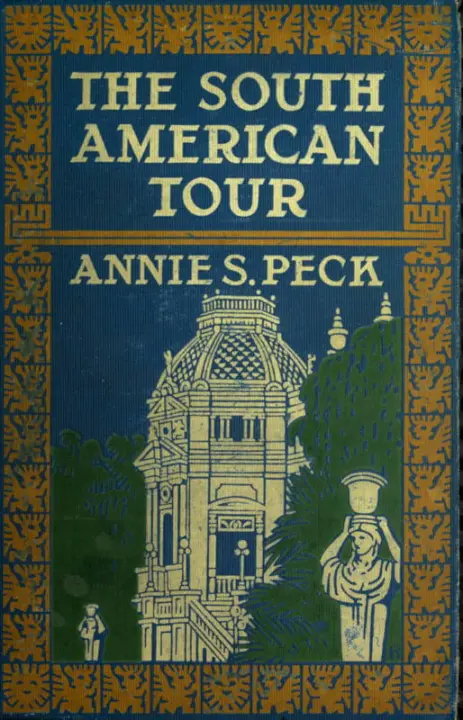
THE CLASSIC COLLECTION · 1913
"The South American Tour" by Annie S. Peck is a travelogue written in the early 20th century. The book serves as a guide for tourists interested in exploring South America, detailing itineraries, locations of interest, and various practicalities for traveling through the continent. With rich descriptions and insightful observations, it aims to both encourage travel and inform readers of the cultural and natural wonders awaiting them in Latin America. At the start of the travelogue, the author emphasizes the increasing popularity and accessibility of a South American tour. She lays out an enticing overview of the diverse attractions, from breathtaking natural landscapes to vibrant cities rich in history. Peck discusses the logistics of embarking on such a journey, providing essential information about routes, costs, and timing. She sets the stage for a comprehensive exploration of several countries, including Panama, Peru, Bolivia, and Chile, inviting readers to experience the regions' distinct characteristics and cultural treasures firsthand.
Introduction adapted from the source catalogue; source summaries may be automatically generated.
Free to read · English · 149,540 words · No account needed
MAKE TIME FOR A GOOD BOOK
On by default. Untick to stop anonymous reading totals. Each page counts after 10 seconds in view. How this works.
Anonymous counting is on unless you have switched it off.
On the way to the beaches by the rua Cattete, before reaching the Strangers’ Hotel, the President’s Palace may be observed on the left. The large garden extends through to the boulevard along the Praia de Flamengo, but the entrance is from Cattete. The exterior of the Palace, which was constructed by the Baron of Nova Friburgo and later purchased by the Government, is not noteworthy, but the interior has magnificent decorations; the garden would be a fitting accessory of a royal palace. Next to the Palace is the beautiful school building, Rodriguez Alves, a suitable monument to the great President of Brazil, in whose administration was inaugurated the tremendous undertaking by which the city has been transformed.
Not far from the Hotel Estrangeiros, a beautiful avenue lined with royal palms, half a mile long, leads to a fine mansion, which in 1911 was the residence of the President.
In a long afternoon of four or five hours the entire circuit of the city may be made by automobile along the Beira Mar on the shore of the bay, then past the ocean beaches to the mountains and by a splendid road along the mountain-side past Gavea and Tijuca, thence across to the waterfront, and by the docks returning to the Avenida Central; a circuit with varied panorama such as no other city of the world affords, to which an entire day might better be devoted.
The Botanical Garden, long celebrated as possessing the finest collection of tropical plants among the parks of the world, was founded in 1808 by Dom João VI when Prince Regent of Portugal. At the Avenida Station, a car marked Gavea may be taken about once in ten minutes. The route is at first a familiar one, near the shore of the bay, but turns at length to the west, passing presently under the steep walls of Corcovado on the right and near the shore of a considerable lake, the Lagõa Rodrigues de Freitas on the left, a ride for which the three-quarters of an hour required is none too long. Within the gateway, flanked by small office buildings, one is confronted by a splendid avenue of superb palms, 150 in number, extending in a straight line nearly half a mile. The tree trunks, a yard in diameter at the base, are straight shafts 75 feet high, ere they are topped by their leafage crown. Some distance up, this avenue is crossed by another of 140 palms, a fountain adorning the square of intersection. These palms, with all those forming colonnades in other parts of the city, are descendants of the ancient tree which was planted by D. João VI. The story goes that some Brazilian officers, shipwrecked, were carried to the Isle of France, where was a fine botanical garden. One of the officers, Luiz de Abreu, after gaining possession of several choice specimens, managed to escape with them. Returning to Brazil he presented them to Dom João, who, transferring them to the Garden, planted with his own hands the seed of the Royal Palm. The tree still standing, 130 feet high, apparently destined to flourish for some time longer, is marked by an inscription, and will be pointed out by an attendant if overlooked. It is not, of course, in any of the rows. Besides hundreds of varieties of Brazilian plants, the Garden contains as many from all parts of the world; it maintains close relations with other Gardens, sending to them hundreds of thousands of seeds, as well as making extensive distribution in various parts of Brazil. A delightful section at the left of the entrance is called the Bamboo Salon, where a walk under the feathery archway recalls the aisle of a Gothic cathedral. Of great interest is the traveler’s tree, somewhat resembling a banana plant, of which the sap is like pure cold water. The gentleman who showed me about, kindly cut the stalk with his knife. I drank as the sap spouted forth, and found it indistinguishable from clear water. If the tree would grow in desert regions, what a godsend to the thirsty traveler! The victoria regia with its great leaves, four or five feet in diameter floating on the water is always noteworthy, even if it is not the flowering season, there May or June. Naturally rubber trees of many varieties are to be seen, coffee shrubs, tea plants, and others in profusion, both useful and beautiful, a wealth of vines, but fewer orchids, at least in blossom, than I had hoped. The candelabra tree, so called from its shape, and the cow tree, which supplies a kind of milk better for making cement than for drinking, are of interest. An especial curiosity is one tree growing inside of another, the trunk of the palm being almost completely surrounded by the trunk of another tree of entirely different character, both trees now 30 or 40 feet high.
Your reading position is saved on this browser. Take it to another device with a library code. Reading pages adapt to text, rather than matching a printed edition.
BEHIND THE BOOK
This eBook is for the use of anyone anywhere in the United States and most other parts of the world at no cost and with almost no restrictions whatsoever. You may copy it, give it away or re-use it under the terms of the Project Gutenberg License included with this eBook or online at www.gutenberg.org. If you are not located in the United States, you will have to check the laws of the country where you are located before using this eBook. Read the source licence.
The original source file, including credits and licence, is retained by this library. Request an original-format copy at no charge. Please include the book title and Project Gutenberg identifier #59715.
KEEP YOUR CURIOSITY GOING
Wilfrid Scawen Blunt
Wilfrid Scawen Blunt

E. W. (Edgar Watson) Howe
Francis Greenleaf Allinson & Anne C. E. (Anne Crosby Emery) Allinson
Cyrenus Cole

John Martineau