THE CLASSIC COLLECTION✦Industrial and commercial South AmericaCLASSIC FREE BOOKS
Industrial and commercial South America
Annie S. (Annie Smith) Peck
THE CLASSIC COLLECTION · 1913
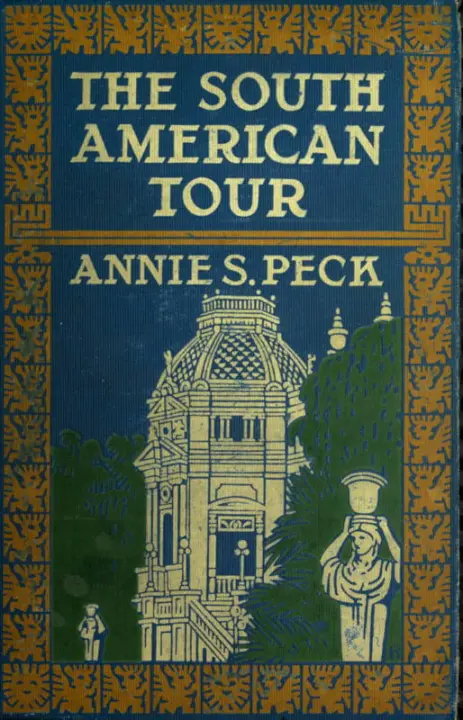
"The South American Tour" by Annie S. Peck is a travelogue written in the early 20th century. The book serves as a guide for tourists interested in exploring South America, detailing itineraries, locations of interest, and various practicalities for traveling through the continent. With rich descriptions and insightful observations, it aims to both encourage travel and inform readers of the cultural and natural wonders awaiting them in Latin America. At the start of the travelogue, the author emphasizes the increasing popularity and accessibility of a South American tour. She lays out an enticing overview of the diverse attractions, from breathtaking natural landscapes to vibrant cities rich in history. Peck discusses the logistics of embarking on such a journey, providing essential information about routes, costs, and timing. She sets the stage for a comprehensive exploration of several countries, including Panama, Peru, Bolivia, and Chile, inviting readers to experience the regions' distinct characteristics and cultural treasures firsthand.
Introduction adapted from the source catalogue; source summaries may be automatically generated.
Free to read · English · 149,540 words · No account needed
MAKE TIME FOR A GOOD BOOK
On by default. Untick to stop anonymous reading totals. Each page counts after 10 seconds in view. How this works.
Anonymous counting is on unless you have switched it off.
At length the mountains are left behind, probably after dusk has fallen, so that the arrival at Mendoza is in the early evening. The tourist who is making a hasty trip will hurry across the station to the probably waiting train, by which he will arrive in Buenos Aires the following evening. The more leisurely, and the tired traveler will take a carriage to the Grand Hotel where an excellent dinner will be enjoyed and comfortable night quarters may be obtained. In looking about the town and visiting one of the great bodegas, a day or two will be agreeably spent.
Mendoza Hotels, the Grand, the Club, the Francia and others. At the Grand, on Plaza San Martin, the table was unexpectedly good; the dinner, served on the broad veranda, from seven to nine on a balmy summer evening, was a genuine pleasure.
=Mendoza=, with 45,000 inhabitants, the largest city in West Argentina, has a remarkable record. Strange, indeed, that this town at the base of the loftiest of the Andes, by these separated from one ocean, and by 650 miles of pampa from the other, was founded nearly fifty years before the first settlement in the United States and twenty years before the city of Buenos Aires came permanently into being. If we knew or reflected more on the bold deeds of other days in other countries, we might, perchance, have more respect for others and less assurance of our own great superiority. May 2, 1561 (some say March 2, 1560), a city was founded by Pedro del Castillo in a fruitful spot watered by the Mendoza River. At an altitude of 2500 feet, in the longitude of Portland, Maine, and a latitude corresponding to that of Charleston, it is an agreeable place, with plazas, wide, pleasant streets, and attractive buildings; but all seems new. Two cities there are, the living and the dead; not as in Cuzco, the one of an earlier race, built over and around by invaders, but an old city of the sixteenth century, a new one of the nineteenth. Unless aware of this fact, the old will be ignored, the visitor passing on, unaware of its existence. Some, indeed, may prefer so to do, but others will desire to have a glimpse of the ruins: for the city of 1561, 300 years later, was utterly destroyed by a tremendous earthquake. The catastrophe was of a singular character. At 8.30 p.m., March 20, 1861, a subterranean groan was heard. On the instant, before there was time to flee, the house walls crumbling fell, the roofs in the middle, so that the people, generally in their houses, perished to the number of 10,000-15,000. Some, who were promenading in the streets or plaza, were killed or thrown to the ground; but many of these who were saved engaged in the work of rescue: too few, however, to do effective labor, so that a large number who had not been killed outright, confined among the ruins, perished from asphyxiation and starvation. From lamps and fires in the dwellings and the breaking of gas pipes, a conflagration followed, rendering the night more horrible. Some districts next day were flooded from the obstruction of the canals; the odor of dead bodies became insupportable, as the survivors were too few to remove them. The shocks had continued until nothing was left standing; there were 19 within the next 24 hours, 17 of which were violent; 14 more the next day; gradually they diminished, coming to an end in May. It is extraordinary that the strength of this violent convulsion was confined to a district 60 miles long and 6 wide, extending southeast from the Uspallata Valley. A slight jar was felt at Buenos Aires, but in Chile across the Andes no tremor at all. Assistance, though promptly sent, was long delayed in arrival, as at that time practically no railroads existed in Argentina. Succor first came from the neighboring towns of San Juan and San Luis, then from Chile, all of Argentina, Paraguay, Uruguay, Peru, and Europe; by which the survivors were enabled to rehabilitate themselves.
Your reading position is saved on this browser. Take it to another device with a library code. Reading pages adapt to text, rather than matching a printed edition.
BEHIND THE BOOK
This eBook is for the use of anyone anywhere in the United States and most other parts of the world at no cost and with almost no restrictions whatsoever. You may copy it, give it away or re-use it under the terms of the Project Gutenberg License included with this eBook or online at www.gutenberg.org. If you are not located in the United States, you will have to check the laws of the country where you are located before using this eBook. Read the source licence.
The original source file, including credits and licence, is retained by this library. Request an original-format copy at no charge. Please include the book title and Project Gutenberg identifier #59715.
KEEP YOUR CURIOSITY GOING
Wilfrid Scawen Blunt
Wilfrid Scawen Blunt

E. W. (Edgar Watson) Howe
Francis Greenleaf Allinson & Anne C. E. (Anne Crosby Emery) Allinson
Cyrenus Cole

John Martineau