THE CLASSIC COLLECTION✦Industrial and commercial South AmericaCLASSIC FREE BOOKS
Industrial and commercial South America
Annie S. (Annie Smith) Peck
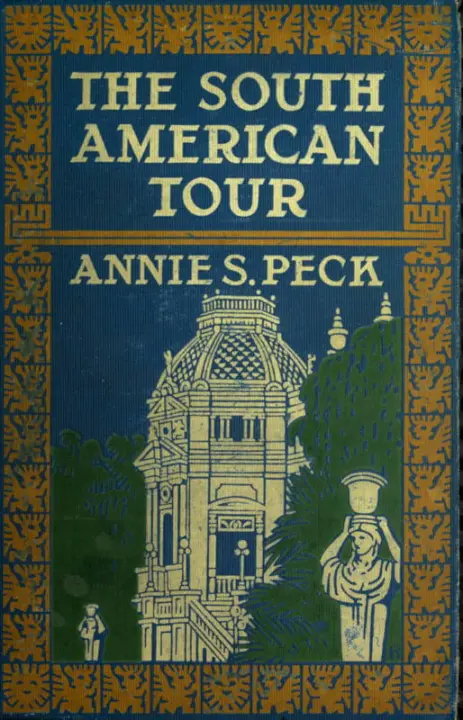
THE CLASSIC COLLECTION · 1913
"The South American Tour" by Annie S. Peck is a travelogue written in the early 20th century. The book serves as a guide for tourists interested in exploring South America, detailing itineraries, locations of interest, and various practicalities for traveling through the continent. With rich descriptions and insightful observations, it aims to both encourage travel and inform readers of the cultural and natural wonders awaiting them in Latin America. At the start of the travelogue, the author emphasizes the increasing popularity and accessibility of a South American tour. She lays out an enticing overview of the diverse attractions, from breathtaking natural landscapes to vibrant cities rich in history. Peck discusses the logistics of embarking on such a journey, providing essential information about routes, costs, and timing. She sets the stage for a comprehensive exploration of several countries, including Panama, Peru, Bolivia, and Chile, inviting readers to experience the regions' distinct characteristics and cultural treasures firsthand.
Introduction adapted from the source catalogue; source summaries may be automatically generated.
Free to read · English · 149,540 words · No account needed
MAKE TIME FOR A GOOD BOOK
On by default. Untick to stop anonymous reading totals. Each page counts after 10 seconds in view. How this works.
Anonymous counting is on unless you have switched it off.
It is worth while to go over to the modern Indian village, Tiahuanaco. On the plaza is a church, largely constructed of stones taken from the ancient ruins. In front of the church are two ancient and dilapidated statues, long since transported from their original site. The interior of this small church is of extraordinary magnificence, with elaborate gilt carvings, an altar of pure silver, and some religious paintings of moderate excellence.
On the 16th of September elaborate festivities occur, when many Indians appear in velvet or plush garments, blue, pink, or green, embroidered with gold or silver, wearing masks, black, white, or yellow, and elaborate feather head dresses. Pipes and drums, other wind instruments, and wooden rattles make plenty of noise if not music. Some men are dressed to represent devils, with horns and tail; others, animals, as a sheep or a green turtle. The finest suits cost each as much as $200 gold. At Sorata town a still more elaborate festival occurs at the same period, lasting for four or five days. Gorgeous feather head dresses may be seen, and fans which could not be purchased for $75. The execution of the Inca Atahuallpa is here represented with mourning by the Indians. These festivals are all accompanied or concluded by drunken orgies. In La Paz, August 15, 1903, occurred somewhat similar but milder festivities, Indians in costume and dances.
=Sorata.= One who is fond of horseback riding and not afraid of a little discomfort might, with from five to seven days to spare, enjoy an expedition to the town of Sorata. This city of 8000 or 10,000 inhabitants is situated about a hundred miles north of La Paz in a beautiful valley at the foot of the mountain of the same name, better called by the euphonius Indian appellation, Illampu. In 1911 a diligence or covered wagon with four horses twice a week made the trip by a fair road over the plain to Achacachi, perhaps 70 miles distant. The diligence sets out at a very early hour, six or half past, making a rather long day. From Achacachi to Sorata town it is a ride of from six to nine hours according to the animals provided. These must be engaged in advance in La Paz and probably sent ahead to meet one there, in which case it is obviously cheaper, though more tiresome, to go on horseback all the way. If this method of travel is decided upon, or indeed the other, an arriero must be engaged to provide saddle animals and to take care of them, being paid somewhat in advance. Unless he receives a sum to bind the bargain and to pay his preliminary expenses, whatever he may promise, he is likely never to be seen again. But having accepted money, he generally carries out the bargain, though a written contract is desirable. An arriero once agreed with me to furnish four animals, two saddle, one of these for himself, and two baggage animals for eight bol. a day for all, he paying the expenses for his own food and the animals; but it might cost double that now. Much depends on chance and ability at bargaining. If making the journey on horseback one should at least take the early train to the alto arranging in advance for the animals to meet him above. Setting out from there promptly, a good horseman with first-rate animals might reach Guarina or even Achacachi the same evening and from either place go on to Sorata the next day. Soon after leaving the Alto Station all traces of life disappear save what is met upon the road, Indians with llamas, burros, etc. The brown plain shows no signs of cultivation, being thickly covered with stones. No village or hut is passed for hours. But the great peaks seen from slowly varying angles are a continual source of enjoyment. A splendid imposing mountain, Huaina Potosí or Cacaaca, about 21,000 feet, with tin mines on its lower slopes, affords an opportunity for a difficult first ascent. The tambo, Cocuta, should be reached in time for almuerzo; at the very least, Machacamarca for the night: better Guarina, if possible. If one lodges at Machacamarca one must spend the next night at Achacachi and go the third day to Sorata. It is desirable, even necessary, to take blankets for the night, and to provide in the alforjas (saddle-bags), a supply of chocolate, raisins, etc., perhaps canned meat and crackers. At Cocuta, and the other places, meals are provided, soup, eggs, beefsteak, coarse bread, and tea, but between Achacachi and Sorata there is no place for luncheon; and some chocolate, etc., will come in very well the first day. Except at Achacachi no bed will be found better than a couch of adobe, but with blankets a hard bed is no harm. I have heard dire tales of the insect life which infests some such places, but in my own considerable experience, I never found anything worse than fleas and not many of them. The immense snow fields of Illampu come into view soon after leaving Cocuta. Before reaching Guarina there are glimpses of Lake Titicaca. Between Achacachi and Sorata the Huallata pass is crossed at a height of 14,000 feet. This is a big buttress of Illampu, from the top of which one has a splendid view of the enormous mountain massif close at hand, with its several summits all from this side seeming absolutely unclimbable. Descending towards Sorata attention is divided between the tremendous cliffs of Illampu on the right and the romantic Mapiri Valley below. The town, Sorata, at an altitude of 8000 feet, has a charmingly picturesque location on a terrace near the head of the valley, among trees, shrubs, and fragrant flowers, in striking contrast to the bare, bleak, brown plain above. On one side the grim walls and glittering summits of Illampu rise nearly 14,000 feet (the height of the mountain being over 21,000), contrasting sharply with the bluish purple tints down the steeply enclosed gorge opposite. At no distant day electric cars will cross the mountain ridge, and this charming town will be regularly included in the fashionable tours of South America. Sorata now has a fair hotel, as it is the headquarters for several rubber companies which conduct the industry on the lower eastern slope of the Andes, and for many miners who seek placer deposits, or the veins above them, also on the eastern side. Any one with the spirit of the explorer would find it a most interesting trip to make the circuit of the mountain: not a difficult task, but probably never yet accomplished by a white person. To the mountaineer, Illampu still affords opportunity for a splendid first ascent, Miss Peck in 1904 being obliged to turn back in good weather and a fine condition of the mountain at about 20,500 feet simply because her companions refused to advance; while Conway in 1898 retreated from a higher point on account of dangerous conditions of the snow. With Swiss guides the ascent should be easily made, or without them by experts like the conquerors of Mt. McKinley, Parker and Browne.
Your reading position is saved on this browser. Take it to another device with a library code. Reading pages adapt to text, rather than matching a printed edition.
BEHIND THE BOOK
This eBook is for the use of anyone anywhere in the United States and most other parts of the world at no cost and with almost no restrictions whatsoever. You may copy it, give it away or re-use it under the terms of the Project Gutenberg License included with this eBook or online at www.gutenberg.org. If you are not located in the United States, you will have to check the laws of the country where you are located before using this eBook. Read the source licence.
The original source file, including credits and licence, is retained by this library. Request an original-format copy at no charge. Please include the book title and Project Gutenberg identifier #59715.
KEEP YOUR CURIOSITY GOING
Wilfrid Scawen Blunt
Wilfrid Scawen Blunt

E. W. (Edgar Watson) Howe
Francis Greenleaf Allinson & Anne C. E. (Anne Crosby Emery) Allinson
Cyrenus Cole

John Martineau