
Wilde v Whistler Being an Acrimonious Correspondence on Art Between Oscar Wilde and James A McNeill Whistler
Oscar Wilde & James McNeill Whistler
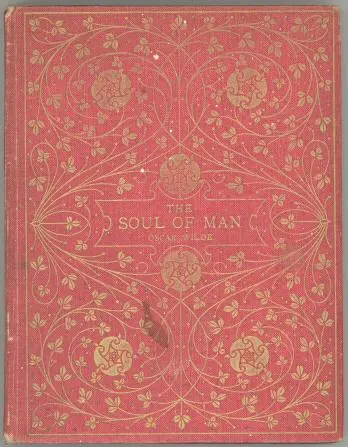
THE CLASSIC COLLECTION · 1891
"The Soul of Man under Socialism" by Oscar Wilde is an essay published in 1891. Wilde presents a libertarian socialist vision that challenges conventional charity and capitalism. He argues that poverty prevents people from realizing their true potential and that well-meaning altruism only prolongs suffering by addressing symptoms rather than causes. Wilde advocates for a socialist society that abolishes private property, freeing individuals from material concerns to pursue creative self-development and artistic expression. He envisions socialism as a path to true individualism, not authoritarian control.
Introduction adapted from the source catalogue; source summaries may be automatically generated.
Free to read · English · 14,457 words · No account needed
MAKE TIME FOR A GOOD BOOK
On by default. Untick to stop anonymous reading totals. Each page counts after 10 seconds in view. How this works.
Anonymous counting is on unless you have switched it off.
It will be a marvellous thing—the true personality of man—when we see it. It will grow naturally and simply, flowerlike, or as a tree grows. It will not be at discord. It will never argue or dispute. It will not prove things. It will know everything. And yet it will not busy itself about knowledge. It will have wisdom. Its value will not be measured by material things. It will have nothing. And yet it will have everything, and whatever one takes from it, it will still have, so rich will it be. It will not be always meddling with others, or asking them to be like itself. It will love them because they will be different. And yet while it will not meddle with others, it will help all, as a beautiful thing helps us, by being what it is. The personality of man will be very wonderful. It will be as wonderful as the personality of a child.
In its development it will be assisted by Christianity, if men desire that; but if men do not desire that, it will develop none the less surely. For it will not worry itself about the past, nor care whether things happened or did not happen. Nor will it admit any laws but its own laws; nor any authority but its own authority. Yet it will love those who sought to intensify it, and speak often of them. And of these Christ was one.
‘Know thyself’ was written over the portal of the antique world. Over the portal of the new world, ‘Be thyself’ shall be written. And the message of Christ to man was simply ‘Be thyself.’ That is the secret of Christ.
When Jesus talks about the poor he simply means personalities, just as when he talks about the rich he simply means people who have not developed their personalities. Jesus moved in a community that allowed the accumulation of private property just as ours does, and the gospel that he preached was not that in such a community it is an advantage for a man to live on scanty, unwholesome food, to wear ragged, unwholesome clothes, to sleep in horrid, unwholesome dwellings, and a disadvantage for a man to live under healthy, pleasant, and decent conditions. Such a view would have been wrong there and then, and would, of course, be still more wrong now and in England; for as man moves northward the material necessities of life become of more vital importance, and our society is infinitely more complex, and displays far greater extremes of luxury and pauperism than any society of the antique world. What Jesus meant, was this. He said to man, ‘You have a wonderful personality. Develop it. Be yourself. Don’t imagine that your perfection lies in accumulating or possessing external things. Your affection is inside of you. If only you could realise that, you would not want to be rich. Ordinary riches can be stolen from a man. Real riches cannot. In the treasury-house of your soul, there are infinitely precious things, that may not be taken from you. And so, try to so shape your life that external things will not harm you. And try also to get rid of personal property. It involves sordid preoccupation, endless industry, continual wrong. Personal property hinders Individualism at every step.’ It is to be noted that Jesus never says that impoverished people are necessarily good, or wealthy people necessarily bad. That would not have been true. Wealthy people are, as a class, better than impoverished people, more moral, more intellectual, more well-behaved. There is only one class in the community that thinks more about money than the rich, and that is the poor. The poor can think of nothing else. That is the misery of being poor. What Jesus does say is that man reaches his perfection, not through what he has, not even through what he does, but entirely through what he is. And so the wealthy young man who comes to Jesus is represented as a thoroughly good citizen, who has broken none of the laws of his state, none of the commandments of his religion. He is quite respectable, in the ordinary sense of that extraordinary word. Jesus says to him, ‘You should give up private property. It hinders you from realising your perfection. It is a drag upon you. It is a burden. Your personality does not need it. It is within you, and not outside of you, that you will find what you really are, and what you really want.’ To his own friends he says the same thing. He tells them to be themselves, and not to be always worrying about other things. What do other things matter? Man is complete in himself. When they go into the world, the world will disagree with them. That is inevitable. The world hates Individualism. But that is not to trouble them. They are to be calm and self-centred. If a man takes their cloak, they are to give him their coat, just to show that material things are of no importance. If people abuse them, they are not to answer back. What does it signify? The things people say of a man do not alter a man. He is what he is. Public opinion is of no value whatsoever. Even if people employ actual violence, they are not to be violent in turn. That would be to fall to the same low level. After all, even in prison, a man can be quite free. His soul can be free. His personality can be untroubled. He can be at peace. And, above all things, they are not to interfere with other people or judge them in any way. Personality is a very mysterious thing. A man cannot always be estimated by what he does. He may keep the law, and yet be worthless. He may break the law, and yet be fine. He may be bad, without ever doing anything bad. He may commit a sin against society, and yet realise through that sin his true perfection.
Your reading position is saved on this browser. Take it to another device with a library code. Reading pages adapt to text, rather than matching a printed edition.
Oscar Wilde & James McNeill Whistler
Oscar Wilde

Oscar Wilde

Oscar Wilde
BEHIND THE BOOK
This eBook is for the use of anyone anywhere in the United States and most other parts of the world at no cost and with almost no restrictions whatsoever. You may copy it, give it away or re-use it under the terms of the Project Gutenberg License included with this eBook or online at www.gutenberg.org. If you are not located in the United States, you will have to check the laws of the country where you are located before using this eBook. Read the source licence.
The original source file, including credits and licence, is retained by this library. Request an original-format copy at no charge. Please include the book title and Project Gutenberg identifier #1017.
KEEP YOUR CURIOSITY GOING

David Patterson (Spirit) Hatch

David Patterson (Spirit) Hatch

David Patterson (Spirit) Hatch
Coulson Kernahan

Ralph Waldo Emerson

Maurice Baring