
Wilde v Whistler Being an Acrimonious Correspondence on Art Between Oscar Wilde and James A McNeill Whistler
Oscar Wilde & James McNeill Whistler
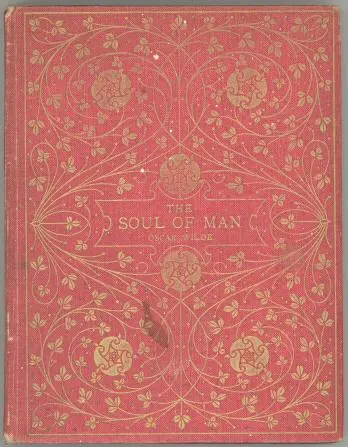
THE CLASSIC COLLECTION · 1891
"The Soul of Man under Socialism" by Oscar Wilde is an essay published in 1891. Wilde presents a libertarian socialist vision that challenges conventional charity and capitalism. He argues that poverty prevents people from realizing their true potential and that well-meaning altruism only prolongs suffering by addressing symptoms rather than causes. Wilde advocates for a socialist society that abolishes private property, freeing individuals from material concerns to pursue creative self-development and artistic expression. He envisions socialism as a path to true individualism, not authoritarian control.
Introduction adapted from the source catalogue; source summaries may be automatically generated.
Free to read · English · 14,457 words · No account needed
MAKE TIME FOR A GOOD BOOK
On by default. Untick to stop anonymous reading totals. Each page counts after 10 seconds in view. How this works.
Anonymous counting is on unless you have switched it off.
Indeed, there is much more to be said in favour of the physical force of the public than there is in favour of the public’s opinion. The former may be fine. The latter must be foolish. It is often said that force is no argument. That, however, entirely depends on what one wants to prove. Many of the most important problems of the last few centuries, such as the continuance of personal government in England, or of feudalism in France, have been solved entirely by means of physical force. The very violence of a revolution may make the public grand and splendid for a moment. It was a fatal day when the public discovered that the pen is mightier than the paving-stone, and can be made as offensive as the brickbat. They at once sought for the journalist, found him, developed him, and made him their industrious and well-paid servant. It is greatly to be regretted, for both their sakes. Behind the barricade there may be much that is noble and heroic. But what is there behind the leading-article but prejudice, stupidity, cant, and twaddle? And when these four are joined together they make a terrible force, and constitute the new authority.
In old days men had the rack. Now they have the press. That is an improvement certainly. But still it is very bad, and wrong, and demoralising. Somebody—was it Burke?—called journalism the fourth estate. That was true at the time, no doubt. But at the present moment it really is the only estate. It has eaten up the other three. The Lords Temporal say nothing, the Lords Spiritual have nothing to say, and the House of Commons has nothing to say and says it. We are dominated by Journalism. In America the President reigns for four years, and Journalism governs for ever and ever. Fortunately in America Journalism has carried its authority to the grossest and most brutal extreme. As a natural consequence it has begun to create a spirit of revolt. People are amused by it, or disgusted by it, according to their temperaments. But it is no longer the real force it was. It is not seriously treated. In England, Journalism, not, except in a few well-known instances, having been carried to such excesses of brutality, is still a great factor, a really remarkable power. The tyranny that it proposes to exercise over people’s private lives seems to me to be quite extraordinary. The fact is, that the public have an insatiable curiosity to know everything, except what is worth knowing. Journalism, conscious of this, and having tradesman-like habits, supplies their demands. In centuries before ours the public nailed the ears of journalists to the pump. That was quite hideous. In this century journalists have nailed their own ears to the keyhole. That is much worse. And what aggravates the mischief is that the journalists who are most to blame are not the amusing journalists who write for what are called Society papers. The harm is done by the serious, thoughtful, earnest journalists, who solemnly, as they are doing at present, will drag before the eyes of the public some incident in the private life of a great statesman, of a man who is a leader of political thought as he is a creator of political force, and invite the public to discuss the incident, to exercise authority in the matter, to give their views, and not merely to give their views, but to carry them into action, to dictate to the man upon all other points, to dictate to his party, to dictate to his country; in fact, to make themselves ridiculous, offensive, and harmful. The private lives of men and women should not be told to the public. The public have nothing to do with them at all. In France they manage these things better. There they do not allow the details of the trials that take place in the divorce courts to be published for the amusement or criticism of the public. All that the public are allowed to know is that the divorce has taken place and was granted on petition of one or other or both of the married parties concerned. In France, in fact, they limit the journalist, and allow the artist almost perfect freedom. Here we allow absolute freedom to the journalist, and entirely limit the artist. English public opinion, that is to say, tries to constrain and impede and warp the man who makes things that are beautiful in effect, and compels the journalist to retail things that are ugly, or disgusting, or revolting in fact, so that we have the most serious journalists in the world, and the most indecent newspapers. It is no exaggeration to talk of compulsion. There are possibly some journalists who take a real pleasure in publishing horrible things, or who, being poor, look to scandals as forming a sort of permanent basis for an income. But there are other journalists, I feel certain, men of education and cultivation, who really dislike publishing these things, who know that it is wrong to do so, and only do it because the unhealthy conditions under which their occupation is carried on oblige them to supply the public with what the public wants, and to compete with other journalists in making that supply as full and satisfying to the gross popular appetite as possible. It is a very degrading position for any body of educated men to be placed in, and I have no doubt that most of them feel it acutely.
Your reading position is saved on this browser. Take it to another device with a library code. Reading pages adapt to text, rather than matching a printed edition.
Oscar Wilde & James McNeill Whistler
Oscar Wilde
Oscar Wilde
Oscar Wilde
BEHIND THE BOOK
This eBook is for the use of anyone anywhere in the United States and most other parts of the world at no cost and with almost no restrictions whatsoever. You may copy it, give it away or re-use it under the terms of the Project Gutenberg License included with this eBook or online at www.gutenberg.org. If you are not located in the United States, you will have to check the laws of the country where you are located before using this eBook. Read the source licence.
The original source file, including credits and licence, is retained by this library. Request an original-format copy at no charge. Please include the book title and Project Gutenberg identifier #1017.
KEEP YOUR CURIOSITY GOING

David Patterson (Spirit) Hatch

David Patterson (Spirit) Hatch

David Patterson (Spirit) Hatch
Coulson Kernahan

Ralph Waldo Emerson

Maurice Baring