THE CLASSIC COLLECTION✦Satan’s DiaryCLASSIC FREE BOOKS
Satan’s Diary
Leonid Andreyev
THE CLASSIC COLLECTION · 1915
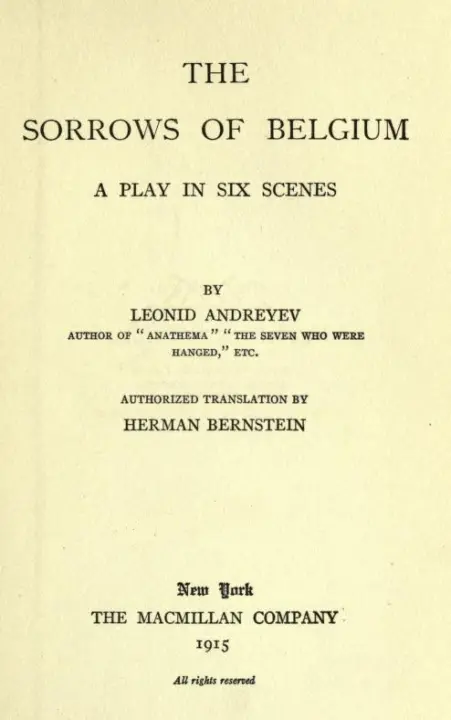
"The Sorrows of Belgium: A Play in Six Scenes" by Leonid Andreyev is a dramatic work written in the early 20th century. This play captures the tragic circumstances of the Belgian people during World War I, particularly through the lens of a prominent Belgian author, Emil Grelieu, and his family. It addresses themes of suffering, resistance, and the moral complexities posed by war, reflecting Andreyev’s deep empathy for oppressed nations. The opening of the play sets a serene scene in Grelieu's garden as the war begins to encroach upon their lives. Characters like François, the deaf gardener, and Maurice, Grelieu's son, express a mix of alarm and disbelief as they come to terms with the reality of the German invasion. Grelieu himself appears anxious, consumed with conflict about his responsibilities and the implications of war. As the sounds of war grow nearer, the family's peaceful existence shatters, setting the stage for a deeper exploration of their emotional and moral dilemmas as they face the impending chaos. The stark contrast between the tranquil garden and the impending violence underscores the play's themes of disruption and sorrow.
Introduction adapted from the source catalogue; source summaries may be automatically generated.
Free to read · English · 16,414 words · No account needed
MAKE TIME FOR A GOOD BOOK
On by default. Untick to stop anonymous reading totals. Each page counts after 10 seconds in view. How this works.
Anonymous counting is on unless you have switched it off.
No, she is not concealing anything, but she has gone into the depths of her own self, where all is silence and mystery. She is living through her motherhood again, from the very beginning--do you understand? when you and Maurice were not yet born--but in this she is crafty, like François. Sometimes I see clearly that she is suffering unbearably, that she is terrified by the war--. But she smiles in answer and then I see something else--I see how there has suddenly awakened in her the prehistoric woman--the woman who handed her husband the fighting club--. Wait, the soldiers are coming again!
Military music is heard in the distance, nearing.
Yes, according to the assignment, it is the Ninth Regiment.
Let us hear it, Pierre. I hear this music several times a day.
There it starts on the right, and there it dies down. Always
there.
They listen.
But they are brave fellows!
Yes.
Both listen attentively at the window. François looks at them askance and tries in vain to hear. The music begins to die out.
Walking away from the window.
Yesterday they played the "Marseillaise." But they are brave
fellows!
Emil Grelieu's wife enters quickly.
Do you hear it? How beautiful! Even our refugees smiled when
they heard it. Emil, I have brought you some telegrams, here. I
have read them.
What is it? Let me have them!
Reading the telegrams, he staggers to an armchair and sinks
into it. He turns pale.
What is it, father?
Read!
Pierre reads it over the shoulder of his father. The woman looks at them with an enigmatical expression upon her face. She sits calmly, her beautiful head thrown back. Emil Grelieu rises quickly, and both he and his son start to pace the room in opposite directions.
Do you see?
Yes.
Do you see?
Yes! Yes!
As though indifferently.
Emil, was that an interesting library which they have destroyed?
I don't know.
Yes, very. But what are you asking me, Jeanne? How can you speak?
Oh, I speak only of those books! Tell me, were there many books
there?
Yes, many, many!
And they've burned them?
She hums softly in afresh, strong voice.
"Only the halo of the arts crowns law, liberty, and the
King!--Law--"
Books, books.
And there was also a Cathedral there. Oh, I remember it! Isn't it true, Emil, that it was a beautiful structure?
Hums.
"Law, liberty, and the King--"
Father!
What?
He walks up and down the room.
Your reading position is saved on this browser. Take it to another device with a library code. Reading pages adapt to text, rather than matching a printed edition.
BEHIND THE BOOK
This eBook is for the use of anyone anywhere in the United States and most other parts of the world at no cost and with almost no restrictions whatsoever. You may copy it, give it away or re-use it under the terms of the Project Gutenberg License included with this eBook or online at www.gutenberg.org. If you are not located in the United States, you will have to check the laws of the country where you are located before using this eBook. Read the source licence.
The original source file, including credits and licence, is retained by this library. Request an original-format copy at no charge. Please include the book title and Project Gutenberg identifier #49596.
KEEP YOUR CURIOSITY GOING
Cécile Tormay

Moritz Busch
John L. Ransom
Frances Wright
Cécile Tormay

Mabel Potter Daggett