THE CLASSIC COLLECTION✦Satan’s DiaryCLASSIC FREE BOOKS
Satan’s Diary
Leonid Andreyev
THE CLASSIC COLLECTION · 1915
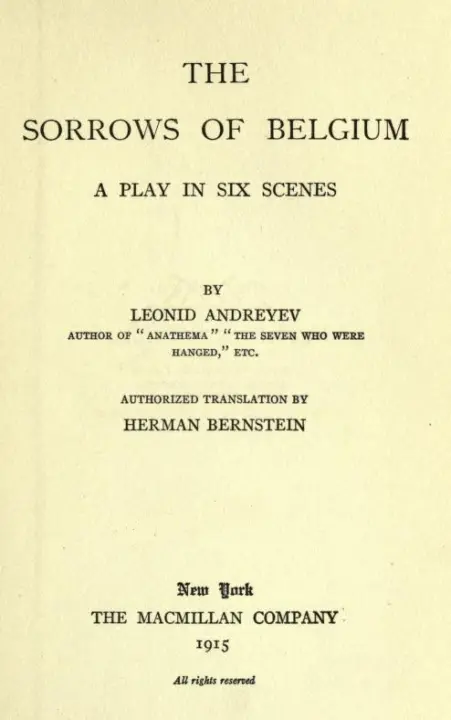
"The Sorrows of Belgium: A Play in Six Scenes" by Leonid Andreyev is a dramatic work written in the early 20th century. This play captures the tragic circumstances of the Belgian people during World War I, particularly through the lens of a prominent Belgian author, Emil Grelieu, and his family. It addresses themes of suffering, resistance, and the moral complexities posed by war, reflecting Andreyev’s deep empathy for oppressed nations. The opening of the play sets a serene scene in Grelieu's garden as the war begins to encroach upon their lives. Characters like François, the deaf gardener, and Maurice, Grelieu's son, express a mix of alarm and disbelief as they come to terms with the reality of the German invasion. Grelieu himself appears anxious, consumed with conflict about his responsibilities and the implications of war. As the sounds of war grow nearer, the family's peaceful existence shatters, setting the stage for a deeper exploration of their emotional and moral dilemmas as they face the impending chaos. The stark contrast between the tranquil garden and the impending violence underscores the play's themes of disruption and sorrow.
Introduction adapted from the source catalogue; source summaries may be automatically generated.
Free to read · English · 16,414 words · No account needed
MAKE TIME FOR A GOOD BOOK
On by default. Untick to stop anonymous reading totals. Each page counts after 10 seconds in view. How this works.
Anonymous counting is on unless you have switched it off.
Madmen! I am seventy years old. I am seventy years old, and they want me to believe a story about Prussians. Nonsense, they are crazy! Prussians! But it is true that I don't hear anything.
Rising, he listens attentively.
No, not a sound. Or do I hear something? Oh, the devil take it! I can't hear a sound. Impossible! No, no, impossible! But what is that? How could I believe that in this calm sky--in this calm sky--
The din of battle is growing. François listens again and hears it. He grows thoughtful. His eyes express fright. He looks as though he had suddenly solved a terrible problem. He moves to and fro, his head bent down, as though trying to catch the sounds. Suddenly he throws down the scissors. He is seized with a feeling of terror. He raises his hands.
I hear it. No. No. Now I don't hear a sound. Oh, God, give me
the power to hear!
He tries again to catch the fleeting sounds, his head bent, his neck outstretched. His hair is disheveled. His eyes stare. Suddenly, by a great effort, he hears the tolling of the bells and voices full of despair. He retreats and raises his hands again.
My God! They are tolling! They are crying! War! What war? What war? Eh, who is there--who is shouting "War!"?
The sound of the bells and the cries grows louder. Emil Grelieu appears, walking quickly in the alley.
What are you shouting, François? Where is Maurice? No one is in
the house.
Is it war?
Yes, yes, it is war. The Prussians have entered Belgium. But you
don't hear anything.
Painfully trying to catch the sounds.
I hear, I hear; are they killing?
Yes, they are killing. The Prussians have entered Belgium. Where
is Maurice?
But, Monsieur Emil--but, Monsieur, what Prussians? Pardon me; I am seventy years old, and I lost my sense of hearing long ago.
Weeps.
Is it really a war?
Yes, it is a real war. I can't understand it either. But the
fighting has already commenced. I can't realize it myself, but
it is war, old man.
Tell me, Monsieur. Tell me about it. I believe you as I believe God. Tell me. I can hear you. Are they killing?
It is war! What horror, François. It is very hard to understand
it--yes, very hard.
Frowns and rubs his high, pale forehead nervously.
Bent, weeps, his head shaking.
And the flowers? Our flowers?
Absentmindedly.
Our flowers? Don't cry, François--ah, what is that?
Your reading position is saved on this browser. Take it to another device with a library code. Reading pages adapt to text, rather than matching a printed edition.
BEHIND THE BOOK
This eBook is for the use of anyone anywhere in the United States and most other parts of the world at no cost and with almost no restrictions whatsoever. You may copy it, give it away or re-use it under the terms of the Project Gutenberg License included with this eBook or online at www.gutenberg.org. If you are not located in the United States, you will have to check the laws of the country where you are located before using this eBook. Read the source licence.
The original source file, including credits and licence, is retained by this library. Request an original-format copy at no charge. Please include the book title and Project Gutenberg identifier #49596.
KEEP YOUR CURIOSITY GOING
Cécile Tormay

Moritz Busch
John L. Ransom
Frances Wright
Cécile Tormay

Mabel Potter Daggett