THE CLASSIC COLLECTION✦Satan’s DiaryCLASSIC FREE BOOKS
Satan’s Diary
Leonid Andreyev
THE CLASSIC COLLECTION · 1915
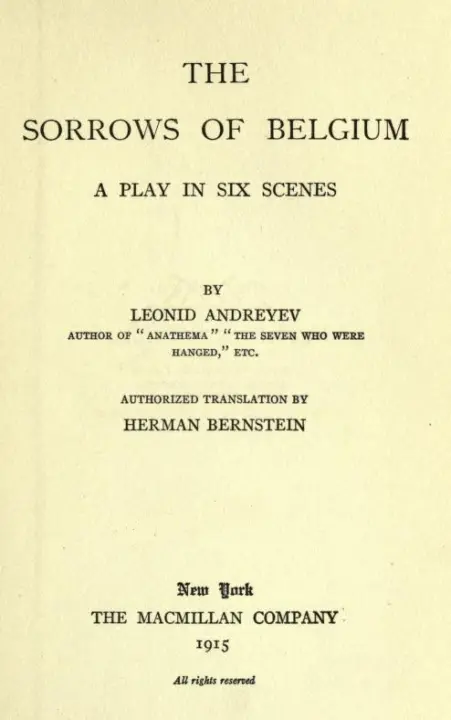
"The Sorrows of Belgium: A Play in Six Scenes" by Leonid Andreyev is a dramatic work written in the early 20th century. This play captures the tragic circumstances of the Belgian people during World War I, particularly through the lens of a prominent Belgian author, Emil Grelieu, and his family. It addresses themes of suffering, resistance, and the moral complexities posed by war, reflecting Andreyev’s deep empathy for oppressed nations. The opening of the play sets a serene scene in Grelieu's garden as the war begins to encroach upon their lives. Characters like François, the deaf gardener, and Maurice, Grelieu's son, express a mix of alarm and disbelief as they come to terms with the reality of the German invasion. Grelieu himself appears anxious, consumed with conflict about his responsibilities and the implications of war. As the sounds of war grow nearer, the family's peaceful existence shatters, setting the stage for a deeper exploration of their emotional and moral dilemmas as they face the impending chaos. The stark contrast between the tranquil garden and the impending violence underscores the play's themes of disruption and sorrow.
Introduction adapted from the source catalogue; source summaries may be automatically generated.
Free to read · English · 16,414 words · No account needed
MAKE TIME FOR A GOOD BOOK
On by default. Untick to stop anonymous reading totals. Each page counts after 10 seconds in view. How this works.
Anonymous counting is on unless you have switched it off.
How can he sleep, if the movement of our armies is but the movement of parts of his brains! And what is the use of sleep in general? I sleep very little myself, and I advise you, gentlemen, not to indulge in foolish sleep.
But our human organism requires sleep.
Nonsense! Organism--that is something invented by the doctors who are looking for practice among the fools. I know of no organism. I know only my desires and my will, which says: "Gerhardt, do this! Gerhardt, go there! Gerhardt, take this!" And I take it!
Great!
Will you permit me to take down your words in my notebook?
Please, Schauss. What is it you want, Zigler?
The telegraphist has entered.
I really don't know, but something strange has happened. It
seems that we are being interfered with, I can't understand
anything.
What is it? What is the matter?
We can make out one word, "Water"--but after that all is incomprehensible. And then again, "Water"--
What water? You are intoxicated, Zigler. That must be wine, not
water. Is the engineer there?
He is also surprised and cannot understand.
You are a donkey, Zigler! We'll have to call out--
The Commander comes out. He is a tall, erect old man. His face is pale. His voice is dry and unimpassioned.
Blumenfeld!
All jump up, straighten themselves, as if petrified.
What is this?
I have not yet investigated it, your Highness. Zigler is
reporting--
What is it, Zigler?
Your Highness, we are being interfered with. I don't know what it is, but I can't understand anything. We have been able to make out only one word--"Water." Then again--"Water."
Turning around.
See what it is, Blumenfeld, and report to me--
Engineer runs in.
Where is Blumenfeld? I beg your pardon, your Highness!
Pausing.
What has happened there, Kloetz?
They don't respond to our calls, your Highness. They are silent like the dead. Something has happened there.
You think something serious has happened?
I dare not think so, your Highness, but I am alarmed. Silence is the only answer to our most energetic calls. But Greitzer wishes to say something. ... Well? What is it, Greitzer?
The second telegraphist has entered quietly.
They are silent, your Highness.
Brief pause.
Again turning to the door.
Please investigate this, Lieutenant.
He advances a step to the door, then stops. There is a commotion behind the windows--a noise and the sound of voices. The word "water" is repeated frequently. The noise keeps growing, turning at times into a loud roar.
What is that?
Your reading position is saved on this browser. Take it to another device with a library code. Reading pages adapt to text, rather than matching a printed edition.
BEHIND THE BOOK
This eBook is for the use of anyone anywhere in the United States and most other parts of the world at no cost and with almost no restrictions whatsoever. You may copy it, give it away or re-use it under the terms of the Project Gutenberg License included with this eBook or online at www.gutenberg.org. If you are not located in the United States, you will have to check the laws of the country where you are located before using this eBook. Read the source licence.
The original source file, including credits and licence, is retained by this library. Request an original-format copy at no charge. Please include the book title and Project Gutenberg identifier #49596.
KEEP YOUR CURIOSITY GOING
Cécile Tormay

Moritz Busch
John L. Ransom
Frances Wright
Cécile Tormay

Mabel Potter Daggett