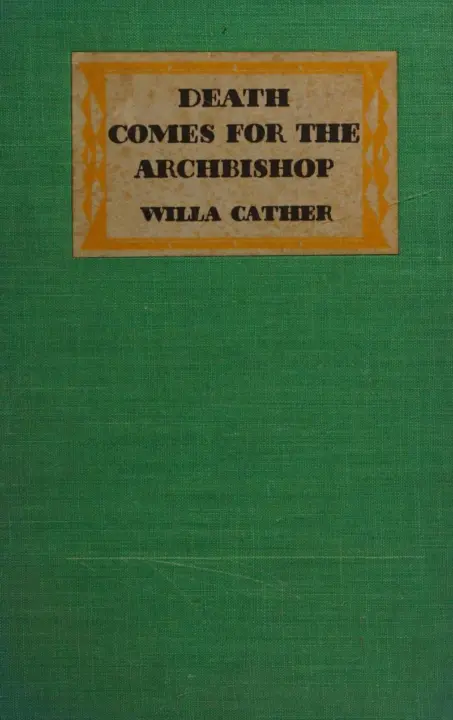
Death comes for the archbishop
Willa Cather
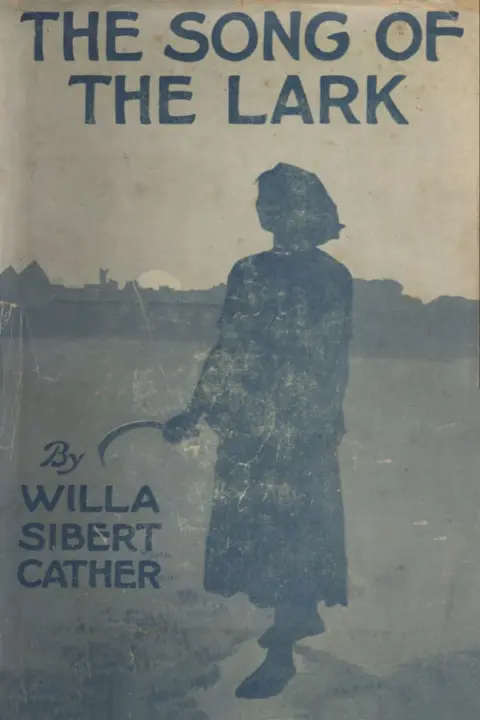
THE CLASSIC COLLECTION · 1915
"The Song of the Lark" by Willa Cather is a novel written in 1915. It follows Thea Kronborg, a talented girl from a small Colorado town who dreams of becoming a musician. When a teacher discovers her remarkable singing voice, she leaves home to pursue vocal training in Chicago and beyond. The novel traces her artistic development and personal sacrifices as she climbs toward success, shedding relationships that no longer serve her ambition in the burgeoning American West.
Introduction adapted from the source catalogue; source summaries may be automatically generated.
Free to read · English · 154,671 words · No account needed
MAKE TIME FOR A GOOD BOOK
On by default. Untick to stop anonymous reading totals. Each page counts after 10 seconds in view. How this works.
Anonymous counting is on unless you have switched it off.
“The scale of B flat major,” he directed, and then fell into an attitude of deep attention. Without a word his pupil set to work.
To Mrs. Kohler, in the garden, came the cheerful sound of effort, of vigorous striving. Unconsciously she wielded her rake more lightly. Occasionally she heard the teacher’s voice. “Scale of E minor.... Weiter, weiter!... Immer I hear the thumb, like a lame foot. Weiter... weiter, once... Schön! The chords, quick!”
The pupil did not open her mouth until they began the second movement of the Clementi sonata, when she remonstrated in low tones about the way he had marked the fingering of a passage.
“It makes no matter what you think,” replied her teacher coldly. “There is only one right way. The thumb there. Ein, zwei, drei, vier,” etc. Then for an hour there was no further interruption.
At the end of the lesson Thea turned on her stool and leaned her arm on the keyboard. They usually had a little talk after the lesson.
Herr Wunsch grinned. “How soon is it you are free from school? Then we make ahead faster, eh?”
“First week in June. Then will you give me the ‘Invitation to the
Dance’?”
He shrugged his shoulders. “It makes no matter. If you want him, you play him out of lesson hours.”
“All right.” Thea fumbled in her pocket and brought out a crumpled slip of paper. “What does this mean, please? I guess it’s Latin.”
Wunsch blinked at the line penciled on the paper. “Wherefrom you get this?” he asked gruffly.
“Out of a book Dr. Archie gave me to read. It’s all English but that. Did you ever see it before?” she asked, watching his face.
“Yes. A long time ago,” he muttered, scowling. “Ovidius!” He took a stub of lead pencil from his vest pocket, steadied his hand by a visible effort, and under the words:
“Lente currite, lente currite, noctis equi,”
he wrote in a clear, elegant Gothic hand,—
“Go slowly, go slowly, ye steeds of the night.”
He put the pencil back in his pocket and continued to stare at the Latin. It recalled the poem, which he had read as a student, and thought very fine. There were treasures of memory which no lodging-house keeper could attach. One carried things about in one’s head, long after one’s linen could be smuggled out in a tuning-bag. He handed the paper back to Thea. “There is the English, quite elegant,” he said, rising.
Mrs. Kohler stuck her head in at the door, and Thea slid off the stool. “Come in, Mrs. Kohler,” she called, “and show me the piece-picture.”
Your reading position is saved on this browser. Take it to another device with a library code. Reading pages adapt to text, rather than matching a printed edition.
Willa Cather
Willa Cather
Willa Cather
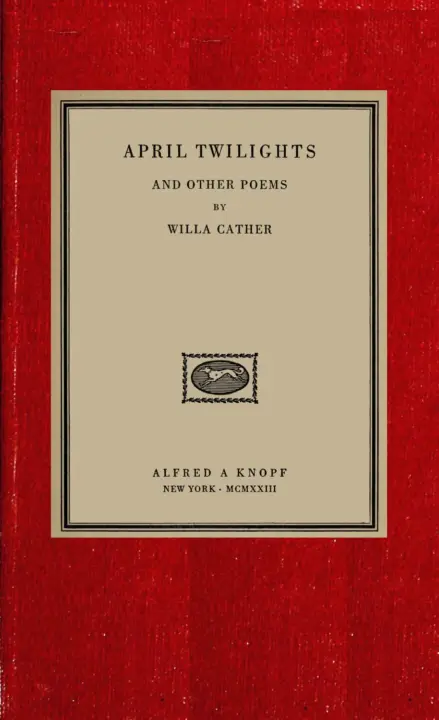
Willa Cather
BEHIND THE BOOK
This eBook is for the use of anyone anywhere in the United States and most other parts of the world at no cost and with almost no restrictions whatsoever. You may copy it, give it away or re-use it under the terms of the Project Gutenberg License included with this eBook or online at www.gutenberg.org. If you are not located in the United States, you will have to check the laws of the country where you are located before using this eBook. Read the source licence.
The original source file, including credits and licence, is retained by this library. Request an original-format copy at no charge. Please include the book title and Project Gutenberg identifier #44.
KEEP YOUR CURIOSITY GOING
Coulson Kernahan

Maurice Baring
Frances Wright
Cécile Tormay

Frederic Jesup Stimson

W. H. P. (William Henry Pope) Jarvis