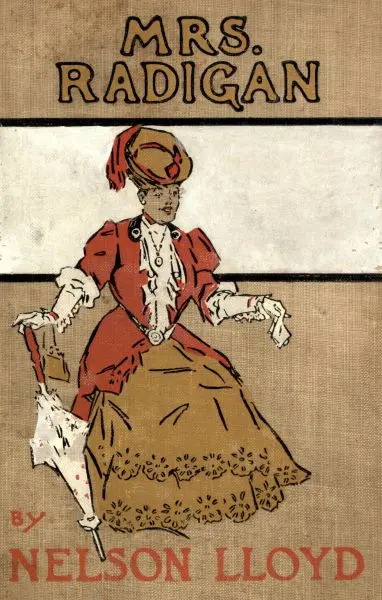
Mrs. Radigan: Her Biography, with that of Miss Pearl Veal, and the Memoirs of J. Madison Mudison
Nelson Lloyd
THE CLASSIC COLLECTION · 1904
"The Soldier of the Valley" by Nelson Lloyd is a novel written in the early 20th century. The story revolves around Mark Hope, a soldier who has returned home after losing a leg in battle but is greeted with warmth and celebration from the townsfolk of Black Log. As he adjusts to life back in the valley, he grapples with his identity as a war hero and a newfound life limitation, while also being drawn to the complexities of the people around him, including his younger brother Tim and the captivating Mary Warden. The opening of the novel introduces Mark as a soldier transformed into a kind of hero despite his physical limitations. He reflects on his earlier life in the valley and his yearning for adventure, along with the experiences of war that have brought him back, albeit a changed man. As he arrives, he is welcomed by friends and family who celebrate his return, yet Mark feels the weight of their kindness mingled with an unexpected pity. Through his interactions with townspeople, learning about their lives, and absorbing their lengthy congratulations, Mark begins to navigate his new reality at home. The tone captures a sense of nostalgia and uncertainty as he also finds himself intrigued by Mary, a recent acquaintance with ties to the local preacher, hinting at themes of love, loss, and adaptation in the wake of war.
Introduction adapted from the source catalogue; source summaries may be automatically generated.
Free to read · English · 55,183 words · No account needed
MAKE TIME FOR A GOOD BOOK
On by default. Untick to stop anonymous reading totals. Each page counts after 10 seconds in view. How this works.
Anonymous counting is on unless you have switched it off.
"Of course Tim has made some friends," she said, glancing up from her
work very casually.
"Of course he has," I snapped.
"That's nice," she murmured--knitting, knitting, knitting.
I expected her to ask who his friends were, and how he had made them. That was all in the letter. Moreover, it was in the part I had not read to her. But she abruptly abandoned this line of inquiry. She did not care. She let me smoke on.
Suddenly she dropped her work and asked, "Is that a footstep on the
porch?"
"Footsteps! No--why, who did you think was coming?" I said.
"Mr. Weston promised to drop in on his way home from hunting--but I guess he'll disappoint me. I hoped it was he." She fell to her task again, only now she began to hum softly, thus shutting me off entirely.
For a very long while I endured it, but the time came when action of some kind was called for. We were not married, that I could sit forever smoking while she hummed. Even in Black Log, etiquette requires that a man talk to a woman when in her company; and when the woman ceases to listen, the wise man departs. That was just what I did not want to do, and only one alternative was left me. I got out the letter and held it under the light.
"You were asking about Tim's friends, Mary," said I.
"Was I?" she returned. "I had forgotten. What did I say?"
"You asked if he had made any friends," I replied, as calmly as I could. "I was going to read you what he said."
"Oh!" she cried. And at last she dropped her knitting, and resting her elbows on her knees, clasping her chin in her hands, she looked up at me from her low chair. "I thought it was forbidden," she said.
"Tim didn't say anything about not reading it," I answered. "At first, though, it seemed best not to; but you'll understand, Mary. Of course, we mustn't take him too seriously, but it does sound foolish. Poor Tim!"
"Poor Tim!" repeated the girl. "He must be in love."
"He is," said I.
"Then don't read it!" she cried. "Surely he never intended you to read
it to me."
"Of course he did," I laughed, for at last I had aroused her, and now her infernal knitting was forgotten; she no longer strained her ears for Weston's footfalls. Her eyes were fixed on me. "Poor old Tim! Well, let's wish him luck, Mary. Now listen."
So I read her the forbidden pages.
Your reading position is saved on this browser. Take it to another device with a library code. Reading pages adapt to text, rather than matching a printed edition.
BEHIND THE BOOK
This eBook is for the use of anyone anywhere in the United States and most other parts of the world at no cost and with almost no restrictions whatsoever. You may copy it, give it away or re-use it under the terms of the Project Gutenberg License included with this eBook or online at www.gutenberg.org. If you are not located in the United States, you will have to check the laws of the country where you are located before using this eBook. Read the source licence.
The original source file, including credits and licence, is retained by this library. Request an original-format copy at no charge. Please include the book title and Project Gutenberg identifier #17156.
KEEP YOUR CURIOSITY GOING
Coulson Kernahan

Maurice Baring
Frances Wright
Cécile Tormay

Frederic Jesup Stimson

W. H. P. (William Henry Pope) Jarvis