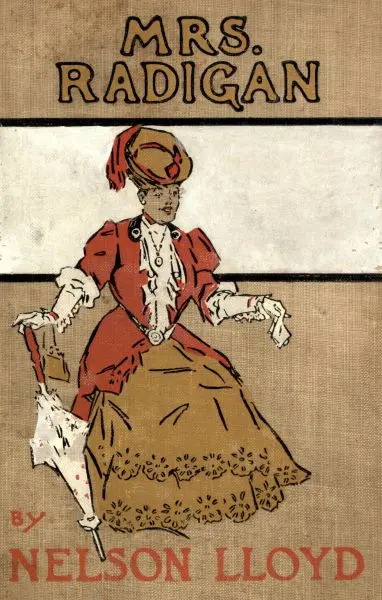
Mrs. Radigan: Her Biography, with that of Miss Pearl Veal, and the Memoirs of J. Madison Mudison
Nelson Lloyd
THE CLASSIC COLLECTION · 1904
"The Soldier of the Valley" by Nelson Lloyd is a novel written in the early 20th century. The story revolves around Mark Hope, a soldier who has returned home after losing a leg in battle but is greeted with warmth and celebration from the townsfolk of Black Log. As he adjusts to life back in the valley, he grapples with his identity as a war hero and a newfound life limitation, while also being drawn to the complexities of the people around him, including his younger brother Tim and the captivating Mary Warden. The opening of the novel introduces Mark as a soldier transformed into a kind of hero despite his physical limitations. He reflects on his earlier life in the valley and his yearning for adventure, along with the experiences of war that have brought him back, albeit a changed man. As he arrives, he is welcomed by friends and family who celebrate his return, yet Mark feels the weight of their kindness mingled with an unexpected pity. Through his interactions with townspeople, learning about their lives, and absorbing their lengthy congratulations, Mark begins to navigate his new reality at home. The tone captures a sense of nostalgia and uncertainty as he also finds himself intrigued by Mary, a recent acquaintance with ties to the local preacher, hinting at themes of love, loss, and adaptation in the wake of war.
Introduction adapted from the source catalogue; source summaries may be automatically generated.
Free to read · English · 55,183 words · No account needed
MAKE TIME FOR A GOOD BOOK
On by default. Untick to stop anonymous reading totals. Each page counts after 10 seconds in view. How this works.
Anonymous counting is on unless you have switched it off.
"I should say I had," I said again.
"She must be a splendid singer," John Shadrack's widow exclaimed with much enthusiasm. "Tip says she has one of the best tenor voices they is. He says sometimes he can hear her clean from his clearin' down to your barn."
"Farther," said I. "All the way to the school-house."
"Indeed! Now that's nice. I allow she must be very handsome."
"Handsome?" said I, a bit incredulous.
"Why, Tip says she's the best-lookin' woman in the walley, and that she's a terrible tasty dresser."
"Terrible," I muttered.
"Indeed! Now that's nice. And is she spare or fleshy?"
"Medium," I said. "Just right."
"That's nice. But what'll she run to? It makes a heap of difference to a woman what she runs to. Now I naterally take on."
"I should say Nanny Pulsifer would naturally lose weight," I answered.
"That's nice. It's so much better to run to that--it's easier gittin' around. Tip says she has a be-yutiful figger. There's nothin' like figger. If there's anythin' I hate to see it's a first-class gingham fittin' a woman like it was hung there to air. But about Tip's wife agin--she must have a lovely disposition?"
"Splendid," I said.
"That's what Tip says. He told me that oncet in a while when he was kind of low-down she'd git het-up and spited like, but ordinarily, he says, she's jest a-singin' and a-singin' and makin' him comf'table and helpin' the children. And them children! I'm jest longin' to see 'em. They must be lovely."
"From what Tip says," I interjected.
"From what Tip says," she went on. "He was tellin' me about Earl and Alice Eliza, and Pearl and Cevery and the rest of 'em. He says it's jest a pickter to see 'em all in bed together--a perfect pickter."
"A perfect picture," said I sleepily.
"Tip must have a lovely home. Why, he tells me they have a
sewin'-machine."
"Lovely," said I. "And a spring-bed."
"And a double-heater stove," said she.
"And an accordion," said I.
"And a washin'-machine," said she.
"And two hogs."
"And he tells me he's going to git her a melodium."
"Indeed," said I. "Why, I thought he was never going back."
"To sech a lovely home?" The old woman held up her hands. "He's goin' jest as soon as he gets that me-yule and you're able." She laid her hand on my forehead. "There," she cried, "it's painin' you again, poor thing--that terrible spot."
Your reading position is saved on this browser. Take it to another device with a library code. Reading pages adapt to text, rather than matching a printed edition.
BEHIND THE BOOK
This eBook is for the use of anyone anywhere in the United States and most other parts of the world at no cost and with almost no restrictions whatsoever. You may copy it, give it away or re-use it under the terms of the Project Gutenberg License included with this eBook or online at www.gutenberg.org. If you are not located in the United States, you will have to check the laws of the country where you are located before using this eBook. Read the source licence.
The original source file, including credits and licence, is retained by this library. Request an original-format copy at no charge. Please include the book title and Project Gutenberg identifier #17156.
KEEP YOUR CURIOSITY GOING
Coulson Kernahan

Maurice Baring
Frances Wright
Cécile Tormay

Frederic Jesup Stimson

W. H. P. (William Henry Pope) Jarvis