Rizal’s own story of his life
José Rizal
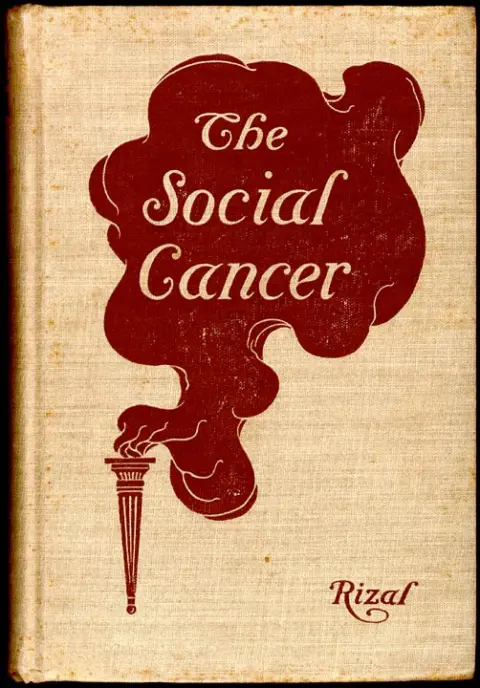
THE CLASSIC COLLECTION · 1912
"The Social Cancer: A Complete English Version of Noli Me Tangere by José Rizal" is a novel published in 1887 during the Spanish colonial period of the Philippines. Written by Filipino nationalist and polymath José Rizal, it exposes the injustices inflicted by the ruling government and Spanish Catholic friars on the Filipino people. The story follows Crisóstomo Ibarra, who returns home after studying in Europe to find his father dead under mysterious circumstances and his grave desecrated. As he attempts to build a school and improve his town, he faces hostility from powerful priests and deadly conspiracies that threaten his life.
Introduction adapted from the source catalogue; source summaries may be automatically generated.
Free to read · English · 176,045 words · No account needed
MAKE TIME FOR A GOOD BOOK
On by default. Untick to stop anonymous reading totals. Each page counts after 10 seconds in view. How this works.
Anonymous counting is on unless you have switched it off.
[105] "The old man of the village," patriarch.--TR.
[106] The secular name of St. Francis of Assisi, founder of the
Franciscan order.--TR.
[107] A Spanish official, author of several works relating to the Philippines, one of which, Recuerdos de Filipinas (Madrid, 1877 and 1880), a loose series of sketches and impressions giving anything but a complimentary picture of the character and conduct of the Spaniards in the Islands, and in a rather naive and perhaps unintentional way throwing some lurid side-lights on the governmental administration and the friar régime,--enjoyed the distinction of being officially prohibited from circulation in the archipelago.--TR.
[108] "Magcanta-ca!" "(You) sing!"--TR.
[109] Europea: European woman.--TR.
[110] In 1527-29 Alvaro de Saavedra led an unsuccessful expedition to take possession of the "Western Isles." The name "Filipina," in honor of the Prince of the Asturias, afterwards Felipe II (Philip II), was first applied to what is probably the present island of Leyte by Ruy Lopez de Villalobos, who led another unsuccessful expedition thither in 1542-43, this name being later extended to the whole group.--TR.
[111] A barrio of Tanawan, Batangas, noted for the manufacture of
horsewhips.--TR.
[112] The actors named were real persons. Ratia was a Spanish-Filipino who acquired quite a reputation not only in Manila but also in Spain. He died in Manila in 1910.--TR.
[113] In the year 1879.--Author's note.
[114] A similar incident occurred in Kalamba.--Author's note.
[115] "The Maid of Saragossa," noted for her heroic exploits during the siege of that city by the French in 1808-09.--TR.
[116] A region in southwestern Spain, including the provinces of
Badajoz and Caceres.--TR.
[117] Author of a little book of fables in Castilian verse for the use of schools. The fable of the young philosopher illustrates the thought in Pope's well-known lines:
"Vice is a monster of so frightful mien,
As to be hated needs but to be seen;
Yet seen too oft, familiar with her face,
We first endure, then pity, then embrace."--TR.
[118] Bones for those who come late.
[119] According to Spanish custom, a matron is known by prefixing her maiden name with de (possessive of) to her husband's name.--TR.
[120] The marble-shop of Rodoreda is still in existence on Calle
Carriedo, Santa Cruz.--TR.
[121] There is a play on words here, Campanario meaning belfry and
Torre tower.--TR.
[122] The Roman Catholic decalogue does not contain the commandment forbidding the worship of "graven images," its second being the prohibition against "taking His holy name in vain." To make up the ten, the commandment against covetousness is divided into two.--TR.
[123] The famous Virgin of Saragossa, Spain, and patroness of Santa
Cruz, Manila.--TR.
Your reading position is saved on this browser. Take it to another device with a library code. Reading pages adapt to text, rather than matching a printed edition.
BEHIND THE BOOK
This eBook is for the use of anyone anywhere in the United States and most other parts of the world at no cost and with almost no restrictions whatsoever. You may copy it, give it away or re-use it under the terms of the Project Gutenberg License included with this eBook or online at www.gutenberg.org. If you are not located in the United States, you will have to check the laws of the country where you are located before using this eBook. Read the source licence.
The original source file, including credits and licence, is retained by this library. Request an original-format copy at no charge. Please include the book title and Project Gutenberg identifier #6737.
KEEP YOUR CURIOSITY GOING
Cécile Tormay

Moritz Busch
Coulson Kernahan
John L. Ransom

Maurice Baring
Frances Wright