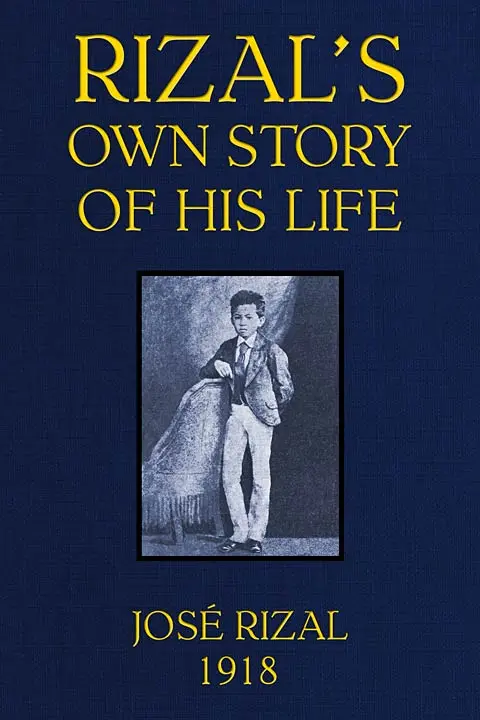
Rizal’s own story of his life
José Rizal
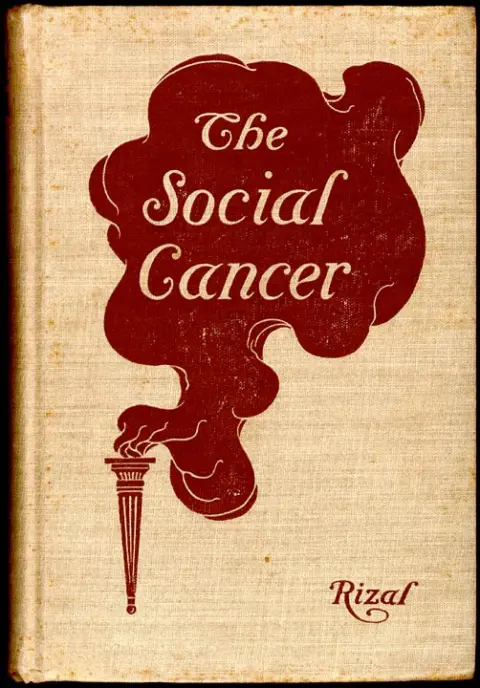
THE CLASSIC COLLECTION · 1912
"The Social Cancer: A Complete English Version of Noli Me Tangere by José Rizal" is a novel published in 1887 during the Spanish colonial period of the Philippines. Written by Filipino nationalist and polymath José Rizal, it exposes the injustices inflicted by the ruling government and Spanish Catholic friars on the Filipino people. The story follows Crisóstomo Ibarra, who returns home after studying in Europe to find his father dead under mysterious circumstances and his grave desecrated. As he attempts to build a school and improve his town, he faces hostility from powerful priests and deadly conspiracies that threaten his life.
Introduction adapted from the source catalogue; source summaries may be automatically generated.
Free to read · English · 176,045 words · No account needed
MAKE TIME FOR A GOOD BOOK
On by default. Untick to stop anonymous reading totals. Each page counts after 10 seconds in view. How this works.
Anonymous counting is on unless you have switched it off.
[82] Every one talks of the fiesta according to the way he fared at it.
[83] A Spanish prelate, notable for his determined opposition in the Constituent Cortes of 1869 to the clause in the new Constitution providing for religious liberty.--TR.
[84] "Camacho's wedding" is an episode in Don Quixote, wherein a wealthy man named Camacho is cheated out of his bride after he has prepared a magnificent wedding-feast.--TR.
[85] The full dress of the Filipino women, consisting of the camisa, pañuelo, and saya suelta, the latter a heavy skirt with a long train. The name mestiza is not inappropriate, as well from its composition as its use, since the first two are distinctly native, antedating the conquest, while the saya suelta was no doubt introduced by the Spaniards.
[86] The nunnery of St. Clara, situated on the Pasig River just east of Fort Santiago, was founded in 1621 by the Poor Clares, an order of nuns affiliated with the Franciscans, and was taken under the royal patronage as the "Real Monasterio de Santa Clara" in 1662. It is still in existence and is perhaps the most curious of all the curious relics of the Middle Ages in old Manila.--TR.
[87] The principal character in Calderon de la Barca's La Vida es Sueño. There is also a Tagalog corrido, or metrical romance, with this title.--TR.
[88] The Douay version.--TR.
[89] "Errare humanum est": "To err is human."
[90] To the Philippine Chinese "d" and "l" look and sound about
the same.--TR.
[91] "Brothers in Christ."
[92] "Venerable patron saint."
[93] Muy Reverendo Padre: Very Reverend Father.
[94] Very rich landlord. The United States Philippine Commission, constituting the government of the Archipelago, paid to the religious orders "a lump sum of $7,239,000, more or less," for the bulk of the lands claimed by them. See the Annual Report of the Philippine Commission to the Secretary of War, December 23, 1903.--TR.
[95] Cumare and cumpare are corruptions of the Spanish comadre and compadre, which have an origin analogous to the English "gossip" in its original meaning of "sponsor in baptism." In the Philippines these words are used among the simpler folk as familiar forms of address, "friend," "neighbor."--TR.
[96] Dominus vobiscum.
[97] The Spanish proverb equivalent to the English "Birds of a feather
flock together."--TR.
[98] For "filibustero."
[99] Tarantado is a Spanish vulgarism meaning "blunderhead," "bungler." Saragate (or zaragate) is a Mexican provincialism meaning "disturber," "mischief-maker."--TR.
[100] Vete á la porra is a vulgarism almost the same in meaning and use as the English slang, "Tell it to the policeman," porra being the Spanish term for the policeman's "billy."--TR.
[101] For sospechoso, "a suspicious character."--TR.
[102] Sanctus Deus and Requiem aeternam (so called from their first words) are prayers for the dead.--TR.
Your reading position is saved on this browser. Take it to another device with a library code. Reading pages adapt to text, rather than matching a printed edition.
BEHIND THE BOOK
This eBook is for the use of anyone anywhere in the United States and most other parts of the world at no cost and with almost no restrictions whatsoever. You may copy it, give it away or re-use it under the terms of the Project Gutenberg License included with this eBook or online at www.gutenberg.org. If you are not located in the United States, you will have to check the laws of the country where you are located before using this eBook. Read the source licence.
The original source file, including credits and licence, is retained by this library. Request an original-format copy at no charge. Please include the book title and Project Gutenberg identifier #6737.
KEEP YOUR CURIOSITY GOING
Cécile Tormay

Moritz Busch
Coulson Kernahan
John L. Ransom

Maurice Baring
Frances Wright