Rizal’s own story of his life
José Rizal
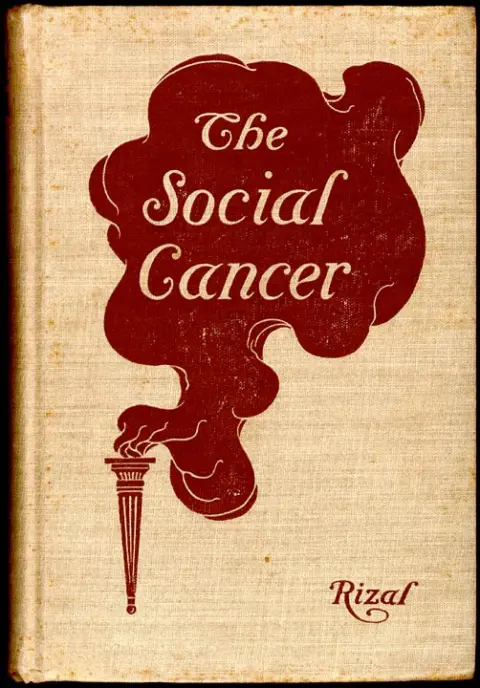
THE CLASSIC COLLECTION · 1912
"The Social Cancer: A Complete English Version of Noli Me Tangere by José Rizal" is a novel published in 1887 during the Spanish colonial period of the Philippines. Written by Filipino nationalist and polymath José Rizal, it exposes the injustices inflicted by the ruling government and Spanish Catholic friars on the Filipino people. The story follows Crisóstomo Ibarra, who returns home after studying in Europe to find his father dead under mysterious circumstances and his grave desecrated. As he attempts to build a school and improve his town, he faces hostility from powerful priests and deadly conspiracies that threaten his life.
Introduction adapted from the source catalogue; source summaries may be automatically generated.
Free to read · English · 176,045 words · No account needed
MAKE TIME FOR A GOOD BOOK
On by default. Untick to stop anonymous reading totals. Each page counts after 10 seconds in view. How this works.
Anonymous counting is on unless you have switched it off.
real: One-eighth of a peso, twenty cuartos.
sala: The principal room in the more pretentious Philippine houses.
salabat: An infusion of ginger.
salakot: Wide hat of palm or bamboo and rattan, distinctively
Filipino.
sampaguita: The Arabian jasmine: a small, white, very fragrant flower, extensively cultivated, and worn in chaplets and rosaries by the women and girls--the typical Philippine flower.
santol: The Philippine sandal-tree.
sawali: Plaited bamboo wattle.
sinamay: A transparent cloth woven from abaka fibers.
sinigang: Water with vegetables or some acid fruit, in which fish
are boiled; "fish soup."
Susmariosep: A common exclamation: contraction of the Spanish, Jesús, María, y José, the Holy Family.
tabí: The cry of carriage drivers to warn pedestrians.
talibon: A short sword, the "war bolo."
tapa: Jerked meat.
tápis: A piece of dark cloth or lace, often richly worked or embroidered, worn at the waist somewhat in the fashion of an apron: a distinctive portion of the native women's attire, especially among the Tagalogs.
tarambulo: A low weed whose leaves and fruit pedicles are covered
with short, sharp spines.
teniente-mayor: Senior lieutenant, the senior member of the town council and substitute for the gobernadorcillo.
tikas-tikas: A variety of canna bearing bright red flowers.
tertiary brethren: Members of a lay society affiliated with a regular monastic order, especially the Venerable Tertiary Order of the Franciscans.
timbaín: The "water-cure," and hence, any kind of torture. The primary meaning is "to draw water from a well," from timba, pail.
tikbalang: An evil spirit, capable of assuming various forms, but said to appear usually in the shape of a tall black man with disproportionately long legs: the "bogey man" of Tagalog children.
tulisan: Outlaw, bandit. Under the old régime in the Philippines the tulisanes were those who, on account of real or fancied grievances against the authorities, or from fear of punishment for crime, or from an instinctive desire to return to primitive simplicity, foreswore life in the towns "under the bell," and made their homes in the mountains or other remote places. Gathered in small bands with such arms as they could secure, they sustained themselves by highway robbery and the levying of blackmail from the country folk.
zacate: Native grass used for feeding livestock.
[1] Quoted by Macaulay: Essay on the Succession in Spain.
[2] The ruins of the Fuerza de Playa Honda, ó Real de Paynavén, are still to be seen in the present municipality of Botolan, Zambales. The walls are overgrown with rank vegetation, but are well preserved, with the exception of a portion looking toward the Bankal River, which has been undermined by the currents and has fallen intact into the stream.
Your reading position is saved on this browser. Take it to another device with a library code. Reading pages adapt to text, rather than matching a printed edition.
BEHIND THE BOOK
This eBook is for the use of anyone anywhere in the United States and most other parts of the world at no cost and with almost no restrictions whatsoever. You may copy it, give it away or re-use it under the terms of the Project Gutenberg License included with this eBook or online at www.gutenberg.org. If you are not located in the United States, you will have to check the laws of the country where you are located before using this eBook. Read the source licence.
The original source file, including credits and licence, is retained by this library. Request an original-format copy at no charge. Please include the book title and Project Gutenberg identifier #6737.
KEEP YOUR CURIOSITY GOING
Cécile Tormay

Moritz Busch
Coulson Kernahan
John L. Ransom

Maurice Baring
Frances Wright