
Letters to a Friend, Written to Mrs. Ezra S. Carr, 1866-1879
John Muir
THE CLASSIC COLLECTION · 1913
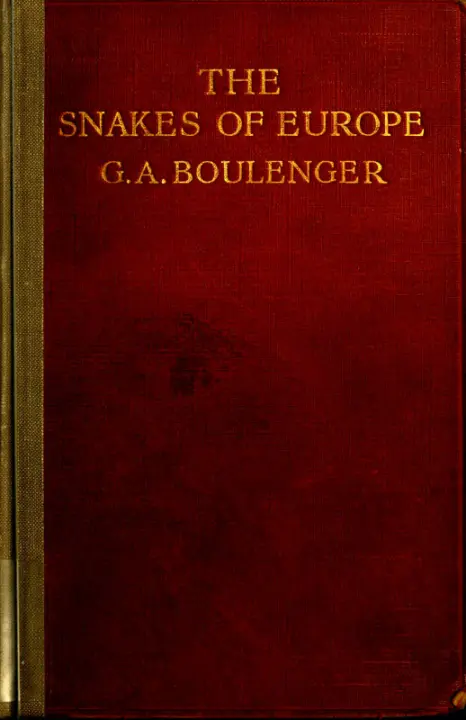
"The Snakes of Europe" by George Albert Boulenger is a scientific publication written in the early 20th century. The work serves as a comprehensive account of the snakes found across Europe, detailing their characteristics, distribution, and life histories. This detailed approach is likely to appeal to readers interested in herpetology or those seeking a deeper understanding of European snake species. The opening of the work presents a preface in which Boulenger outlines the lack of resources discussing European reptiles, specifically snakes, in the English language. He discusses the necessity of summarizing the available knowledge on various snake species, emphasizing his intent to keep the descriptions concise while ensuring accuracy through illustrations and contributions from various experts. The introduction hints at a structured classification of snakes based on scientific principles, paving the way for the chapters that follow, which cover aspects from external characteristics to the complexities of their habitats and interactions with humans.
Introduction adapted from the source catalogue; source summaries may be automatically generated.
Free to read · English · 54,689 words · No account needed
MAKE TIME FOR A GOOD BOOK
On by default. Untick to stop anonymous reading totals. Each page counts after 10 seconds in view. How this works.
Anonymous counting is on unless you have switched it off.
Head-Shields.--Rostral broader than deep, visible from above. Nasal divided, very rarely semidivided. Internasals at least as broad as long, trapezoid, shorter than the prefrontals. Frontal broader than the supraocular, once and one-third to once and a half as long as broad, as long as or a little shorter than its distance from the end of the snout, shorter than the parietals, not in contact with the preocular. Loreal deeper than long. One (rarely two) pre- and three (rarely two or four) postoculars. Temporals 1 + 2. Upper labials seven (rarely six or eight), third and fourth (or fourth and fifth) entering the eye. Four or five lower labials in contact with the anterior chin-shields, which are shorter than the posterior.
Scales with two apical pits, in nineteen rows, strongly keeled on the body, of outer row smooth or faintly keeled. Ventral shields 157 to 181; anal divided; subcaudals 50 to 88.
Coloration.--Very variable. We shall first describe the typical form, and then allude to the principal varieties and individual variations with which we are acquainted.
Grey, bluish-grey, olive, or brown, above, usually with black spots or narrow bars on the back, and vertical bars on the sides; upper lip whitish or yellowish, with the sutures between the shields black; the preocular, and sometimes the postoculars, yellow in the young; a white, yellow, or orange collar on the nape, sometimes uninterrupted, more often divided in the middle, bordered behind by two black subtriangular or crescentic blotches, which usually meet on the median line; the bright collar often becomes faint, or even entirely disappears, in large females (Plate II., first figure); belly usually checkered black and grey or white, more rarely grey with small black spots, or entirely black. Iris dark brown or reddish-brown, with a golden circle round the pupil. This is the form found in England and Central Europe and in some parts of Southern Europe.
In Jersey, in the Spanish Peninsula, and in Cyprus, the white or yellow collar, which is always present in the very young, soon disappears, and so does usually the black collar, which is either much reduced or entirely absent (var. astreptophorus, Seoane). Some large specimens from the Spanish Peninsula are uniform olive, without any markings.
Another variation (Plate II., third figure), rare in France, but common in Italy, South-Eastern Europe, and Asia Minor (var. persa, Pallas; bilineatus, Bibr.; murorum, Bonap.) has the collar well marked, though widely interrupted in the middle, and a white, yellow, or orange streak extends along each side of the back, which may bear the usual black markings in addition.
In some specimens from Austria and Corfu (var. subfasciatus, Werner) the belly is white, with black bars occupying the free edge of each ventral shield.
Your reading position is saved on this browser. Take it to another device with a library code. Reading pages adapt to text, rather than matching a printed edition.
BEHIND THE BOOK
This eBook is for the use of anyone anywhere in the United States and most other parts of the world at no cost and with almost no restrictions whatsoever. You may copy it, give it away or re-use it under the terms of the Project Gutenberg License included with this eBook or online at www.gutenberg.org. If you are not located in the United States, you will have to check the laws of the country where you are located before using this eBook. Read the source licence.
The original source file, including credits and licence, is retained by this library. Request an original-format copy at no charge. Please include the book title and Project Gutenberg identifier #46590.
KEEP YOUR CURIOSITY GOING
John Muir

Asa Gray
Asa Gray

Florence Nightingale
Elizabeth Robins Pennell
Denison Olmsted