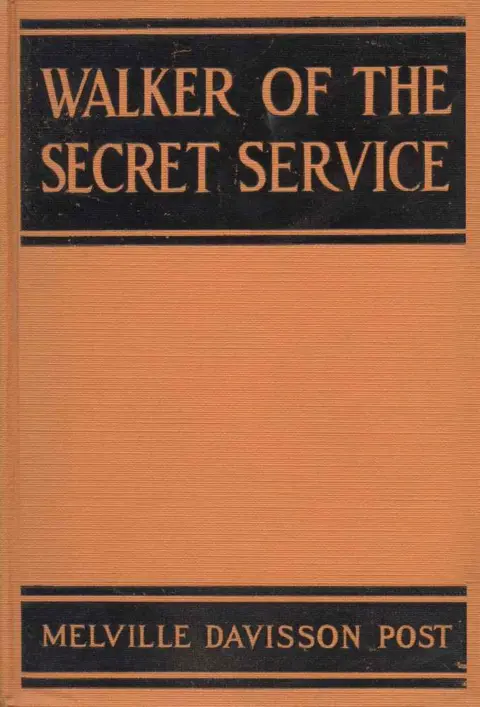
Walker of the Secret Service
Melville Davisson Post
THE CLASSIC COLLECTION · 1920
"The Sleuth of St. James's Square" by Melville Davisson Post is a detective novel that likely dates back to the early 20th century. This engaging mystery revolves around a scientist named Rodman and the intriguing circumstances of his death, intertwined with elements of supernatural occurrences and Oriental mystique. Central to the story are the enigmatic influences surrounding Rodman, including a peculiar servant and a significant scientific breakthrough that has the potential to upend the world's understanding of gemstones. The beginning of the novel introduces us to the astoundingly intelligent and mysterious Rodman, who, while pursuing his work on synthetic gemstones, becomes embroiled in a bizarre tragedy. An Oriental companion brings a gift to Rodman, a remarkable carpet with hidden significance, marking the onset of extraordinary events. As the narrative unfolds, Rodman becomes increasingly entranced by this gift, leading to a fateful encounter with supernatural forces, evidenced by a chilling footprint found on his hearth. The tension builds as the reader ponders whether Rodman's genius will protect him from the dark influences at play, setting the stage for a thrilling exploration into the interplay between ambition, mysticism, and eventual doom.
Introduction adapted from the source catalogue; source summaries may be automatically generated.
Free to read · English · 80,087 words · No account needed
MAKE TIME FOR A GOOD BOOK
On by default. Untick to stop anonymous reading totals. Each page counts after 10 seconds in view. How this works.
Anonymous counting is on unless you have switched it off.
“And so I have,” replied the man, “it left me a sum of money.”
“A large sum?”
“A very large sum, sir.”
“Mr. Anthony Gosford,” said my father, “for what purpose did Peyton Marshall bequeath you a large sum of money? You are no kin; nor was he in your debt.”
The Englishman sat down and put his fingers together with a judicial
air.
“Sir,” he began, “I am not advised that the purpose of a bequest is relevant, when the bequest is direct and unencumbered by the testator with any indicatory words of trust or uses. This will bequeathes me a sum of money. I am not required by any provision of the law to show the reasons moving the testator. Doubtless, Mr. Peyton Marshall had reasons which he deemed excellent for this course, but they are, sir, entombed in the grave with him.”
My father looked steadily at the man, but he did not seem to consider his explanation, nor to go any further on that line.
“Is there another who would know about this will?” he said.
“This effeminate son would know,” replied Gosford, a sneer in the epithet, “but no other. Marshall wrote the testament in his own hand, without witnesses, as he had the legal right to do under the laws of Virginia. The lawyer,” he added, “Mr. Lewis, will confirm me in the legality of that.”
“It is the law,” said Lewis. “One may draw up a holograph will if he likes, in his own hand, and it is valid without a witness in this State, although the law does not so run in every commonwealth.”
“And now, sir,” continued the Englishman, turning to my father, “we will inquire into the theft of this testament.”
But my father did not appear to notice Mr. Gosford. He seemed perplexed
and in some concern.
“Lewis,” he said, “what is your definition of a crime?”
“It is a violation of the law,” replied the lawyer.
“I do not accept your definition,” said my father. “It is, rather, I think, a violation of justice--a violation of something behind the law that makes an act a crime. I think,” he went on, “that God must take a broader view than Mr. Blackstone and Lord Coke. I have seen a murder in the law that was, in fact, only a kind of awful accident, and I have seen your catalogue of crimes gone about by feeble men with no intent except an adjustment of their rights. Their crimes, Lewis, were merely errors of their impractical judgment.”
Then he seemed to remember that the Englishman was present.
Your reading position is saved on this browser. Take it to another device with a library code. Reading pages adapt to text, rather than matching a printed edition.
Melville Davisson Post
Melville Davisson Post
Melville Davisson Post
Melville Davisson Post
BEHIND THE BOOK
This eBook is for the use of anyone anywhere in the United States and most other parts of the world at no cost and with almost no restrictions whatsoever. You may copy it, give it away or re-use it under the terms of the Project Gutenberg License included with this eBook or online at www.gutenberg.org. If you are not located in the United States, you will have to check the laws of the country where you are located before using this eBook. Read the source licence.
The original source file, including credits and licence, is retained by this library. Request an original-format copy at no charge. Please include the book title and Project Gutenberg identifier #2861.
KEEP YOUR CURIOSITY GOING
Coulson Kernahan

Maurice Baring
Frances Wright
Cécile Tormay

Frederic Jesup Stimson

W. H. P. (William Henry Pope) Jarvis