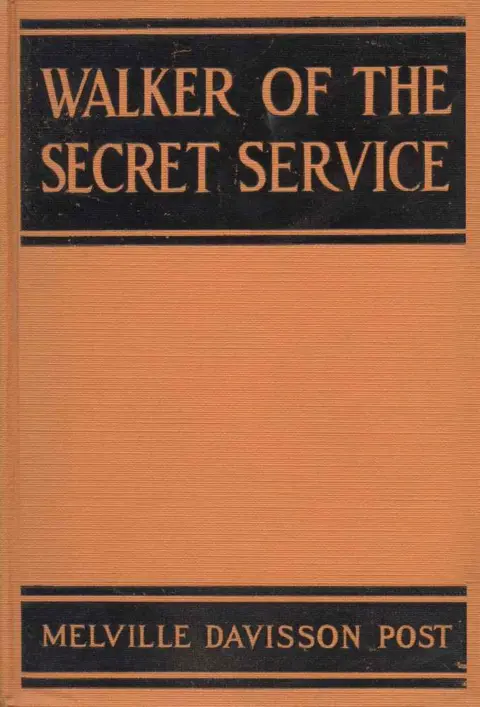
Walker of the Secret Service
Melville Davisson Post
THE CLASSIC COLLECTION · 1920
"The Sleuth of St. James's Square" by Melville Davisson Post is a detective novel that likely dates back to the early 20th century. This engaging mystery revolves around a scientist named Rodman and the intriguing circumstances of his death, intertwined with elements of supernatural occurrences and Oriental mystique. Central to the story are the enigmatic influences surrounding Rodman, including a peculiar servant and a significant scientific breakthrough that has the potential to upend the world's understanding of gemstones. The beginning of the novel introduces us to the astoundingly intelligent and mysterious Rodman, who, while pursuing his work on synthetic gemstones, becomes embroiled in a bizarre tragedy. An Oriental companion brings a gift to Rodman, a remarkable carpet with hidden significance, marking the onset of extraordinary events. As the narrative unfolds, Rodman becomes increasingly entranced by this gift, leading to a fateful encounter with supernatural forces, evidenced by a chilling footprint found on his hearth. The tension builds as the reader ponders whether Rodman's genius will protect him from the dark influences at play, setting the stage for a thrilling exploration into the interplay between ambition, mysticism, and eventual doom.
Introduction adapted from the source catalogue; source summaries may be automatically generated.
Free to read · English · 80,087 words · No account needed
MAKE TIME FOR A GOOD BOOK
On by default. Untick to stop anonymous reading totals. Each page counts after 10 seconds in view. How this works.
Anonymous counting is on unless you have switched it off.
He came with a young girl on his arm, as in the ceremony of marriage sometimes the priest emerges with the bride. The girl was young and of a Spanish beauty. She was all in white with blossoms in her hair. And she was radiant, my father said, as in the glory of some happy contemplation. There was no slave like this on the block in Virginia. Young girls like this, my father had seen in Havana in the houses of Spanish Grandees.
“This is Mr. Pendleton, our neighbor,” Zindorf said. “He comes to offer you his felicitations.”
The girl made a little formal curtsy.
“When my father returns,” she said in a queer, liquid accent, “he will thank you, Meester Pendleton; just now he is on a journey.”
And she gave her hand to Lucian Morrow to kiss, like a lady of the time. Then Zindorf, mincing his big step, led her out.
And my father stood behind the table in the enclosure of the window, with his arms folded, and his chin lifted above his great black stock. I know how my father looked, for I have seen him stand like that before moving factors in great events, when he intended, at a certain cue, to enter.
He said that it was at this point that Mr. Lucian Morrow's early comment on Zindorf seemed, all at once, to discover the nature of this whole affair. He said that suddenly, with a range of vision like the great figures in the Pentateuch, he saw how things right and true would work out backward into abominations, if, by any chance, the virtue of God in events were displaced!
Zindorf returned, and as he stepped through the door, closing it behind him, the far-off tolling of the bell, faint, eerie, carried by a stronger breath of April air, entered through the window. My father extended his arm toward the distant wood.
“Zindorf,” he said, “do you mark the sign?” The man listened.
“What sign?” he said.
“The sign of death!” replied my father.
The man made a deprecating gesture with his hands, “I do not believe in
signs,” he said.
My father replied like one corrected by a memory.
“Why, yes,” he said, “that is true. I should have remembered that. You do not believe in signs, Zindorf, since you abandoned the sign of the cross, and set these coarse patches on your knees to remind you not to bend them in the sign of submission to the King of Kings.”
The intent in the mended clothing was the economy of avarice, but my father turned it to his use.
The man's face clouded with anger.
Your reading position is saved on this browser. Take it to another device with a library code. Reading pages adapt to text, rather than matching a printed edition.
Melville Davisson Post
Melville Davisson Post
Melville Davisson Post
Melville Davisson Post
BEHIND THE BOOK
This eBook is for the use of anyone anywhere in the United States and most other parts of the world at no cost and with almost no restrictions whatsoever. You may copy it, give it away or re-use it under the terms of the Project Gutenberg License included with this eBook or online at www.gutenberg.org. If you are not located in the United States, you will have to check the laws of the country where you are located before using this eBook. Read the source licence.
The original source file, including credits and licence, is retained by this library. Request an original-format copy at no charge. Please include the book title and Project Gutenberg identifier #2861.
KEEP YOUR CURIOSITY GOING
Coulson Kernahan

Maurice Baring
Frances Wright
Cécile Tormay

Frederic Jesup Stimson

W. H. P. (William Henry Pope) Jarvis