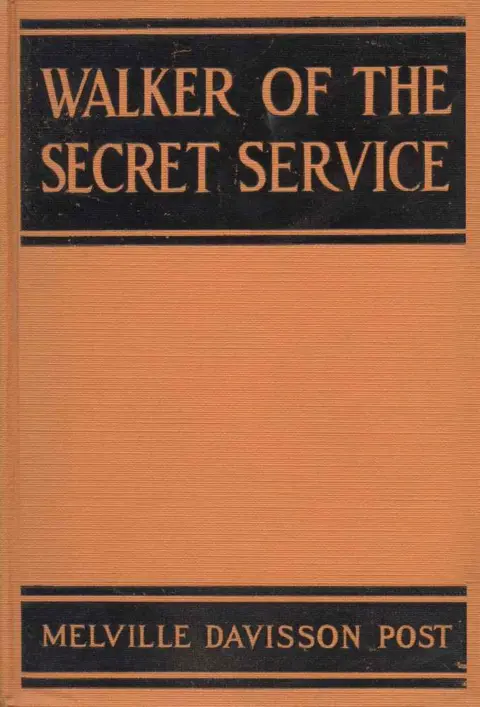
Walker of the Secret Service
Melville Davisson Post
THE CLASSIC COLLECTION · 1920
"The Sleuth of St. James's Square" by Melville Davisson Post is a detective novel that likely dates back to the early 20th century. This engaging mystery revolves around a scientist named Rodman and the intriguing circumstances of his death, intertwined with elements of supernatural occurrences and Oriental mystique. Central to the story are the enigmatic influences surrounding Rodman, including a peculiar servant and a significant scientific breakthrough that has the potential to upend the world's understanding of gemstones. The beginning of the novel introduces us to the astoundingly intelligent and mysterious Rodman, who, while pursuing his work on synthetic gemstones, becomes embroiled in a bizarre tragedy. An Oriental companion brings a gift to Rodman, a remarkable carpet with hidden significance, marking the onset of extraordinary events. As the narrative unfolds, Rodman becomes increasingly entranced by this gift, leading to a fateful encounter with supernatural forces, evidenced by a chilling footprint found on his hearth. The tension builds as the reader ponders whether Rodman's genius will protect him from the dark influences at play, setting the stage for a thrilling exploration into the interplay between ambition, mysticism, and eventual doom.
Introduction adapted from the source catalogue; source summaries may be automatically generated.
Free to read · English · 80,087 words · No account needed
MAKE TIME FOR A GOOD BOOK
On by default. Untick to stop anonymous reading totals. Each page counts after 10 seconds in view. How this works.
Anonymous counting is on unless you have switched it off.
At this moment an object before us in the road diverted our attention. It was the cut-under and the horse. They were standing by the roadside where it makes a great turn to enter the village from the south. There is a wide border to the road at this point, clear of underbrush, where the forest edges it, and there are here, at the whim of some one, or by chance, two great flat stones, one lying upon the other, but not fitting by a hand's thickness by reason of the uneven surfaces.
What had now happened was evident. The assailants of the cut-under had abandoned it here before entering the village. They could not, of course, go on with this incriminating vehicle.
The sight of the cut-under here had on Marquis the usual effect of any important evidential sign. He at once ceased to hurry. He pulled up; looked over the cut-under and the horse, and began to saunter about.
This careless manner was difficult for me at such a time. But for his assurance that Madame Barras, was uninjured it would have been impossible. I had a blind confidence in the man although his expressions were so absurdly in conflict.
I started to go on toward the village, but as he did not follow I turned back. Marquis was sitting on the flat stones with a cigarette in his fingers:
“Good heavens, man,” I cried, “you're not stopping to smoke a
cigarette?”
“Not this cigarette, at any rate,” he replied. “Madame Barras has already smoked it.... I can, perhaps, find you the burnt match.”
He got the electric-flash out of his pocket, and stooped over. Immediately he made an exclamation of surprise.
I leaned down beside him.
There was a little heap of charred paper on the brown bed of pine-needles. Marquis was about to take up this charred paper when his eye caught something thrust in between the two stones. It was a handful of torn bits of paper.
Marquis got them out and laid them on the top of the flat stones under
his light.
“Ah,” he said, “Madame Barras, while she smoked, got rid of some money.”
“The package of gold certificates!” I cried. “She has burned them?”
“No,” he replied, “Madame Barras has favored your Treasury in her destructive process. These are five-pound notes, of the Bank of England.”
I was astonished and I expressed it.
“But why should Madame Barras destroy notes of the Bank of England?”
“I imagine,” he answered, “that they were some which she had, by chance, failed to give you for exchange.”
“But why should she destroy them?” I went on.
Your reading position is saved on this browser. Take it to another device with a library code. Reading pages adapt to text, rather than matching a printed edition.
Melville Davisson Post
Melville Davisson Post
Melville Davisson Post
Melville Davisson Post
BEHIND THE BOOK
This eBook is for the use of anyone anywhere in the United States and most other parts of the world at no cost and with almost no restrictions whatsoever. You may copy it, give it away or re-use it under the terms of the Project Gutenberg License included with this eBook or online at www.gutenberg.org. If you are not located in the United States, you will have to check the laws of the country where you are located before using this eBook. Read the source licence.
The original source file, including credits and licence, is retained by this library. Request an original-format copy at no charge. Please include the book title and Project Gutenberg identifier #2861.
KEEP YOUR CURIOSITY GOING
Coulson Kernahan

Maurice Baring
Frances Wright
Cécile Tormay

Frederic Jesup Stimson

W. H. P. (William Henry Pope) Jarvis