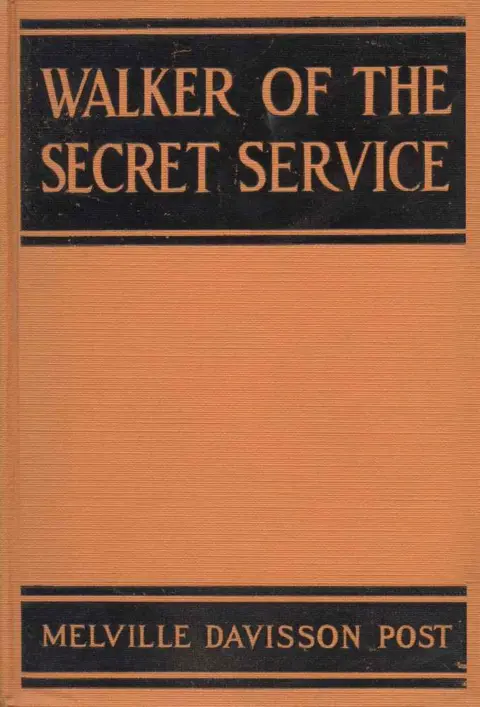
Walker of the Secret Service
Melville Davisson Post
THE CLASSIC COLLECTION · 1920
"The Sleuth of St. James's Square" by Melville Davisson Post is a detective novel that likely dates back to the early 20th century. This engaging mystery revolves around a scientist named Rodman and the intriguing circumstances of his death, intertwined with elements of supernatural occurrences and Oriental mystique. Central to the story are the enigmatic influences surrounding Rodman, including a peculiar servant and a significant scientific breakthrough that has the potential to upend the world's understanding of gemstones. The beginning of the novel introduces us to the astoundingly intelligent and mysterious Rodman, who, while pursuing his work on synthetic gemstones, becomes embroiled in a bizarre tragedy. An Oriental companion brings a gift to Rodman, a remarkable carpet with hidden significance, marking the onset of extraordinary events. As the narrative unfolds, Rodman becomes increasingly entranced by this gift, leading to a fateful encounter with supernatural forces, evidenced by a chilling footprint found on his hearth. The tension builds as the reader ponders whether Rodman's genius will protect him from the dark influences at play, setting the stage for a thrilling exploration into the interplay between ambition, mysticism, and eventual doom.
Introduction adapted from the source catalogue; source summaries may be automatically generated.
Free to read · English · 80,087 words · No account needed
MAKE TIME FOR A GOOD BOOK
On by default. Untick to stop anonymous reading totals. Each page counts after 10 seconds in view. How this works.
Anonymous counting is on unless you have switched it off.
“Possible,” said Marion, “but not likely. Not to be expected, not in line with the preponderance of common experience; therefore, not to be passed. We have got to stop here and try to find out why this track spread under a slow train.”
“But we see it spread, Miss Warfield,” said the trackman with a
conclusive gesture.
“True,” replied Marion, “we see that it did spread, under this
condition, but why?”
The old woman sitting beside the track seemed to realize what was under way; for she rose and came over to where I stood. “Contessa,” she whispered, in those quaint, old world words, “do not reveal, what I have tol'. I pray you!”
And she followed me across the few steps to where the others stood.
I did not answer. I stood like one in some Hellenic drama, between two tragic figures. The love of woman lay in the solution of this problem--in the beginning and at the end of life.
Marion and the big track boss continued with this woman looking on.
I feared to speak or move; the thing was like a sort of trap, set with ghastly cunning, by some evil Fate. The ruin of a woman it would have. And perhaps on the vast level plain where it evilly dwelt, through its hard all-seeing eyes, the ruin and the sorrow either way would be precisely equal. How could I, then, lay a finger on the scale.
“Now,” said Marion, “when the engine reached this point on the track, one of the rails gave way first.”
The big workman looked steadily at her.
“How do you know that, Miss Warfield?” he said.
“Because,” replied Marion, “the marks of the wheels of the locomotive on the ties are found, in the beginning, only on one side of the track, showing that the rail on that side gave way, when the engine struck it, and the other rail for some distance bore the weight of the train.”
She illustrated with her hands.
“When the one rail was pushed out, the wheels on that side went down and continued on the ties, while the wheels on the other side went ahead on the firm rail.”
The workman saw it.
“That's true, Miss Warfield,” he said, “one rail sometimes spreads and the other holds solid.”
Marion was absorbed in the problem.
“But why should the one rail give way like this and its companion hold?”
“One of the rails might not be as solid as the other,” said the man.
Your reading position is saved on this browser. Take it to another device with a library code. Reading pages adapt to text, rather than matching a printed edition.
Melville Davisson Post
Melville Davisson Post
Melville Davisson Post
Melville Davisson Post
BEHIND THE BOOK
This eBook is for the use of anyone anywhere in the United States and most other parts of the world at no cost and with almost no restrictions whatsoever. You may copy it, give it away or re-use it under the terms of the Project Gutenberg License included with this eBook or online at www.gutenberg.org. If you are not located in the United States, you will have to check the laws of the country where you are located before using this eBook. Read the source licence.
The original source file, including credits and licence, is retained by this library. Request an original-format copy at no charge. Please include the book title and Project Gutenberg identifier #2861.
KEEP YOUR CURIOSITY GOING
Coulson Kernahan

Maurice Baring
Frances Wright
Cécile Tormay

Frederic Jesup Stimson

W. H. P. (William Henry Pope) Jarvis