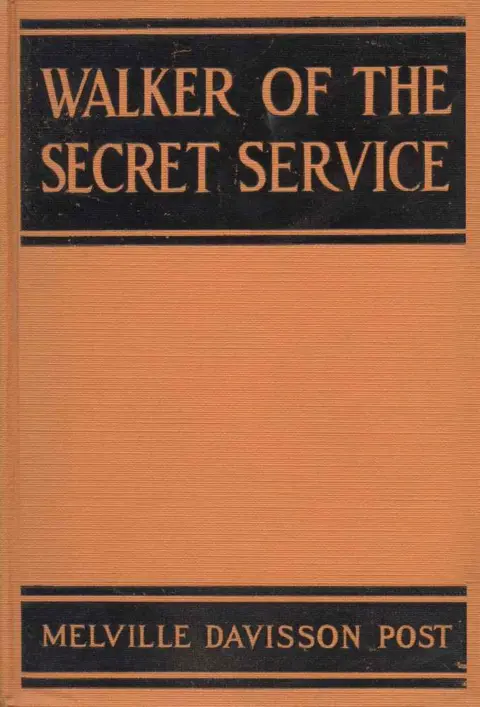
Walker of the Secret Service
Melville Davisson Post
THE CLASSIC COLLECTION · 1920
"The Sleuth of St. James's Square" by Melville Davisson Post is a detective novel that likely dates back to the early 20th century. This engaging mystery revolves around a scientist named Rodman and the intriguing circumstances of his death, intertwined with elements of supernatural occurrences and Oriental mystique. Central to the story are the enigmatic influences surrounding Rodman, including a peculiar servant and a significant scientific breakthrough that has the potential to upend the world's understanding of gemstones. The beginning of the novel introduces us to the astoundingly intelligent and mysterious Rodman, who, while pursuing his work on synthetic gemstones, becomes embroiled in a bizarre tragedy. An Oriental companion brings a gift to Rodman, a remarkable carpet with hidden significance, marking the onset of extraordinary events. As the narrative unfolds, Rodman becomes increasingly entranced by this gift, leading to a fateful encounter with supernatural forces, evidenced by a chilling footprint found on his hearth. The tension builds as the reader ponders whether Rodman's genius will protect him from the dark influences at play, setting the stage for a thrilling exploration into the interplay between ambition, mysticism, and eventual doom.
Introduction adapted from the source catalogue; source summaries may be automatically generated.
Free to read · English · 80,087 words · No account needed
MAKE TIME FOR A GOOD BOOK
On by default. Untick to stop anonymous reading totals. Each page counts after 10 seconds in view. How this works.
Anonymous counting is on unless you have switched it off.
“The brute drove the rails apart,” he said, “that's all there is to it.”
“Was the track in repair?” said Marion.
“It was patrolled to-day, Miss, and it was all in shape.”
Then he repeated:
“The big engine just pushed the rails out.”
“But the road is built for this type of engine,” said Marion.
“Yes, Miss Warfield,” replied the man, “it's supposed to be, but every roadbed gets a spread rail sometimes.”
Then he added:
“It has to be mighty solid to hold these hundred ton engines on the rails at sixty miles an hour.”
“It does hold them,” said Marion.
“Yes, Miss Warfield, usually,” said the man.
“Then why should it fail here?”
The man's big grimy face wrinkled into a sort of smile.
“Now, Miss Warfield,” he said, “if we knew why an accident was likely to happen at one place more than another we wouldn't have any wrecks.”
“Precisely,” replied Marion, “but isn't it peculiar that the track should spread at the synclinal of this grade with the train running at a reduced speed, when it holds on the synclinal of other grades with the train running at full speed?”
The man's big face continued to smile.
“All accidents are peculiar, Miss Warfield; that's what makes them
accidents.”
“But,” said Marion, “is not the aspect of these peculiarities indicatory of either a natural event or one designed by a human intelligence?”
The man fingered his torch.
“Mighty strange things happen, Miss Warfield. I've seen a train go over into a canal and one coach lodge against a tree that was standing exactly in the right place to save it. And I've seen a passenger engine run by a signal and through a block and knock a single car out of a passing freight-train, at a crossing, and that car be the very one that the freight train's brakeman had just reached on his way to the caboose; just like somebody had timed it all, to the second, to kill him. And I've seen a whole wreck piled up, as high as a house, on top of a man, and the man not scratched.”
“I do not mean the coincidence of accident,” said Marion, “that is a mystery beyond us; what I mean is that there must be an organic difference in the indicatory signs of a thing as it happens in the course of nature, and as it happens by human arrangement.”
The trackman was a person accustomed to the reality and not the theory
of things.
Your reading position is saved on this browser. Take it to another device with a library code. Reading pages adapt to text, rather than matching a printed edition.
Melville Davisson Post
Melville Davisson Post
Melville Davisson Post
Melville Davisson Post
BEHIND THE BOOK
This eBook is for the use of anyone anywhere in the United States and most other parts of the world at no cost and with almost no restrictions whatsoever. You may copy it, give it away or re-use it under the terms of the Project Gutenberg License included with this eBook or online at www.gutenberg.org. If you are not located in the United States, you will have to check the laws of the country where you are located before using this eBook. Read the source licence.
The original source file, including credits and licence, is retained by this library. Request an original-format copy at no charge. Please include the book title and Project Gutenberg identifier #2861.
KEEP YOUR CURIOSITY GOING
Coulson Kernahan

Maurice Baring
Frances Wright
Cécile Tormay

Frederic Jesup Stimson

W. H. P. (William Henry Pope) Jarvis