THE CLASSIC COLLECTION✦The haunts of menCLASSIC FREE BOOKS
The haunts of men
Robert W. (Robert William) Chambers
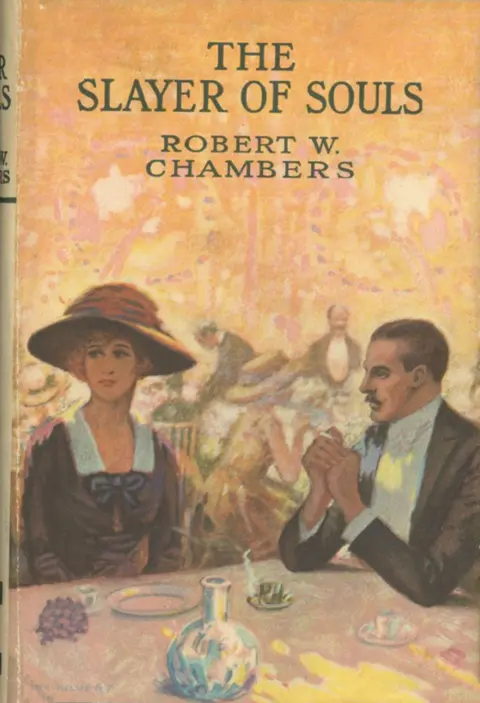
THE CLASSIC COLLECTION · 1920
"The Slayer of Souls" by Robert W. Chambers is a novel written in the early 20th century. This story centers around Tressa Norne, a young American girl who is haunted by the memories of her traumatic past during her time in Asia, where she was often ensnared by the sinister influences of a cult known as the Yezidees under the enigmatic Prince Sanang. As she navigates her fear and the potential perils that accompany her existence, the narrative explores deeper themes of life, death, and the battle for one’s soul against malevolent forces. At the start of the novel, we witness Tressa's emergence from a long period steeped in dread and trauma as she travels on a steamer, leaving behind the shadows of her past. She struggles to reclaim her sense of self amidst the kindness of fellow passengers but is still confronted by foreboding visions that hint at her entanglement with dark forces. When confronted by Sanang, an emissary of the Yezidees, Tressa's previous convictions about the control over her soul are deeply challenged. Her determination to survive and assert her autonomy against the sinister magic of her past becomes central to her character, setting the stage for the novel's unfolding conflict between good and evil.
Introduction adapted from the source catalogue; source summaries may be automatically generated.
Free to read · English · 63,043 words · No account needed
MAKE TIME FOR A GOOD BOOK
On by default. Untick to stop anonymous reading totals. Each page counts after 10 seconds in view. How this works.
Anonymous counting is on unless you have switched it off.
Tressa was standing very straight and still in a strange, supple, agonised attitude, her left forearm across her eyes, her right hand clenched, her slender body slightly twisted to the left.
The men gazed pallidly at her with tense, set faces, knowing that the girl was in terrible mental conflict against another mind—a powerful, sinister mind which was seeking to grasp her thoughts and control them.
Minute after minute sped: the girl never moved, locked in her psychic duel with this other brutal mind,—beating back its terrible thought-waves which were attacking her, fighting for mental supremacy, struggling in silence with an unseen adversary whose mental dominance meant death.
Suddenly her cry rang out sharply in the moonlight, and then, all at once, a man in white stood there in the lustre of the moon—a young, graceful man dressed in white flannels and carrying on his right arm what seemed to be a long white cloak.
Instantly the girl was transformed from a living statue into a lithe, supple, lightly moving thing that passed swiftly to the west of the glade, keeping the young man in white facing the wind, which was blowing and tossing the plumy young pines.
“So it is you, young man, with whom I have been wrestling here under the moon of the only God!” she said in a strange little voice, all vibrant and metallic with menacing laughter.
“It is I, Keuke Mongol,” replied the young man in white, tranquilly; yet his words came as though he were tired and out of breath, and the hand he raised to touch his small black moustache trembled as if from physical exhaustion.
“Yarghouz!” she exclaimed. “Why did I not know you there on the golf links, Assassin of the Seventh Tower? And why do you come here with your shroud over your arm and hidden under it, in your right hand, a flask full of death?”
He said, smiling:
“I come because you are to die, Heavenly-Azure Eyes. I bring you your shroud.” And he moved warily westward around the open circle of young pines.
Instantly the girl flung her right arm straight upward.
“Yarghouz!”
“I hear thee, Heavenly Azure.”
“Another step to the west and I shatter thy flask of gas.”
“With what?” he demanded; but stood discreetly motionless.
“With what I grasp in an empty palm. Thou knowest, Yarghouz.”
“I have heard,” he said with smiling uncertainty, “but to hear of force that can be hurled out of an empty palm is one thing, and to see it and feel it is another. I think you lie, Heavenly Azure.”
“So thought Gutchlug. And died of a yellow snake.”
Your reading position is saved on this browser. Take it to another device with a library code. Reading pages adapt to text, rather than matching a printed edition.
Robert W. (Robert William) Chambers
Robert W. (Robert William) Chambers

Robert W. (Robert William) Chambers
Robert W. (Robert William) Chambers
BEHIND THE BOOK
This eBook is for the use of anyone anywhere in the United States and most other parts of the world at no cost and with almost no restrictions whatsoever. You may copy it, give it away or re-use it under the terms of the Project Gutenberg License included with this eBook or online at www.gutenberg.org. If you are not located in the United States, you will have to check the laws of the country where you are located before using this eBook. Read the source licence.
The original source file, including credits and licence, is retained by this library. Request an original-format copy at no charge. Please include the book title and Project Gutenberg identifier #36281.
KEEP YOUR CURIOSITY GOING
Coulson Kernahan

Maurice Baring
Frances Wright
Cécile Tormay
Francis Greenleaf Allinson & Anne C. E. (Anne Crosby Emery) Allinson

Frederic Jesup Stimson