THE CLASSIC COLLECTION✦The haunts of menCLASSIC FREE BOOKS
The haunts of men
Robert W. (Robert William) Chambers
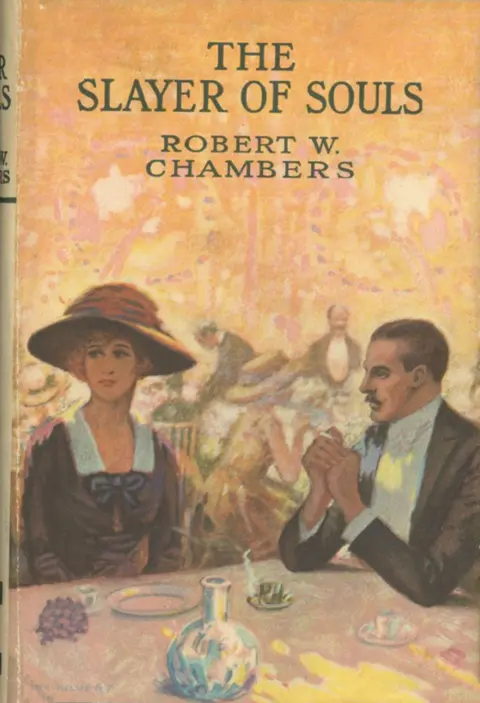
THE CLASSIC COLLECTION · 1920
"The Slayer of Souls" by Robert W. Chambers is a novel written in the early 20th century. This story centers around Tressa Norne, a young American girl who is haunted by the memories of her traumatic past during her time in Asia, where she was often ensnared by the sinister influences of a cult known as the Yezidees under the enigmatic Prince Sanang. As she navigates her fear and the potential perils that accompany her existence, the narrative explores deeper themes of life, death, and the battle for one’s soul against malevolent forces. At the start of the novel, we witness Tressa's emergence from a long period steeped in dread and trauma as she travels on a steamer, leaving behind the shadows of her past. She struggles to reclaim her sense of self amidst the kindness of fellow passengers but is still confronted by foreboding visions that hint at her entanglement with dark forces. When confronted by Sanang, an emissary of the Yezidees, Tressa's previous convictions about the control over her soul are deeply challenged. Her determination to survive and assert her autonomy against the sinister magic of her past becomes central to her character, setting the stage for the novel's unfolding conflict between good and evil.
Introduction adapted from the source catalogue; source summaries may be automatically generated.
Free to read · English · 63,043 words · No account needed
MAKE TIME FOR A GOOD BOOK
On by default. Untick to stop anonymous reading totals. Each page counts after 10 seconds in view. How this works.
Anonymous counting is on unless you have switched it off.
“I think some of your men have arrived.”
“Where?” he asked, astonished.
“At the house.”
“Why do you think so?”
“I think so.”
They paddled a little faster. In a few minutes their dock came into
view.
“It’s funny,” he said, “that you should think some of our men have arrived from the North. I don’t see anybody on the dock.”
“It’s Mr. Recklow,” she said in a low voice. “He is seated on our
veranda.”
As it was impossible to see the house, let alone the veranda, Cleves made no reply. He beached the canoe; Tressa stepped out; he followed, carrying the golf bags.
A mousy light lingered in the shrubbery; bats were flying against a salmon-tinted sky as they took the path homeward.
With an impulse quite involuntary, Cleves encircled his young wife’s shoulders with his left arm.
“Girl-comrade,” he said lightly, “I’d kill any man who even looked as though he’d harm you.”
He smiled, but she had not missed the ugly undertone in his words.
They walked slowly, his arm around her shoulders. Suddenly he felt her
start. They halted.
“What was it?” he whispered.
“I thought there was something white in the woods.”
“Where, dear?” he asked coolly.
“Over there beyond the lawn.”
What she called the “lawn” was only a vast sheet of pink and white phlox, now all misty with the whirring wings of sphinx-moths and Noctuidæ.
The oak grove beyond was dusky. Cleves could see nothing among the
trees.
After a moment they went forward. His arm had fallen away from her
shoulders.
There were no lights except in the kitchen when they came in sight of the house. At first nobody was visible on the screened veranda under the orange trees. But when he opened the swing door for her a shadowy figure arose from a chair.
It was John Recklow. He came forward, bent his strong white head, and
kissed Tressa’s hand.
“Is all well with you, Mrs. Cleves?”
“Yes. I am glad you came.”
Cleves clasped the elder man’s firm hand.
“I’m glad too, Recklow. You’ll stop with us, of course.”
“Do you really want me?”
“Of course,” said Cleves.
“All right. I’ve a coon and a surrey behind your house.”
So Cleves went around in the dusk and sent the outfit back to the hotel, and he himself carried in Recklow’s suitcase.
Then Tressa went away to give instructions, and the two men were left together on the dusky veranda.
“Well?” said Recklow quietly.
Cleves went to him and rested both hands on his shoulders:
Your reading position is saved on this browser. Take it to another device with a library code. Reading pages adapt to text, rather than matching a printed edition.
Robert W. (Robert William) Chambers
Robert W. (Robert William) Chambers

Robert W. (Robert William) Chambers
Robert W. (Robert William) Chambers
BEHIND THE BOOK
This eBook is for the use of anyone anywhere in the United States and most other parts of the world at no cost and with almost no restrictions whatsoever. You may copy it, give it away or re-use it under the terms of the Project Gutenberg License included with this eBook or online at www.gutenberg.org. If you are not located in the United States, you will have to check the laws of the country where you are located before using this eBook. Read the source licence.
The original source file, including credits and licence, is retained by this library. Request an original-format copy at no charge. Please include the book title and Project Gutenberg identifier #36281.
KEEP YOUR CURIOSITY GOING
Coulson Kernahan

Maurice Baring
Frances Wright
Cécile Tormay
Francis Greenleaf Allinson & Anne C. E. (Anne Crosby Emery) Allinson

Frederic Jesup Stimson