THE CLASSIC COLLECTION✦The haunts of menCLASSIC FREE BOOKS
The haunts of men
Robert W. (Robert William) Chambers
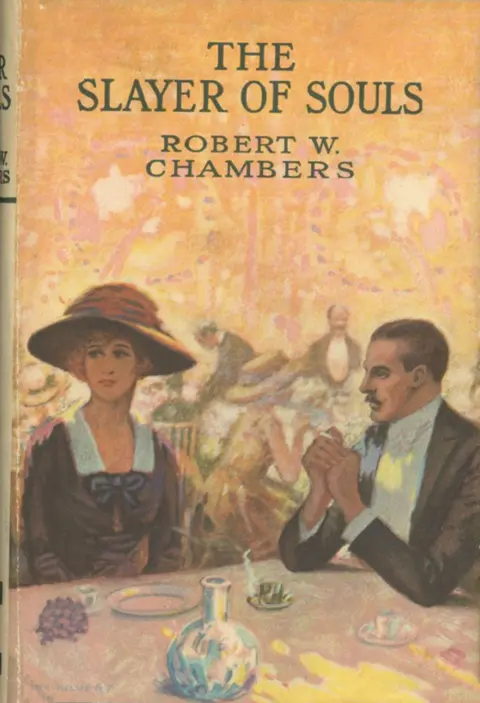
THE CLASSIC COLLECTION · 1920
"The Slayer of Souls" by Robert W. Chambers is a novel written in the early 20th century. This story centers around Tressa Norne, a young American girl who is haunted by the memories of her traumatic past during her time in Asia, where she was often ensnared by the sinister influences of a cult known as the Yezidees under the enigmatic Prince Sanang. As she navigates her fear and the potential perils that accompany her existence, the narrative explores deeper themes of life, death, and the battle for one’s soul against malevolent forces. At the start of the novel, we witness Tressa's emergence from a long period steeped in dread and trauma as she travels on a steamer, leaving behind the shadows of her past. She struggles to reclaim her sense of self amidst the kindness of fellow passengers but is still confronted by foreboding visions that hint at her entanglement with dark forces. When confronted by Sanang, an emissary of the Yezidees, Tressa's previous convictions about the control over her soul are deeply challenged. Her determination to survive and assert her autonomy against the sinister magic of her past becomes central to her character, setting the stage for the novel's unfolding conflict between good and evil.
Introduction adapted from the source catalogue; source summaries may be automatically generated.
Free to read · English · 63,043 words · No account needed
MAKE TIME FOR A GOOD BOOK
On by default. Untick to stop anonymous reading totals. Each page counts after 10 seconds in view. How this works.
Anonymous counting is on unless you have switched it off.
She nodded absently, occupied with her own thoughts, sitting there, chin on hand, her musing eyes intensely blue.
“I think I can amuse you,” she concluded, “without bringing any harm to
myself.”
“Don’t try it, Tressa!—--”
“I’ll be very careful. Now, sit quite still—closer to me, please.”
He edged closer; and became conscious of an indefinable freshness in the air that enveloped him, like the scent of something young and growing. But it was no magic odour,—merely the virginal scent of her hair and skin that even clung to her summer gown.
He heard her singing under her breath to herself:
“La-ē-la!
La-ē-la!”
and murmuring caressingly in an unknown tongue.
Then, suddenly in the pale sunshine, scores of little birds came hovering around them, alighting all over them. And he saw them swarming out of the mossy festoons of the water-oaks—scores and scores of tiny birds—Parula warblers, mostly—all flitting fearlessly down to alight upon his shoulders and knees, all keeping up their sweet, dreamy little twittering sound.
“This is wonderful,” he whispered.
The girl laughed, took several birds on her forefinger.
“This is nothing,” she said. “If I only dared—wait a moment!—--” And, to the Parula warblers:
“Go home, little friends of God!”
The air was filled with the musical whisper of wings. She passed her right arm around her husband’s neck.
“Look at the river,” she said.
“Good God!” he blurted out. And sat dumb.
For, over the St. John’s misty surface, there was the span of a bridge—a strange, marble bridge humped up high in the centre.
And over it were passing thousands of people—he could make them out vaguely—see them passing in two never-ending streams—tinted shapes on the marble bridge.
And now, on the farther shore of the river, he was aware of a city—a vast one, with spectral pagoda shapes against the sky——
Her arm tightened around his neck.
He saw boats on the river—like the grotesque shapes that decorate
ancient lacquer.
She rested her face lightly against his cheek.
In his ears was a far confusion of voices—the stir and movement of multitudes—noises on ships, boatmen’s cries, the creak of oars.
Then, far and sonorous, quavering across the water from the city, the
din of a temple gong.
There were bells, too—very sweet and silvery—camel bells, bells from
the Buddhist temples.
He strained his eyes, and thought, amid the pagodas, that there were
minarets, also.
Suddenly, clear and ringing came the distant muezzin’s cry: “There is no other god but God!... It is noon. Mussulmans, pray!”
Your reading position is saved on this browser. Take it to another device with a library code. Reading pages adapt to text, rather than matching a printed edition.
Robert W. (Robert William) Chambers
Robert W. (Robert William) Chambers

Robert W. (Robert William) Chambers
Robert W. (Robert William) Chambers
BEHIND THE BOOK
This eBook is for the use of anyone anywhere in the United States and most other parts of the world at no cost and with almost no restrictions whatsoever. You may copy it, give it away or re-use it under the terms of the Project Gutenberg License included with this eBook or online at www.gutenberg.org. If you are not located in the United States, you will have to check the laws of the country where you are located before using this eBook. Read the source licence.
The original source file, including credits and licence, is retained by this library. Request an original-format copy at no charge. Please include the book title and Project Gutenberg identifier #36281.
KEEP YOUR CURIOSITY GOING
Coulson Kernahan

Maurice Baring
Frances Wright
Cécile Tormay
Francis Greenleaf Allinson & Anne C. E. (Anne Crosby Emery) Allinson

Frederic Jesup Stimson