THE CLASSIC COLLECTION✦The haunts of menCLASSIC FREE BOOKS
The haunts of men
Robert W. (Robert William) Chambers
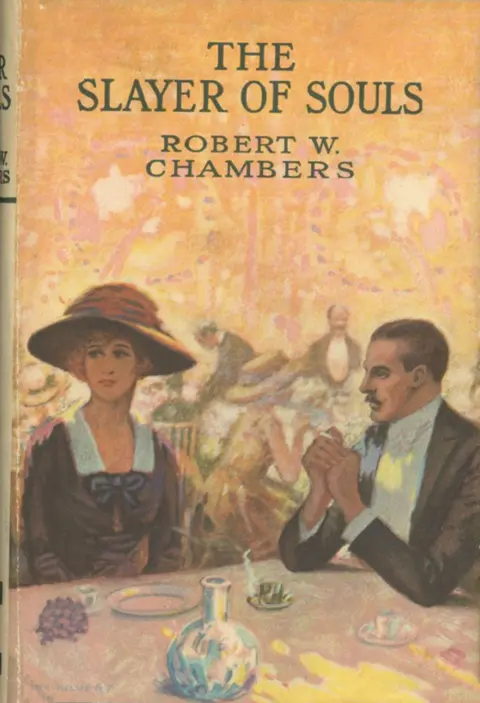
THE CLASSIC COLLECTION · 1920
"The Slayer of Souls" by Robert W. Chambers is a novel written in the early 20th century. This story centers around Tressa Norne, a young American girl who is haunted by the memories of her traumatic past during her time in Asia, where she was often ensnared by the sinister influences of a cult known as the Yezidees under the enigmatic Prince Sanang. As she navigates her fear and the potential perils that accompany her existence, the narrative explores deeper themes of life, death, and the battle for one’s soul against malevolent forces. At the start of the novel, we witness Tressa's emergence from a long period steeped in dread and trauma as she travels on a steamer, leaving behind the shadows of her past. She struggles to reclaim her sense of self amidst the kindness of fellow passengers but is still confronted by foreboding visions that hint at her entanglement with dark forces. When confronted by Sanang, an emissary of the Yezidees, Tressa's previous convictions about the control over her soul are deeply challenged. Her determination to survive and assert her autonomy against the sinister magic of her past becomes central to her character, setting the stage for the novel's unfolding conflict between good and evil.
Introduction adapted from the source catalogue; source summaries may be automatically generated.
Free to read · English · 63,043 words · No account needed
MAKE TIME FOR A GOOD BOOK
On by default. Untick to stop anonymous reading totals. Each page counts after 10 seconds in view. How this works.
Anonymous counting is on unless you have switched it off.
Driving back to his apartment beside her, he strove to realise that
this girl was his wife.
One of her gloves lay across her lap, and on it rested a slender hand. And on one finger was his ring.
But Victor Cleves could not bring himself to believe that this brand-new ring really signified anything to him,—that it had altered his own life in any way. But always his incredulous eyes returned to that slim finger resting there, unstirring, banded with a narrow circlet of virgin gold.
In the apartment they did not seem to know exactly what to do or say—what attitude to assume—what effort to make.
Tressa went into her own room, removed her hat and furs, and came slowly back into the living-room, where Cleves still stood gazing absently out of the window.
A fine rain was falling.
They seated themselves. There seemed nothing better to do.
He said, politely: “In regard to going away for a rest, you wouldn’t care for the North Woods, I fancy, unless you like winter sports. Do you?”
“I like sunlight and green leaves,” she said in that odd, still voice.
“Then, if it would please you to go South for a few weeks’ rest——”
“Would it inconvenience you?”
Her manner touched him.
“My dear Miss Norne,” he began, and checked himself, flushing painfully. The girl blushed, too; then, when he began to laugh, her lovely, bashful smile glimmered for the first time.
“I really can’t bring myself to realise that you and I are married,” he explained, still embarrassed, though smiling.
Her smile became an endeavour. “I can’t believe it either, Mr. Cleves,” she said. “I feel rather stunned.”
“Hadn’t you better call me Victor—under the circumstances?” he suggested, striving to speak lightly.
“Yes.... It will not be very easy to say it—not for some time, I
think.”
“Tressa?”
“Yes.”
“Yes—what?”
“Yes—Victor.”
“That’s the idea,” he insisted with forced gaiety.
“The thing to do is to face this rather funny situation and take it amiably and with good humour. You’ll have your freedom some day, you know.”
“Yes—I—know.”
“And we’re already on very good terms. We find each other interesting,
don’t we?”
“Yes.”
“It even seems to me,” he ventured, “it certainly seems to me, at times, as though we are approaching a common basis of—of mutual—er—esteem.”
“Yes. I—I do esteem you, Mr. Cleves.”
“In point of fact,” he concluded, surprised, “we are friends—in a way. Wouldn’t you call it—friendship?”
“I think so, I think I’d call it that,” she admitted.
Your reading position is saved on this browser. Take it to another device with a library code. Reading pages adapt to text, rather than matching a printed edition.
Robert W. (Robert William) Chambers
Robert W. (Robert William) Chambers

Robert W. (Robert William) Chambers
Robert W. (Robert William) Chambers
BEHIND THE BOOK
This eBook is for the use of anyone anywhere in the United States and most other parts of the world at no cost and with almost no restrictions whatsoever. You may copy it, give it away or re-use it under the terms of the Project Gutenberg License included with this eBook or online at www.gutenberg.org. If you are not located in the United States, you will have to check the laws of the country where you are located before using this eBook. Read the source licence.
The original source file, including credits and licence, is retained by this library. Request an original-format copy at no charge. Please include the book title and Project Gutenberg identifier #36281.
KEEP YOUR CURIOSITY GOING
Coulson Kernahan

Maurice Baring
Frances Wright
Cécile Tormay
Francis Greenleaf Allinson & Anne C. E. (Anne Crosby Emery) Allinson

Frederic Jesup Stimson