THE CLASSIC COLLECTION✦The haunts of menCLASSIC FREE BOOKS
The haunts of men
Robert W. (Robert William) Chambers
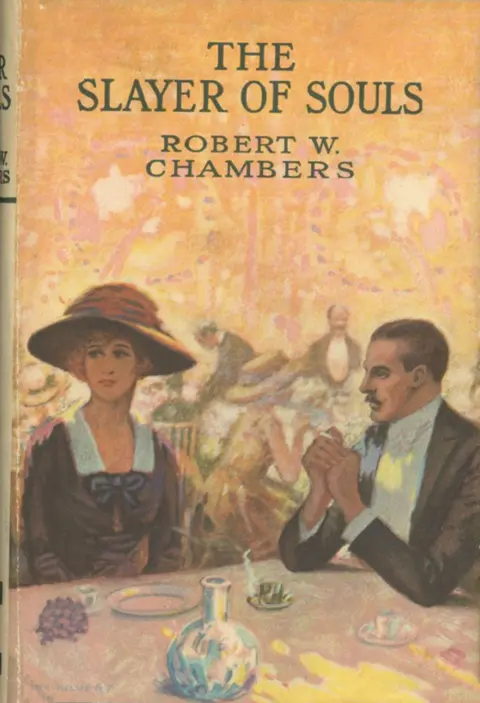
THE CLASSIC COLLECTION · 1920
"The Slayer of Souls" by Robert W. Chambers is a novel written in the early 20th century. This story centers around Tressa Norne, a young American girl who is haunted by the memories of her traumatic past during her time in Asia, where she was often ensnared by the sinister influences of a cult known as the Yezidees under the enigmatic Prince Sanang. As she navigates her fear and the potential perils that accompany her existence, the narrative explores deeper themes of life, death, and the battle for one’s soul against malevolent forces. At the start of the novel, we witness Tressa's emergence from a long period steeped in dread and trauma as she travels on a steamer, leaving behind the shadows of her past. She struggles to reclaim her sense of self amidst the kindness of fellow passengers but is still confronted by foreboding visions that hint at her entanglement with dark forces. When confronted by Sanang, an emissary of the Yezidees, Tressa's previous convictions about the control over her soul are deeply challenged. Her determination to survive and assert her autonomy against the sinister magic of her past becomes central to her character, setting the stage for the novel's unfolding conflict between good and evil.
Introduction adapted from the source catalogue; source summaries may be automatically generated.
Free to read · English · 63,043 words · No account needed
MAKE TIME FOR A GOOD BOOK
On by default. Untick to stop anonymous reading totals. Each page counts after 10 seconds in view. How this works.
Anonymous counting is on unless you have switched it off.
“I have a job to offer if you care for it and if you are up to it,” he
said.
Her eyes became slightly hostile:
“What kind of job do you mean?”
“I want to learn something about you first. Will you come over to my table and talk it over?”
“No.”
“What sort do you suppose me to be?” he inquired, amused.
“The usual sort, I suppose.”
“You mean a Johnny?”
“Yes—of sorts.”
She let her insolent eyes sweep him once more, from head to foot.
He was a well-built young man and in his evening dress he had that something about him which placed him very definitely where he really belonged.
“Would you mind looking at my card?” he asked.
He drew it out and laid it beside her, and without stirring she scanned
it sideways.
“That’s my name and address,” he continued. “I’m not contemplating mischief. I’ve enough excitement in life without seeking adventure. Besides, I’m not the sort who goes about annoying women.”
She glanced up at him again:
“You are annoying me!”
“I’m sorry. I was quite honest. Good-night.”
He took his congé with unhurried amiability; had already turned away
when she said:
“Please ... what do you desire to say to me?” He came back to her
table:
“I couldn’t tell you until I know a little more about you.”
“What—do you wish to know?”
“Several things. I could scarcely ask you—go over such matters with
you—standing here.”
There was a pause; the girl juggled with the straw on the table for a few moments, then, partly turning, she summoned a waiter, paid him, adjusted her stole, picked up her gold bag and her violets and stood up. Then she turned to Cleves and gave him a direct look, which had in it the impersonal and searching gaze of a child.
When they were seated at the table reserved for him the place already was filling rapidly—backwash from the theatres slopped through every aisle—people not yet surfeited with noise, not yet sufficiently sodden by their worship of the great god Jazz.
“Jazz,” said Cleves, glancing across his dinner-card at Tressa Norne—“what’s the meaning of the word? Do you happen to know?”
“Doesn’t it come from the French ‘jaser’?”
He smiled. “Possibly. I’m rather hungry. Are you?”
“Yes.”
“Will you indicate your preferences?”
She studied her card, and presently he gave the order.
“I’d like some champagne,” she said, “unless you think it’s too
expensive.”
He smiled at that, too, and gave the order.
“I didn’t suggest any wine because you seem so young,” he said.
Your reading position is saved on this browser. Take it to another device with a library code. Reading pages adapt to text, rather than matching a printed edition.
Robert W. (Robert William) Chambers
Robert W. (Robert William) Chambers

Robert W. (Robert William) Chambers
Robert W. (Robert William) Chambers
BEHIND THE BOOK
This eBook is for the use of anyone anywhere in the United States and most other parts of the world at no cost and with almost no restrictions whatsoever. You may copy it, give it away or re-use it under the terms of the Project Gutenberg License included with this eBook or online at www.gutenberg.org. If you are not located in the United States, you will have to check the laws of the country where you are located before using this eBook. Read the source licence.
The original source file, including credits and licence, is retained by this library. Request an original-format copy at no charge. Please include the book title and Project Gutenberg identifier #36281.
KEEP YOUR CURIOSITY GOING
Coulson Kernahan

Maurice Baring
Frances Wright
Cécile Tormay
Francis Greenleaf Allinson & Anne C. E. (Anne Crosby Emery) Allinson

Frederic Jesup Stimson