THE CLASSIC COLLECTION✦The haunts of menCLASSIC FREE BOOKS
The haunts of men
Robert W. (Robert William) Chambers
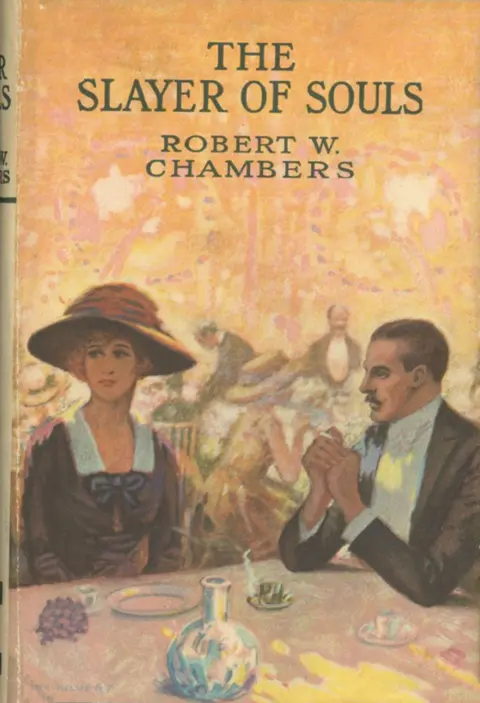
THE CLASSIC COLLECTION · 1920
"The Slayer of Souls" by Robert W. Chambers is a novel written in the early 20th century. This story centers around Tressa Norne, a young American girl who is haunted by the memories of her traumatic past during her time in Asia, where she was often ensnared by the sinister influences of a cult known as the Yezidees under the enigmatic Prince Sanang. As she navigates her fear and the potential perils that accompany her existence, the narrative explores deeper themes of life, death, and the battle for one’s soul against malevolent forces. At the start of the novel, we witness Tressa's emergence from a long period steeped in dread and trauma as she travels on a steamer, leaving behind the shadows of her past. She struggles to reclaim her sense of self amidst the kindness of fellow passengers but is still confronted by foreboding visions that hint at her entanglement with dark forces. When confronted by Sanang, an emissary of the Yezidees, Tressa's previous convictions about the control over her soul are deeply challenged. Her determination to survive and assert her autonomy against the sinister magic of her past becomes central to her character, setting the stage for the novel's unfolding conflict between good and evil.
Introduction adapted from the source catalogue; source summaries may be automatically generated.
Free to read · English · 63,043 words · No account needed
MAKE TIME FOR A GOOD BOOK
On by default. Untick to stop anonymous reading totals. Each page counts after 10 seconds in view. How this works.
Anonymous counting is on unless you have switched it off.
The car swung into the farm-yard, past the barn on the right, and continued on up a very rough trail.
“This is the road to the Ireland Vlaie,” said the trooper. “It is possible for cars for another mile only.”
Splendid spruce, pine, oak, maple, and hemlock fringed the swampy, uneven trail which was no more than a wide, rough vista cut through the forest.
And, as the trooper had said, a little more than a mile farther the trail became a tangle of bushes and swale; the car slowed down and stopped; and a man rose from where he was seated on a mossy log and came forward, his rifle balanced across the hollow of his left arm.
The man was Alek Selden.
It was long after dark and they were still travelling through pathless woods by the aid of their electric torches.
There was little underbrush; the forest of spruce and hemlock was first
growth.
Cleves shined the trees but could discover no blazing, no trodden path.
In explanation, Selden said briefly that he had hunted the territory
for years.
“But I don’t begin to know it,” he added. “There are vast and ugly regions of bog and swale where a sea of alders stretches to the horizon. There are desolate wastes of cat-briers and witch-hopple under leprous tangles of grey birches, where stealthy little brooks darkle deep under matted débris. Only wild things can travel such country.
“Then there are strange, slow-flowing creeks in the perpetual shadows of tamarack woods, where many a man has gone in never to come out.”
“Why?” asked Tressa.
“Under the tender carpet of green cresses are shining black bogs set with tussock; and under the bog stretches quicksand,—and death.”
“Do you know these places?” asked Cleves.
“No.”
Cleves stepped forward to Tressa’s side.
“Keep flashing the ground,” he said harshly. “I don’t want you to step into some hell-hole. I’m sorry I brought you, anyway.”
“But I had to come,” she said in a low voice.
Like the two men, she wore a grey flannel shirt, knickers, and spiral
puttees.
They, however, carried rifles as well as packs; and the girl’s pack was
lighter.
They had halted by a swift, icy rivulet to eat, without building a fire. After that they crossed the Ireland Vlaie and the main creek, where remains of a shanty stood on the bluff above the right bank—the last sign of man.
Beyond lay the uncharted land, skimped and shirked entirely in certain regions by map-makers;—an unknown wilderness on the edges of which Selden had often camped when deer shooting.
Your reading position is saved on this browser. Take it to another device with a library code. Reading pages adapt to text, rather than matching a printed edition.
Robert W. (Robert William) Chambers
Robert W. (Robert William) Chambers

Robert W. (Robert William) Chambers
Robert W. (Robert William) Chambers
BEHIND THE BOOK
This eBook is for the use of anyone anywhere in the United States and most other parts of the world at no cost and with almost no restrictions whatsoever. You may copy it, give it away or re-use it under the terms of the Project Gutenberg License included with this eBook or online at www.gutenberg.org. If you are not located in the United States, you will have to check the laws of the country where you are located before using this eBook. Read the source licence.
The original source file, including credits and licence, is retained by this library. Request an original-format copy at no charge. Please include the book title and Project Gutenberg identifier #36281.
KEEP YOUR CURIOSITY GOING
Coulson Kernahan

Maurice Baring
Frances Wright
Cécile Tormay
Francis Greenleaf Allinson & Anne C. E. (Anne Crosby Emery) Allinson

Frederic Jesup Stimson