THE CLASSIC COLLECTION✦The haunts of menCLASSIC FREE BOOKS
The haunts of men
Robert W. (Robert William) Chambers
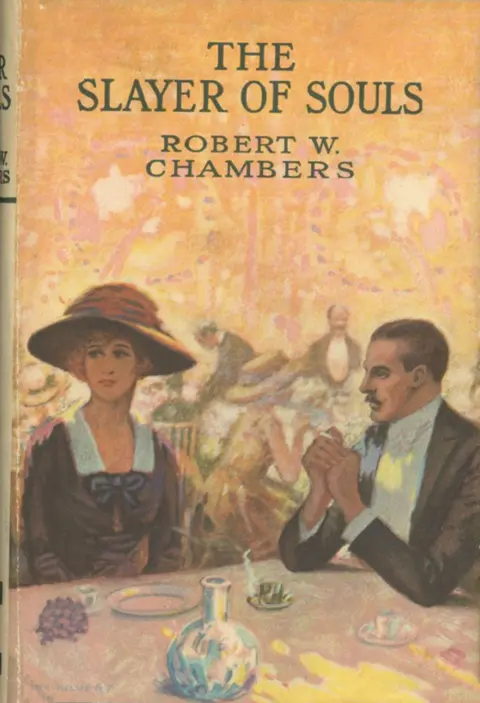
THE CLASSIC COLLECTION · 1920
"The Slayer of Souls" by Robert W. Chambers is a novel written in the early 20th century. This story centers around Tressa Norne, a young American girl who is haunted by the memories of her traumatic past during her time in Asia, where she was often ensnared by the sinister influences of a cult known as the Yezidees under the enigmatic Prince Sanang. As she navigates her fear and the potential perils that accompany her existence, the narrative explores deeper themes of life, death, and the battle for one’s soul against malevolent forces. At the start of the novel, we witness Tressa's emergence from a long period steeped in dread and trauma as she travels on a steamer, leaving behind the shadows of her past. She struggles to reclaim her sense of self amidst the kindness of fellow passengers but is still confronted by foreboding visions that hint at her entanglement with dark forces. When confronted by Sanang, an emissary of the Yezidees, Tressa's previous convictions about the control over her soul are deeply challenged. Her determination to survive and assert her autonomy against the sinister magic of her past becomes central to her character, setting the stage for the novel's unfolding conflict between good and evil.
Introduction adapted from the source catalogue; source summaries may be automatically generated.
Free to read · English · 63,043 words · No account needed
MAKE TIME FOR A GOOD BOOK
On by default. Untick to stop anonymous reading totals. Each page counts after 10 seconds in view. How this works.
Anonymous counting is on unless you have switched it off.
The effects of this vast conspiracy may already be traced in recent events in Egypt, India, and Afghanistan. For the first time, through the creation of this league, the racial and religious differences which have divided Eastern conspirators have been overcome. The Ottoman League, founded by Mahmud Muktar Pasha, Munir Pasha, and Ahmed Rechid Bey, has adhered to the new organisation. So have the extreme Egyptian nationalists and the Hindu revolutionary group, “Pro India,” emissaries of which were recently sentenced for bringing bombs into Switzerland during the war at the instigation of the German General Staff.
At a “Constituent Assembly” of the league, which took place in Yian, there were present, besides Young Turks, Egyptians and Hindus, delegates representing Persia, Afghanistan, Algeria, Morocco, and Mongolia.
The league is of Mongolian origin. Its leading spirit is a certain Prince Sanang, of whom little is known.
Associated with this mischievous and rather mysterious Mongolian personage are three better known criminals, now fugitives from justice—Talaat, Enver, and Djemal. It is to Enver Pasha’s talent for intrigue that the union between Moslems and Hindus, the most striking and dangerous feature of the movement, is chiefly due.
Considerable funds are at the disposal of the league. These are partly supplied from Germany. Besides enjoying the support of the Germans, the league is also in close touch with Lenine, who very soon after his advent to power organised an Oriental Department in Moscow.
The alliance between the league and the Russian Bolsheviki was brought about by the notorious German Socialist agent, “Parvus,” who is now in Switzerland. Many weeks ago he conferred with the Soviet rulers in Moscow, whence he went to Afghanistan, hoping to reorganise the new Amir’s army and establish lines of communication for propaganda in India.
Evidence exists that the recent insurrection in Egypt, the sudden attack of the Afghans, and the rising in India, remarkable for co-operation between Moslems and Hindus, were connected with the activities of the league.
The Secretary looked up after he finished the reading.
“I don’t see anything about Black Magic in this?” he remarked
flippantly.
Recklow’s features became very grave.
“I think,” he said, “that everybody—myself included—and, with all respect, even yourself, sir,—and your honourable colleague,—and perhaps even his Excellency your President,—should be on perpetual guard over their minds, and the thoughts that range there, lest, surreptitiously, stealthily, some taint of Yezidee infection lodge there and take root—and spread—perhaps—throughout your new Republic.”
The Secretary of War grinned. “They say I’m something of a socialist already,” he chuckled. “Do you think your magic Yezidees are responsible?”
Your reading position is saved on this browser. Take it to another device with a library code. Reading pages adapt to text, rather than matching a printed edition.
Robert W. (Robert William) Chambers
Robert W. (Robert William) Chambers

Robert W. (Robert William) Chambers
Robert W. (Robert William) Chambers
BEHIND THE BOOK
This eBook is for the use of anyone anywhere in the United States and most other parts of the world at no cost and with almost no restrictions whatsoever. You may copy it, give it away or re-use it under the terms of the Project Gutenberg License included with this eBook or online at www.gutenberg.org. If you are not located in the United States, you will have to check the laws of the country where you are located before using this eBook. Read the source licence.
The original source file, including credits and licence, is retained by this library. Request an original-format copy at no charge. Please include the book title and Project Gutenberg identifier #36281.
KEEP YOUR CURIOSITY GOING
Coulson Kernahan

Maurice Baring
Frances Wright
Cécile Tormay
Francis Greenleaf Allinson & Anne C. E. (Anne Crosby Emery) Allinson

Frederic Jesup Stimson