THE CLASSIC COLLECTION✦An outlaw’s diary: the CommuneCLASSIC FREE BOOKS
An outlaw’s diary: the Commune
Cécile Tormay
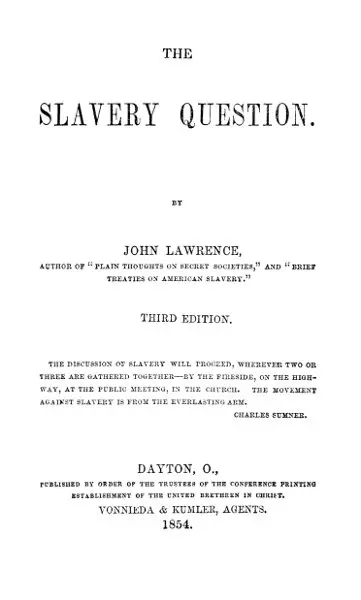
THE CLASSIC COLLECTION · 1854
"The Slavery Question" by John Lawrence is a historical account written in the mid-19th century. The book discusses the moral, political, and religious implications of American slavery, emphasizing the necessity for abolition and the urgent call for ethical consideration regarding human rights. It explores the severe injustices endured by enslaved individuals, aiming to awaken the conscience of the readers regarding the plight of three million slaves in the United States. At the start of the text, the author presents a passionate preface outlining the deep moral crisis posed by slavery in America, condemning it as a profound iniquity that corrupts the nation and its moral fabric. He articulates the complexities of slavery, from its origins in the African slave trade to its legal and societal implications, emphasizing the denial of basic human rights and family bonds for enslaved individuals. Lawrence’s tone is both urgent and accusatory, appealing to readers' emotions and urging collective action against this unjust institution. He firmly believes that a true understanding of slavery can mobilize the moral and political power of ordinary citizens in the fight for liberation.
Introduction adapted from the source catalogue; source summaries may be automatically generated.
Free to read · English · 46,905 words · No account needed
MAKE TIME FOR A GOOD BOOK
On by default. Untick to stop anonymous reading totals. Each page counts after 10 seconds in view. How this works.
Anonymous counting is on unless you have switched it off.
Besides the churches already mentioned the following are decidedly anti-slavery:--"Associate Presbyterian," "Reformed Presbyterian," "Free Presbyterian," (of which the venerable John Rankin is a member,) many local "Independent" churches, and the "Friends" or Quakers. The Quakers have a world-wide reputation for practical philanthropy. And on the other hand the following large denominations are decidedly pro-slavery:--"German Reformed," "Dutch Reformed," "Cumberland Presbyterian," "Lutheran" and "Disciple" (or Campbellite.)
The following estimate made by W. G. Gephart, a Presbyterian minister, will give a "bird's eye view" of the relation of the leading denominations of this country to slavery as it stood a few years since. At the present time they are only more deeply involved in the trade in the souls of men, than they were when this estimate was made:
DENOMINATIONS. NO. OF SLAVES. Methodists, 219,563 Presbyterian, Old and New School, 77,000 Baptists, 125,000 Campbellites, 101,000 Episcopalians, 88,000 Allow for all other denominations, 50,000 ------- Total number of slaves owned by ministers of the gospel and members of the different Protestant churches, 660,563
"Now, suppose the average value of all these slaves be only $400 each, and it will give a capital of $264,225,200! invested in humanity, the interests of 660,653 beings upon whom God has chartered immortality, and stamped it with the signet of his own image."
From this review it will be perceived that the most influential denominations have given their sanction to slavery. They have opened wide their doors to slaveholders, and have welcomed them to their communion. They have not advised nor commanded them to emancipate their slaves as a condition of admission to the church, to the Lord's table, to the pulpit, or even into heaven itself!
Divines have, by a perversion of the Bible, corrupted the consciences of Southern, aye, even of Northern Christians, by the most subtle and monstrous errors. The holy Bible has been made, in the language of Blanchard, a smith shop whence consecrated hands have brought fetters for the feet, and manacles for the mind! "We have," said Frederick Douglass, "men-stealers for ministers, woman-whippers for missionaries, and cradle-plunderers for church-members. The man who wields the blood-clotted cow-skin during the week fills the pulpit on Sunday and claims to be a minister of the meek and lowly Jesus. The man who robs me of my earnings at the end of each week, meets me as class-leader on Sunday morning, to show me the way of life, and the path of salvation. He who sells my sister, for purposes of prostitution, stands forth as the pious advocate of purity. He who proclaims it a religious duty to read the Bible, denies me the right of learning to read the name of God who made me. He who is the religious advocate of marriage, robs whole millions of its sacred influence, and leaves them to the ravages of wholesale pollution. The warm defender of the sacredness of the family relation is the same that, scatters whole families,--sundering husbands and wives, parents and children, sisters and brothers,--leaving the hut vacant, and the hearth desolate. We see the thief preaching against theft, and the adulterer against adultery. We have men sold to build churches, women sold to support the gospel, and babes sold to purchase Bibles for the poor heathen! all for the glory of God and the good of souls! The slave auctioneer's bell and the church-going bell chime in with each other, and the bitter cries of the heart-broken slave are drowned in the religious shouts of his pious master. Revivals of religion and revivals in the slave trade go hand in hand together. The slave prison and the church stand near each other. The clanking of fetters and the rattling of chains in the prison, and the pious psalm and solemn prayer in the church may be heard at the same time. The dealers in the bodies and souls of men, erect their stand in the presence of the pulpit, and they mutually help each other. The dealer gives his blood-stained gold to support the pulpit, and the pulpit, in return, covers his infernal business with the garb of Christianity."
Your reading position is saved on this browser. Take it to another device with a library code. Reading pages adapt to text, rather than matching a printed edition.
BEHIND THE BOOK
This eBook is for the use of anyone anywhere in the United States and most other parts of the world at no cost and with almost no restrictions whatsoever. You may copy it, give it away or re-use it under the terms of the Project Gutenberg License included with this eBook or online at www.gutenberg.org. If you are not located in the United States, you will have to check the laws of the country where you are located before using this eBook. Read the source licence.
The original source file, including credits and licence, is retained by this library. Request an original-format copy at no charge. Please include the book title and Project Gutenberg identifier #47050.
KEEP YOUR CURIOSITY GOING
Cécile Tormay

Moritz Busch
John L. Ransom
Frances Wright
Cécile Tormay

Mabel Potter Daggett