THE CLASSIC COLLECTION✦An outlaw’s diary: the CommuneCLASSIC FREE BOOKS
An outlaw’s diary: the Commune
Cécile Tormay
THE CLASSIC COLLECTION · 1854
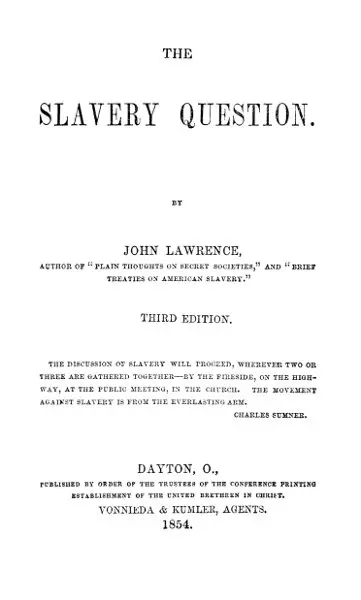
"The Slavery Question" by John Lawrence is a historical account written in the mid-19th century. The book discusses the moral, political, and religious implications of American slavery, emphasizing the necessity for abolition and the urgent call for ethical consideration regarding human rights. It explores the severe injustices endured by enslaved individuals, aiming to awaken the conscience of the readers regarding the plight of three million slaves in the United States. At the start of the text, the author presents a passionate preface outlining the deep moral crisis posed by slavery in America, condemning it as a profound iniquity that corrupts the nation and its moral fabric. He articulates the complexities of slavery, from its origins in the African slave trade to its legal and societal implications, emphasizing the denial of basic human rights and family bonds for enslaved individuals. Lawrence’s tone is both urgent and accusatory, appealing to readers' emotions and urging collective action against this unjust institution. He firmly believes that a true understanding of slavery can mobilize the moral and political power of ordinary citizens in the fight for liberation.
Introduction adapted from the source catalogue; source summaries may be automatically generated.
Free to read · English · 46,905 words · No account needed
MAKE TIME FOR A GOOD BOOK
On by default. Untick to stop anonymous reading totals. Each page counts after 10 seconds in view. How this works.
Anonymous counting is on unless you have switched it off.
And that wife, though a slave, unprotected by the laws, driven by the shameful lash, insulted, disgraced and neglected, is a wife still. And when "Ned," as he is called, runs away, it is quite natural that he should, impelled by a husband's love, seek out the hut where years before he had been suddenly separated from her. These advertisements for husbands who are supposed to be "lurking about" in search of their wives, and of wives hunting for their husbands, tell a sad tale. What husband or wife can read them without deep sorrow?
The following statement from the pen of an eye witness will illustrate scenes which are being enacted continually in the prosecution of the inter-state slave trade.
"As I went on board the steamboat I noticed eight colored men, handcuffed and chained together in pairs, four women and eight or ten children of the apparent ages of from four to ten years, all standing together in the bow of the boat, in charge of a man standing near them. * * * Coming near them, I perceived they were all greatly agitated; and, on inquiry I found they were all slaves, who had been born and raised in North Carolina and had just been sold to a speculator, who was now taking them to the Charleston market. Upon the shore there was a number of colored persons, women and children, awaiting the departure of the boat; and my attention was particularly attracted by two colored females of uncommonly respectable appearance, neatly attired, who stood together, a little distance from the crowd, and upon whose countenance was depicted the keenest sorrow. As the last bell was tolling, I saw the tears gushing from their eyes, and they raised their neat cotton aprons and wiped their faces under the cutting anguish of severed affection. They were the wives of two of the men in chains. There, too, were mothers and sisters, weeping at the departure of their sons and brothers; and there, too, were fathers, taking the last look of their wives and children. My whole attention was directed to those on shore, as they seemed to stand in solemn and submissive silence, occasionally giving utterance to the intensity of their feelings by a sigh or a stifled groan. As the boat was loosed from her moorings, they cast a distressed, lingering look to those on board, and turned away in silence. My eye now turned to those in the boat; and although I had tried to control my feelings amidst my sympathies for those on shore, I could conceal them no longer, and I found myself literally 'weeping with those that wept.' I stood near them, and when one of the husbands saw his wife upon the shore wave her hand for the last time, in token of her affection, his manly efforts to restrain his feelings gave way, and fixing his watery eyes upon her, he exclaimed, 'This is the most distressing thing of all! My dear wife and children, farewell!' The husband of the other wife stood weeping in silence, and with his manacled hands raised to his face, as he looked upon her for the last time. Of the poor women on board; three of them had husbands whom they left behind. One of them had three children, another had two, and the third had none. These husbands and fathers were among the throng upon the shore, witnessing the departure of their wives and children, and as they took their leave of them, they were sitting together upon the floor of the boat sobbing in silence, but giving utterance to no complaint. But the distressing scene was not yet ended. Sailing down the Cape Fear river twenty-five miles, we touched at the little village of Smithport, on the south side of the river. It was at this place that one of these slaves lived, and here was his wife and five children; and while at work on Monday last, his purchaser took him away from his family, carried him in chains to Wilmington, where he had since remained in jail. As we approached the wharf, a flood of tears gushed from his eyes, and anguish seemed to have pierced his heart. The boat stopped but a moment, and as she left, he bid farewell to some of his acquaintances whom he saw upon the shore, exclaiming, 'Boys, I wish you well; tell Molly (meaning his wife) and the children I wish them well, and hope God will bless them.' At that moment he espied his wife on the stoop of a house some rods from the shore, and with one hand which was not in the handcuffs, he pulled off his old hat, and waving it toward her, exclaimed, 'Farewell!' As he saw by the waving of her apron that she recognized him, he leaned back upon the railing, and with a faltering voice repeated, 'Farewell, forever.' After a moment's silence, conflicting passions seemed to tear open his heart, and he exclaimed, 'What have I done that I should suffer this doom? Oh, my wife and children, I want to live no longer!' and then the big tear rolled down his cheek, which he wiped away with the palm of his unchained hand, looked once more upon the mother of his five children, and the turning of the boat hid her face from him forever."
Your reading position is saved on this browser. Take it to another device with a library code. Reading pages adapt to text, rather than matching a printed edition.
BEHIND THE BOOK
This eBook is for the use of anyone anywhere in the United States and most other parts of the world at no cost and with almost no restrictions whatsoever. You may copy it, give it away or re-use it under the terms of the Project Gutenberg License included with this eBook or online at www.gutenberg.org. If you are not located in the United States, you will have to check the laws of the country where you are located before using this eBook. Read the source licence.
The original source file, including credits and licence, is retained by this library. Request an original-format copy at no charge. Please include the book title and Project Gutenberg identifier #47050.
KEEP YOUR CURIOSITY GOING
Cécile Tormay

Moritz Busch
John L. Ransom
Frances Wright
Cécile Tormay

Mabel Potter Daggett