THE CLASSIC COLLECTION✦An outlaw’s diary: the CommuneCLASSIC FREE BOOKS
An outlaw’s diary: the Commune
Cécile Tormay
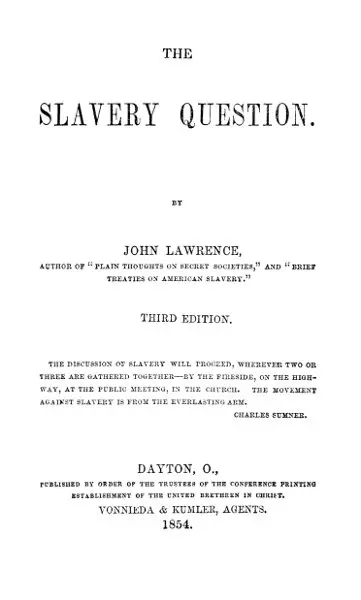
THE CLASSIC COLLECTION · 1854
"The Slavery Question" by John Lawrence is a historical account written in the mid-19th century. The book discusses the moral, political, and religious implications of American slavery, emphasizing the necessity for abolition and the urgent call for ethical consideration regarding human rights. It explores the severe injustices endured by enslaved individuals, aiming to awaken the conscience of the readers regarding the plight of three million slaves in the United States. At the start of the text, the author presents a passionate preface outlining the deep moral crisis posed by slavery in America, condemning it as a profound iniquity that corrupts the nation and its moral fabric. He articulates the complexities of slavery, from its origins in the African slave trade to its legal and societal implications, emphasizing the denial of basic human rights and family bonds for enslaved individuals. Lawrence’s tone is both urgent and accusatory, appealing to readers' emotions and urging collective action against this unjust institution. He firmly believes that a true understanding of slavery can mobilize the moral and political power of ordinary citizens in the fight for liberation.
Introduction adapted from the source catalogue; source summaries may be automatically generated.
Free to read · English · 46,905 words · No account needed
MAKE TIME FOR A GOOD BOOK
On by default. Untick to stop anonymous reading totals. Each page counts after 10 seconds in view. How this works.
Anonymous counting is on unless you have switched it off.
"The slaves were all enclosed under grated hatchways between decks. The space was so low, that they sat between each other's legs, and they were stowed so close together, that there was no possibility of their lying down, or at all changing their position by night or day. As they belonged to, and were shipped on account of different individuals, they were all branded like sheep, with the owner's marks of different forms. These were impressed under their breasts or on their arms, and as the mate informed me, with perfect indifference, quiemados pelo ferro quento--burnt with the red hot iron. Over the hatchway stood a ferocious looking fellow with a scourge of many twisted thongs in his hand, who was the slave driver of the ship; and whenever he heard the slightest noise below, he shook it over them, and seemed eager to exercise it. As soon as the poor creatures saw us looking down at them their dark and melancholy visages brightened up. They perceived something of sympathy and kindness in our looks which they had not been accustomed to, and feeling instinctively, that we were friends, they immediately began to shout and clap their hands. One or two had picked up a few Portuguese words, and cried out Viva! viva! The women were particularly excited. They all held up their arms; and when we bent down and shook hands with them, they could not contain their delight, they endeavored to scramble upon their knees, stretching up to kiss our hands; and we understood that they knew we had come to liberate them. Some, however, hung down their heads, in apparently hopeless dejection, some were greatly emaciated, and some, particularly children, seemed dying. But the circumstance which struck us most forcibly, was, how it was possible for such a number of human beings to exist, packed up and wedged together as tight as they could cram, in low cells, three feet high, the greater part of which, except that immediately under the hatchways, was shut out from light or air, and this when the thermometer, exposed to the open sky, was stand-in the shade, on our deck at 89┬░. The space between the decks was divided into two compartments, three feet, three inches high; the size of one was 16 feet by 18 feet, and of the other 40 feet by 21 feet; into the first there were crammed the women and girls, into the second the men and boys; 226 fellow beings were thus thrust into one space 288 feet square, and 336 into another 800 feet square, giving to the whole an average of 23 inches, and to each of the women, not more than thirteen. The heat of these horrid places was so great and the odor so offensive, that it was quite impossible to enter them even had there been room. They were measured as above when the slaves had left them. The officers insisted that the poor suffering creatures should be admitted on deck to get air and water. This was opposed by the mate of the slaver, who, from a feeling that they deserved it, declared they would murder them all. The officers (of the Eng. ship,) however, persisted, and the poor beings were all turned up together. It is impossible to conceive the effect of this eruption; 507 fellow creatures of all ages and sizes, some children, some adults, old men and women, all in a state of total nudity, scrambling out together to taste a little pure air and water. They came swarming up like bees from the aperture of a hive, till the whole deck was crowded to suffocation, from stem to stern; so that it was impossible to imagine where they could all have come from, or how they could all have been stowed away. On looking into the places where they had been crammed, there were found some children next the sides of the ship, in the places most remote from light and air; they were lying in nearly a torpid state, after the rest had turned out. The little creatures seemed indifferent as to life or death; and when they were carried on deck, many of them could not stand. After enjoying, for a short time, the unusual luxury of air, some water was brought; it was then that the extent of their sufferings was exposed in a fearful manner. They all rushed like maniacs toward it. No entreaties, or threats, or blows could restrain them; they shrieked, and struggled, and fought with one another, for a drop of this precious liquid, as if they grew rabid at the sight of it. When the poor creatures were ordered down again, several of them came, and pressed their heads against our knees, with looks of the greatest anguish, at the prospect of returning to the horrid place of suffering below."[2]
Your reading position is saved on this browser. Take it to another device with a library code. Reading pages adapt to text, rather than matching a printed edition.
BEHIND THE BOOK
This eBook is for the use of anyone anywhere in the United States and most other parts of the world at no cost and with almost no restrictions whatsoever. You may copy it, give it away or re-use it under the terms of the Project Gutenberg License included with this eBook or online at www.gutenberg.org. If you are not located in the United States, you will have to check the laws of the country where you are located before using this eBook. Read the source licence.
The original source file, including credits and licence, is retained by this library. Request an original-format copy at no charge. Please include the book title and Project Gutenberg identifier #47050.
KEEP YOUR CURIOSITY GOING
Cécile Tormay

Moritz Busch
John L. Ransom
Frances Wright
Cécile Tormay

Mabel Potter Daggett