THE CLASSIC COLLECTION✦An outlaw’s diary: the CommuneCLASSIC FREE BOOKS
An outlaw’s diary: the Commune
Cécile Tormay
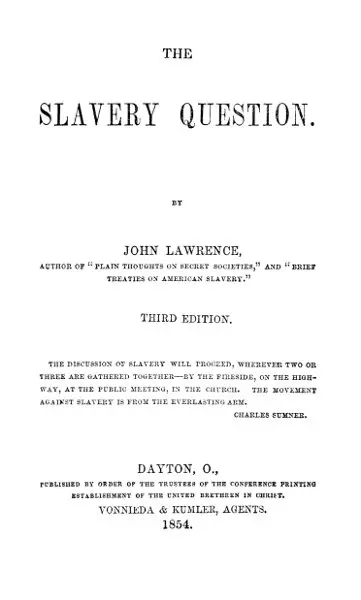
THE CLASSIC COLLECTION · 1854
"The Slavery Question" by John Lawrence is a historical account written in the mid-19th century. The book discusses the moral, political, and religious implications of American slavery, emphasizing the necessity for abolition and the urgent call for ethical consideration regarding human rights. It explores the severe injustices endured by enslaved individuals, aiming to awaken the conscience of the readers regarding the plight of three million slaves in the United States. At the start of the text, the author presents a passionate preface outlining the deep moral crisis posed by slavery in America, condemning it as a profound iniquity that corrupts the nation and its moral fabric. He articulates the complexities of slavery, from its origins in the African slave trade to its legal and societal implications, emphasizing the denial of basic human rights and family bonds for enslaved individuals. Lawrence’s tone is both urgent and accusatory, appealing to readers' emotions and urging collective action against this unjust institution. He firmly believes that a true understanding of slavery can mobilize the moral and political power of ordinary citizens in the fight for liberation.
Introduction adapted from the source catalogue; source summaries may be automatically generated.
Free to read · English · 46,905 words · No account needed
MAKE TIME FOR A GOOD BOOK
On by default. Untick to stop anonymous reading totals. Each page counts after 10 seconds in view. How this works.
Anonymous counting is on unless you have switched it off.
[3] Here are a few advertisements taken from respectable southern
papers, verbatim.
SLAVES WANTED.--We are at all times purchasing Slaves, paying the highest cash prices. Persons wishing to sell will please call at 242 Pratt St. (Slatter's old stand.) Communications attended to. B. M. & W. L. CAMPBELL.
A NEGRO FOR SALE.--I wish to sell a black girl about 24 years old, a good cook and washer, handy with a needle, can spin and weave. I wish to sell her in the neighborhood of Camden Point; if not sold there in a short time, I will hunt the best market; or I will trade her for two small ones, a boy and girl.
November 15, 1852
M. DOYAL.
100 NEGROES FOR SALE, at my depot on Commerce street, immediately between the Exchange Hotel and F. M. Gilmer, Jr.'s Warehouse, where I will be receiving constantly, large lots of Negroes during the season, and will sell on as accommodating terms as any house in this city. I would respectfully request my old customers, and friends to call and examine my stock.
MONTGOMERY, November 2, 1852. JNO. W. LINDSEY.
GREAT SALE OF NEGROES BY J. & L. T. LEVIN.--On Thursday, December 30, at 11 o'clock, will be sold at the Court House in Columbia, one hundred valuable negroes.
It is seldom such an opportunity occurs as now offers. Among them are only four beyond 45 years old, and none above 50. There are twenty five prime young men, between sixteen and thirty; forty of the most likely young women, and as fine a set of children as can be shown!
Terms, &c.
December 18, 1852.
[4] Prof. B. B. Edwards says--"From the time of Augustus to Justinian we may allow three slaves to one free man; we shall thus have a free population in Italy of 6,944,000; and of slaves 20,832,000."
On the treatment of Roman slaves Guizot remarks that "it would be easy to give the most frightful and heartrending accounts of the manner in which the ancient Romans treated their slaves. Entire volumes are occupied with the details." (Hist. Civilization.)
[5] These facts are well authenticated. The "Union Point" tragedy did not occur in 1854, as reported recently, and denied by the "Free Trader," but it did occur in 1842, and we have quoted the "Trader's" own account.
[6] Accepting this celebrated curse as an inspired prophecy, and we are inclined to receive it as such, it finds an easy fulfillment in the conquests of Joshua over the Canaanites; in the oppression of the Phoenicians, (who were descendants of Canaan,) by the Chaldeans, Persians and Greeks; and finally in the subjugation and destruction of the Carthaginians, by the Romans. This is the opinion of President Edwards, and it is entitled to respect.
Your reading position is saved on this browser. Take it to another device with a library code. Reading pages adapt to text, rather than matching a printed edition.
BEHIND THE BOOK
This eBook is for the use of anyone anywhere in the United States and most other parts of the world at no cost and with almost no restrictions whatsoever. You may copy it, give it away or re-use it under the terms of the Project Gutenberg License included with this eBook or online at www.gutenberg.org. If you are not located in the United States, you will have to check the laws of the country where you are located before using this eBook. Read the source licence.
The original source file, including credits and licence, is retained by this library. Request an original-format copy at no charge. Please include the book title and Project Gutenberg identifier #47050.
KEEP YOUR CURIOSITY GOING
Cécile Tormay

Moritz Busch
John L. Ransom
Frances Wright
Cécile Tormay

Mabel Potter Daggett