READ · DISCOVER · ENJOYClassic literature · Always free
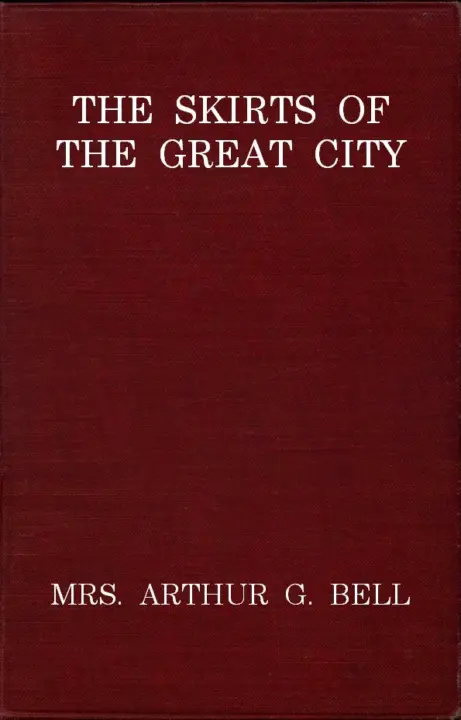
The Skirts of the Great City — digital edition cover

THE CLASSIC COLLECTION · 1907

The Skirts of the Great City

"The Skirts of the Great City" by Mrs. Arthur G. Bell is a historical account focusing on the suburban areas adjacent to London, written in the early 20th century. The work delves into the rich histories, notable landmarks, and cultural significance of various neighborhoods and villages surrounding the great metropolis. Particularly, it begins by discussing Hampstead and its captivating past, providing insights into how these areas evolved over time against a backdrop of significant historical events. The opening of the volume explores Hampstead's history, emphasizing its transformation from a humble village into a fashionable suburb due to its natural springs and health resorts. It introduces various elements such as the ancient manor, associations with historical figures, and the overall atmosphere that influenced its development. The narrative also reflects on the impact of the larger city of London as it enveloped these outlying communities, urging readers to recognize the intertwined stories that give character to each suburb. Highlights include discussions of local governance, architectural changes, and social dynamics that shaped the identity of Hampstead and its surroundings through the years.

Introduction adapted from the source catalogue; source summaries may be automatically generated.

Start reading ↓

Free to read · English · 83,215 words · No account needed

MAKE TIME FOR A GOOD BOOK

The Skirts of the Great City

On by default. Untick to stop anonymous reading totals. Each page counts after 10 seconds in view. How this works.

Anonymous counting is on unless you have switched it off.

The Skirts of the Great City

Ewell, the name of which is a corruption of the Saxon Ætwelle, signifying the village on the well, so called because it is close to the springs forming the source of a stream known as the Hogsmill, that joins the Thames at Kingston, was but a short time ago a secluded village, but is now rapidly growing into a popular suburb. Unfortunately its characteristic old market-hall has been pulled down, and of the ancient church the tower alone remains, but in its modern successor are preserved several old monuments, tablets, and brasses commemorating residents of days gone by, and in the churchyard are some ancient tombs with curious {160} inscriptions. [Sidenote: Nonsuch Palace] Ewell, however, owes its chief distinction to its nearness to the site of Nonsuch Palace, and the whole surrounding district is full of memories connected with the Tudor sovereigns. Situated in the still sparsely populated parish of Cuddington, that owned a manor-house and church at the time of the Doomsday Survey, the history of which can be traced down to the sixteenth century, the property was acquired in 1539 by Henry VIII., who added it to his Hampton Court estate. With his usual reckless lavishness he resolved to clear away all the existing buildings to make room for a palace that should excel all his other residences. He enclosed sixteen hundred acres as pleasure grounds, and brought down from London a whole army of architects and workmen, under whose auspices quickly rose up a truly beautiful structure, to which the name of Nonsuch was given, because, said its proud owner, it had no equal. It was not quite completed when Henry's career was cut short by death, and his son, Edward VI., seems to have cared nothing for it. He simply handed it over to the care of the then Master of the Revels, Sir Thomas Carwardine, who evidently appreciated it greatly, for the story goes that when Queen Mary came to the throne and instructed him to vacate her palace at Nonsuch, he at first refused to leave it. Indeed, he remained till the royal retainers arrived, and many unseemly quarrels took place between them and their servants about trivial details such as the division of the produce of the royal gardens. There were armed encounters in the park {161} before her majesty took over the custody of the property, to which, however, she was really as indifferent as her brother had been. She actually decided that the best way to save herself from further trouble connected with it would be to pull down the palace and sell the materials. It was saved from this untimely fate only through the generosity of the Earl of Arundel, who for love of his former master, who had taken such pride in it, persuaded the queen to exchange it for certain fair lands in his possession elsewhere. The transfer having been duly arranged, the new owner, as related by his biographer Lyons, proceeded 'fully to finish the house in building, reparations, pavements, and gardens in as complete and perfect sort as by the first intent and meaning of the King.' In it, thirty years after the first stone was laid, the Earl of Arundel entertained Queen Elizabeth and her court for a week, presenting her before she left with a costly set of plate. So greatly, indeed, did the maiden queen enjoy herself at Nonsuch that she longed to become its owner, and when a few years later it passed from the possession of her host to that of his son-in-law, Lord Lumley, she made overtures to the latter for its purchase, which had, of course, the force of a command. During the rest of her life Elizabeth was often at the palace, and from it many important state papers, and even more interesting private letters, were dated. It was there that took place the remarkable interview with her disgraced favourite, the Earl of Essex, after his return from Holland on Michaelmas Eve 1599, that {162} is so vividly described by Rowland Whyte in an oft-quoted letter to Sir Robert Sydney, in which he says: 'At about ten o'clock in the morning my Lord of Essex lighted at Court Gate in post, and made all hast up to the Presence, and so to the Privy Chamber, and stayed not till he came to the Queen's Bedchamber, where he found the Queen all newly up, the hair about her face; he kneeled unto her, kissed her hands, and had some private speech with her, which seemed to give him great contentment for coming from her Majesty to go shift himself in his chamber, he was very pleasant, and thanked God, though he had suffered much trouble amid storms abroad, he found a sweet calm at home. 'Tis much wondered at here,' comments the writer, 'that he went so boldly to her Majesty's presence, she not being ready, and he so full of dirt and mire, that his face was full of it.' It was this very boldness, as Essex knew full well, that was his one chance with his angry mistress, but this time it did not serve him long. The memory was still fresh with them both of the bitter quarrel six months before, when Elizabeth, stung to the quick by his insolent assertion that 'her conditions were as crooked as her carcase,' had boxed his ears and told him to go and be hanged, and on the very night of his arrival at Nonsuch, after the apparent reconciliation, the earl was ordered to consider himself a prisoner. A few days later he left the palace in custody, and the next year he was beheaded in the Tower, all the appeals he had addressed to the woman, to whom, in spite of all his plots against {163} her, he pretended to the last to have been devoted, having been in vain.

Your reading position is saved on this browser. Take it to another device with a library code. Reading pages adapt to text, rather than matching a printed edition.

More from this author

BEHIND THE WORDS

About N. D'Anvers

N. D'Anvers (1844–1933). Explore Columbus and Other Heroes of American Discovery, The Skirts of the Great City, Mantegna and other works in this collection. These books span history, travel & exploration, literature & collections.

Explore this author’s books →

THE READERS’ VERDICT

How did this story stay with you?

Not rated yet
Your rating for The Skirts of the Great City

Be the first to share your verdict.

One rating per browser, which you can change or remove. A necessary browser identifier remembers your vote. How ratings work

A GOOD STORY DESERVES COMPANY

Pass this book along.

A great read is even better when it’s shared.

SEND A LITTLE INSPIRATION

Share this book

BEHIND THE BOOK

Edition & source details.

Title
The Skirts of the Great City
Author
N. D'Anvers
First publication (Open Library catalogue match)
1907
Digital edition publisher
Project Gutenberg
Gutenberg release date
2015-06-29
Language
English
Source edition imprint
Not stated in source catalogue
Source identifier
Project Gutenberg #49322
Contributors
Arthur George Bell (ill)

Public-domain source & licence

This eBook is for the use of anyone anywhere in the United States and most other parts of the world at no cost and with almost no restrictions whatsoever. You may copy it, give it away or re-use it under the terms of the Project Gutenberg License included with this eBook or online at www.gutenberg.org. If you are not located in the United States, you will have to check the laws of the country where you are located before using this eBook. Read the source licence.

Full source licence and obtaining an original copy

The original source file, including credits and licence, is retained by this library. Request an original-format copy at no charge. Please include the book title and Project Gutenberg identifier #49322.

the full Project Gutenberg License must appear
prominently whenever any copy of a Project Gutenberg work (any work
on which the phrase “Project Gutenberg” appears, or with which the
phrase “Project Gutenberg” is associated) is accessed, displayed,
performed, viewed, copied or distributed:

This eBook is for the use of anyone anywhere in the United States and most
other parts of the world at no cost and with almost no restrictions
whatsoever. You may copy it, give it away or re-use it under the terms
of the Project Gutenberg™ License included with this eBook or online
at www.gutenberg.org. If you
are not located in the United States, you will have to check the laws
of the country where you are located before using this eBook.

1.E.2. If an individual Project Gutenberg electronic work is
derived from texts not protected by U.S. copyright law (does not
contain a notice indicating that it is posted with permission of the
copyright holder), the work can be copied and distributed to anyone in
the United States without paying any fees or charges. If you are
redistributing or providing access to a work with the phrase “Project
Gutenberg” associated with or appearing on the work, you must comply
either with the requirements of paragraphs 1.E.1 through 1.E.7 or
obtain permission for the use of the work and the Project Gutenberg
trademark as set forth in paragraphs 1.E.8 or 1.E.9.

1.E.3. If an individual Project Gutenberg electronic work is posted
with the permission of the copyright holder, your use and distribution
must comply with both paragraphs 1.E.1 through 1.E.7 and any
additional terms imposed by the copyright holder. Additional terms
will be linked to the Project Gutenberg License for all works
posted with the permission of the copyright holder found at the
beginning of this work.

1.E.4. Do not unlink or detach or remove the full Project Gutenberg
License terms from this work, or any files containing a part of this
work or any other work associated with Project Gutenberg.

1.E.5. Do not copy, display, perform, distribute or redistribute this
electronic work, or any part of this electronic work, without
prominently displaying the sentence set forth in paragraph 1.E.1 with
active links or immediate access to the full terms of the Project
Gutenberg License.

1.E.6. You may convert to and distribute this work in any binary,
compressed, marked up, nonproprietary or proprietary form, including
any word processing or hypertext form. However, if you provide access
to or distribute copies of a Project Gutenberg work in a format
other than “Plain Vanilla ASCII” or other format used in the official
version posted on the official Project Gutenberg website
(www.gutenberg.org), you must, at no additional cost, fee or expense
to the user, provide a copy, a means of exporting a copy, or a means
of obtaining a copy upon request, of the work in its original “Plain
Vanilla ASCII” or other form. Any alternate format must include the
full Project Gutenberg License as specified in paragraph 1.E.1.

1.E.7. Do not charge a fee for access to, viewing, displaying,
performing, copying or distributing any Project Gutenberg works
unless you comply with paragraph 1.E.8 or 1.E.9.

1.E.8. You may charge a reasonable fee for copies of or providing
access to or distributing Project Gutenberg electronic works
provided that:

• You pay a royalty fee of 20% of the gross profits you derive from
the use of Project Gutenberg works calculated using the method
you already use to calculate your applicable taxes. The fee is owed
to the owner of the Project Gutenberg trademark, but he has
agreed to donate royalties under this paragraph to the Project
Gutenberg Literary Archive Foundation. Royalty payments must be paid
within 60 days following each date on which you prepare (or are
legally required to prepare) your periodic tax returns. Royalty
payments should be clearly marked as such and sent to the Project
Gutenberg Literary Archive Foundation at the address specified in
Section 4, “Information about donations to the Project Gutenberg
Literary Archive Foundation.”

• You provide a full refund of any money paid by a user who notifies
you in writing (or by e-mail) within 30 days of receipt that s/he
does not agree to the terms of the full Project Gutenberg™
License. You must require such a user to return or destroy all
copies of the works possessed in a physical medium and discontinue
all use of and all access to other copies of Project Gutenberg™
works.

• You provide, in accordance with paragraph 1.F.3, a full refund of
any money paid for a work or a replacement copy, if a defect in the
electronic work is discovered and reported to you within 90 days of
receipt of the work.

• You comply with all other terms of this agreement for free
distribution of Project Gutenberg™ works.


1.E.9. If you wish to charge a fee or distribute a Project
Gutenberg™ electronic work or group of works on different terms than
are set forth in this agreement, you must obtain permission in writing
from the Project Gutenberg Literary Archive Foundation, the manager of
the Project Gutenberg™ trademark. Contact the Foundation as set
forth in Section 3 below.

1.F.

1.F.1. Project Gutenberg volunteers and employees expend considerable
effort to identify, do copyright research on, transcribe and proofread
works not protected by U.S. copyright law in creating the Project
Gutenberg™ collection. Despite these efforts, Project Gutenberg™
electronic works, and the medium on which they may be stored, may
contain “Defects,” such as, but not limited to, incomplete, inaccurate
or corrupt data, transcription errors, a copyright or other
intellectual property infringement, a defective or damaged disk or
other medium, a computer virus, or computer codes that damage or
cannot be read by your equipment.

1.F.2. LIMITED WARRANTY, DISCLAIMER OF DAMAGES - Except for the “Right
of Replacement or Refund” described in paragraph 1.F.3, the Project
Gutenberg Literary Archive Foundation, the owner of the Project
Gutenberg™ trademark, and any other party distributing a Project
Gutenberg™ electronic work under this agreement, disclaim all
liability to you for damages, costs and expenses, including legal
fees. YOU AGREE THAT YOU HAVE NO REMEDIES FOR NEGLIGENCE, STRICT
LIABILITY, BREACH OF WARRANTY OR BREACH OF CONTRACT EXCEPT THOSE
PROVIDED IN PARAGRAPH 1.F.3. YOU AGREE THAT THE FOUNDATION, THE
TRADEMARK OWNER, AND ANY DISTRIBUTOR UNDER THIS AGREEMENT WILL NOT BE
LIABLE TO YOU FOR ACTUAL, DIRECT, INDIRECT, CONSEQUENTIAL, PUNITIVE OR
INCIDENTAL DAMAGES EVEN IF YOU GIVE NOTICE OF THE POSSIBILITY OF SUCH
DAMAGE.

1.F.3. LIMITED RIGHT OF REPLACEMENT OR REFUND - If you discover a
defect in this electronic work within 90 days of receiving it, you can
receive a refund of the money (if any) you paid for it by sending a
written explanation to the person you received the work from. If you
received the work on a physical medium, you must return the medium
with your written explanation. The person or entity that provided you
with the defective work may elect to provide a replacement copy in
lieu of a refund. If you received the work electronically, the person
or entity providing it to you may choose to give you a second
opportunity to receive the work electronically in lieu of a refund. If
the second copy is also defective, you may demand a refund in writing
without further opportunities to fix the problem.

1.F.4. Except for the limited right of replacement or refund set forth
in paragraph 1.F.3, this work is provided to you ‘AS-IS’, WITH NO
OTHER WARRANTIES OF ANY KIND, EXPRESS OR IMPLIED, INCLUDING BUT NOT
LIMITED TO WARRANTIES OF MERCHANTABILITY OR FITNESS FOR ANY PURPOSE.

1.F.5. Some states do not allow disclaimers of certain implied
warranties or the exclusion or limitation of certain types of
damages. If any disclaimer or limitation set forth in this agreement
violates the law of the state applicable to this agreement, the
agreement shall be interpreted to make the maximum disclaimer or
limitation permitted by the applicable state law. The invalidity or
unenforceability of any provision of this agreement shall not void the
remaining provisions.

1.F.6. INDEMNITY - You agree to indemnify and hold the Foundation, the
trademark owner, any agent or employee of the Foundation, anyone
providing copies of Project Gutenberg™ electronic works in
accordance with this agreement, and any volunteers associated with the
production, promotion and distribution of Project Gutenberg™
electronic works, harmless from all liability, costs and expenses,
including legal fees, that arise directly or indirectly from any of
the following which you do or cause to occur: (a) distribution of this
or any Project Gutenberg work, (b) alteration, modification, or
additions or deletions to any Project Gutenberg work, and (c) any
Defect you cause.

Section 2. Information about the Mission of Project Gutenberg

Project Gutenberg is synonymous with the free distribution of
electronic works in formats readable by the widest variety of
computers including obsolete, old, middle-aged and new computers. It
exists because of the efforts of hundreds of volunteers and donations
from people in all walks of life.

Volunteers and financial support to provide volunteers with the
assistance they need are critical to reaching Project Gutenberg’s
goals and ensuring that the Project Gutenberg collection will
remain freely available for generations to come. In 2001, the Project
Gutenberg Literary Archive Foundation was created to provide a secure
and permanent future for Project Gutenberg and future
generations. To learn more about the Project Gutenberg Literary
Archive Foundation and how your efforts and donations can help, see
Sections 3 and 4 and the Foundation information page at www.gutenberg.org.

Section 3. Information about the Project Gutenberg Literary Archive Foundation

The Project Gutenberg Literary Archive Foundation is a non-profit
501(c)(3) educational corporation organized under the laws of the
state of Mississippi and granted tax exempt status by the Internal
Revenue Service. The Foundation’s EIN or federal tax identification
number is 64-6221541. Contributions to the Project Gutenberg Literary
Archive Foundation are tax deductible to the full extent permitted by
U.S. federal laws and your state’s laws.

The Foundation’s business office is located at 41 Watchung Plaza #516,
Montclair NJ 07042, USA, +1 (862) 621-9288. Email contact links and up
to date contact information can be found at the Foundation’s website
and official page at www.gutenberg.org/contact

Section 4. Information about Donations to the Project Gutenberg
Literary Archive Foundation

Project Gutenberg™ depends upon and cannot survive without widespread
public support and donations to carry out its mission of
increasing the number of public domain and licensed works that can be
freely distributed in machine-readable form accessible by the widest
array of equipment including outdated equipment. Many small donations
($1 to $5,000) are particularly important to maintaining tax exempt
status with the IRS.

The Foundation is committed to complying with the laws regulating
charities and charitable donations in all 50 states of the United
States. Compliance requirements are not uniform and it takes a
considerable effort, much paperwork and many fees to meet and keep up
with these requirements. We do not solicit donations in locations
where we have not received written confirmation of compliance. To SEND
DONATIONS or determine the status of compliance for any particular state
visit www.gutenberg.org/donate.

While we cannot and do not solicit contributions from states where we
have not met the solicitation requirements, we know of no prohibition
against accepting unsolicited donations from donors in such states who
approach us with offers to donate.

International donations are gratefully accepted, but we cannot make
any statements concerning tax treatment of donations received from
outside the United States. U.S. laws alone swamp our small staff.

Please check the Project Gutenberg web pages for current donation
methods and addresses. Donations are accepted in a number of other
ways including checks, online payments and credit card donations. To
donate, please visit: www.gutenberg.org/donate.

Section 5. General Information About Project Gutenberg electronic works

Professor Michael S. Hart was the originator of the Project
Gutenberg concept of a library of electronic works that could be
freely shared with anyone. For forty years, he produced and
distributed Project Gutenberg eBooks with only a loose network of
volunteer support.

Project Gutenberg eBooks are often created from several printed
editions, all of which are confirmed as not protected by copyright in
the U.S. unless a copyright notice is included. Thus, we do not
necessarily keep eBooks in compliance with any particular paper
edition.

Most people start at our website which has the main PG search
facility: www.gutenberg.org.

This website includes information about Project Gutenberg,
including how to make donations to the Project Gutenberg Literary
Archive Foundation, how to help produce our new eBooks, and how to
subscribe to our email newsletter to hear about new eBooks.


KEEP YOUR CURIOSITY GOING

Your next chapter awaits.

Your privacy choices

Reading is always free. You can change these settings at any time.

Book banners link to our books on simonward.net. They do not use advertising cookies or tracking.

Privacy & cookie policy · Reading data and privacy controls