THE CLASSIC COLLECTION✦With God in the World: A Series of PapersCLASSIC FREE BOOKS
With God in the World: A Series of Papers
Charles Henry Brent
THE CLASSIC COLLECTION · 1911
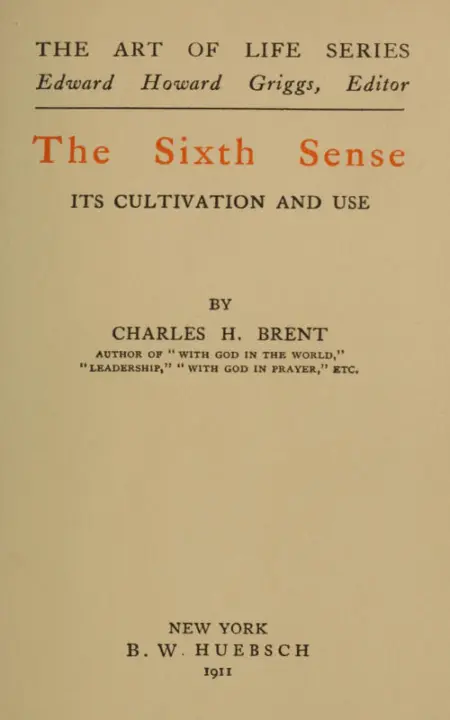
"The Sixth Sense: Its Cultivation and Use" by Charles Henry Brent is a philosophical treatise written in the early 20th century. The book explores the concept of the "Mystic Sense," an inner perceptive faculty that connects humanity with higher spiritual realms and influences various aspects of life, including health, thought, character, and religion. It emphasizes the importance of nurturing this sixth sense in order to reach one's full potential as a human being. At the start of the book, the author introduces the idea of the Mystic Sense as a unique aspect of human perception that transcends the five traditional bodily senses. Brent discusses the evolution of human consciousness and highlights the significance of this mystic faculty in understanding the deeper spiritual essence of reality. He argues that the Mystic Sense allows individuals to engage with the spiritual dimensions of existence, guiding them toward improved health, intellectual growth, moral integrity, and religious faith. This foundational understanding sets the stage for the subsequent chapters, where Brent promises to delve deeper into the applications of this sense across different life areas.
Introduction adapted from the source catalogue; source summaries may be automatically generated.
Free to read · English · 18,727 words · No account needed
MAKE TIME FOR A GOOD BOOK
On by default. Untick to stop anonymous reading totals. Each page counts after 10 seconds in view. How this works.
Anonymous counting is on unless you have switched it off.
This concludes my endeavor to credit the Mystic Sense with that dignity and position of importance which belongs to it by right. The attempt is crude and the brilliant vision which I had at the beginning of my task has become dimmer under the process of putting it into words. Whatever has been written stands as a contribution of thought and experience which cannot be of much value until it has been purified from the dross of individualism through the findings of religion and science, and lost in the great volume of truth to which I submit it with reverence and loyalty.
[1] It is only partially true to say that concept follows upon percept. Their action is simultaneous more nearly than consecutive. Conceptualism as a complete system cannot perhaps stand but in its origin it was a healthy reaction against both nominalism and realism, as well as a mediator combining the good in both.
[2] Heb. xi:1.
[3] VON HÜGEL, The Mystical Element of Religion, vol. ii, p. 264.
[4] Mk. x:23.
[5] Mk. x:24, 25.
[6] Ψυχικὸς δὲ ἄνθρωπος οὐ δέχεται τὰ τοῦ Πνεύματος τοῦ Θεοῦ; μωρία γὰρ αὐτῷ ἐστι, καὶ οὐ δύναται γνῶναι, ὅτι πνευματικῶς ἀνακρίνεται. 1 Cor. ii, 14.
[7] “True priority and superiority lies, not with one of these constituents against the other, but with the total subjective—objective interaction or resultant, which is superior, and indeed gives their place and worth to, those interdependent parts.”—VON HÜGEL’S Mystical Element of Religion, vol. ii, p. 114.
[8] TYRRELL’S Christianity at the Cross Roads, p. 240.
[9] Quoted by VON HÜGEL, vol. ii, p. 18.
[10] CHARLOTTE PERKINS STETSON’S In this our World.
[11] The Mystical Element of Religion, vol. ii, pp. 57, 58.
[12] ROYCE’S The World and the Individual, First Series, p. 58.
[13] See MACFIE’S Science, Matter and Immortality, an admirable volume
on this entire topic.
[14] DARWIN’S Autobiography.
[15] Sir JOSEPH LARMOR in his Wilde Lecture (1908) quoted by Sir OLIVER LODGE in Reason and Belief, p. 172.
[16] Reason and Belief, p. 181.
[17] The Mystical Element of Religion, vol. ii, p. 265.
The author quotes KANT—“we can be mediately conscious of an apprehension as to which we have no distinct consciousness.” “The field of our obscure apprehensions,—that is, apprehensions and impressions of which we are not directly conscious, although we can conclude without doubt that we have them—is immeasureable, whereas clear apprehensions constitute but a very few points within the complete extent of our mental life.”
[18] “Literature consists of those writings which interpret the meanings of nature and life in words of charm and power, touched with the personality of the author, in artistic forms of permanent interest.”—VAN DYKE’S The Spirit of America, p. 242.
Your reading position is saved on this browser. Take it to another device with a library code. Reading pages adapt to text, rather than matching a printed edition.
BEHIND THE BOOK
This eBook is for the use of anyone anywhere in the United States and most other parts of the world at no cost and with almost no restrictions whatsoever. You may copy it, give it away or re-use it under the terms of the Project Gutenberg License included with this eBook or online at www.gutenberg.org. If you are not located in the United States, you will have to check the laws of the country where you are located before using this eBook. Read the source licence.
The original source file, including credits and licence, is retained by this library. Request an original-format copy at no charge. Please include the book title and Project Gutenberg identifier #59091.
KEEP YOUR CURIOSITY GOING

David Patterson (Spirit) Hatch

David Patterson (Spirit) Hatch

David Patterson (Spirit) Hatch
Coulson Kernahan

Ralph Waldo Emerson
Frances Wright