
Madame Gilbert’s Cannibal
Bennet Copplestone
THE CLASSIC COLLECTION · 1918
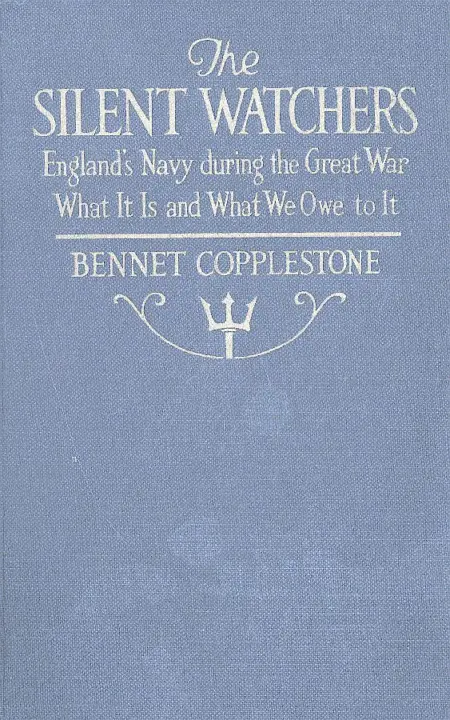
"The Silent Watchers" by Bennet Copplestone is a historical account written in the early 20th century. The book explores the Royal Navy's experiences and contributions during the Great War, emphasizing the concepts of naval tradition, training, and the unique spirit that defines the Navy. It reflects on the individuals within the service, their sacrifices, and the collective strength they possess. The opening of the work introduces readers to the atmosphere among naval officers in June 1916, following the Battle of Jutland, one of the largest naval battles in history. Captured in a candid conversation on a golf course, the officers discuss their experiences during the battle, contrasting the excitement of naval engagement with the monotony encountered during action. They express frustration over public misrepresentation of their victories in the press and discuss the essence of naval discipline, camaraderie, and the importance of capability and valor amongst the crew. The narrative sets a tone that highlights both the challenges faced by the Navy and the intrinsic pride in their service amidst war.
Introduction adapted from the source catalogue; source summaries may be automatically generated.
Free to read · English · 94,912 words · No account needed
MAKE TIME FOR A GOOD BOOK
On by default. Untick to stop anonymous reading totals. Each page counts after 10 seconds in view. How this works.
Anonymous counting is on unless you have switched it off.
The Squadron which had come so far to clean up the mess of Coronel was commanded by Vice-Admiral Sir F. C. Doveton Sturdee, who had been plucked out of his office chair at the Admiralty—he was Director of Naval Intelligence—and thrown up upon the quarter-deck of the Invincible. He was the right man for the job, a cool-headed scientific sailor who would make full use of the power and speed of his big ships and yet run no risk of suffering severe damage thousands of miles away from a repairing base. Those who criticise his leisurely deliberation in the action, and the long-range fighting tactics which dragged out the death agony of the Scharnhorst for three and a half hours and of the Gneisenau for five, forget that to Sturdee an hour or two of time, and a hundred or two rounds of heavy shell, were as nothing when set against the possibility of damage to his battle cruisers. His business was to sink a very capable and well-armed enemy at the minimum of risk to his own ships, and so he determined to fight at a range—on the average about 16,000 yards (9½ land miles)—which made his gunnery rather ineffective and wasteful, yet certain to achieve its purpose in course of time.
Just as von Spee at Coronel, having the advantage of greater speed and greater power, could do what he pleased with the Good Hope and Monmouth, so Sturdee with his battle cruisers could do what he pleased with von Spee. The Invincible and Inflexible could steam at twenty-eight knots—they were clean ships—while the Scharnhorst and the Gneisenau, now five months out of dock, could raise little more than twenty. The superiority of the English battle cruisers in guns was no less than in speed. Each carried eight 12-inch guns, firing a shell of 850 lb., while von Spee’s two armoured cruisers were armed with eight 8.2-inch guns, firing shell of 275 lb. Sturdee, with his great advantage of speed, could set the range outside the effective capacity of von Spee’s guns, secure against anything but an accidental plunging shot upon his decks, while the light German 6-inch armour upon sides and barbettes was little protection against his own 12-inch armour-piercing shell. Sturdee could keep his distance and pound von Spee to bits at leisure. The “visibility” was perfect, space was unlimited, the Germans had no port of refuge, and from dawn to sunset Sturdee had sixteen hours of working daylight. He was in no hurry, though one may doubt if he expected to take so unconscionable a time as three and a half hours to sink the Scharnhorst and five hours to dispose of the Gneisenau. It was not that Sturdee’s gunnery was bad—relatively, that is, to the gunnery of other ships or of other navies. The word bad suggests blame. But it was certainly ineffective. After the Falkland Islands action, and after those running fights in the North Sea between battle cruisers, it became dreadfully clear that naval gunnery is still in its infancy. All the brains and patience and mechanical ingenuity which have been lavished upon the problem of how to shoot accurately from a rapidly moving platform at a rapidly moving object, all the appliances for range-finding and range-keeping and spotting, leave a margin of guesswork in the shooting, which is a good deal bigger than the width of the target fired at. The ease and accuracy of land gunnery in contrast with the supreme difficulty and relative inaccuracy of sea gunnery were brought vividly before me once in conversation with a highly skilled naval gunner. “Take a rook rifle,” said he, “put up a target upon a tree, measure out a distance, sit down, and fire. You will get on to your target after two or three shots and then hit it five times out of six. You will be a land gunner with his fixed guns, his observation posts, his aeroplanes or kite balloons, his maps upon which he can measure up his ranges. Then get into a motor-car with your rook rifle, get a friend to drive you rapidly along a country road, and standing up try what sport you make of hitting the rabbits which are running and jumping about in the fields. That, exaggerated a bit perhaps, is sea gunnery. We know our own speed and our own course, but we don’t know exactly either the enemy’s speed or the enemy’s course; we have to estimate both. As he varies his course and his speed—he does both constantly—he throws out our calculations. It all comes down to range-finding and spotting, trial and error. Can you be surprised that naval gunnery, measured by land standards, is wasteful and ineffective?” “No,” said I, “I am surprised that you ever hit at all.”
Your reading position is saved on this browser. Take it to another device with a library code. Reading pages adapt to text, rather than matching a printed edition.
Bennet Copplestone
Bennet Copplestone
BEHIND THE BOOK
This eBook is for the use of anyone anywhere in the United States and most other parts of the world at no cost and with almost no restrictions whatsoever. You may copy it, give it away or re-use it under the terms of the Project Gutenberg License included with this eBook or online at www.gutenberg.org. If you are not located in the United States, you will have to check the laws of the country where you are located before using this eBook. Read the source licence.
The original source file, including credits and licence, is retained by this library. Request an original-format copy at no charge. Please include the book title and Project Gutenberg identifier #48497.
KEEP YOUR CURIOSITY GOING
Cécile Tormay

Moritz Busch
John L. Ransom
Frances Wright
Cécile Tormay

Mabel Potter Daggett