
Madame Gilbert’s Cannibal
Bennet Copplestone
THE CLASSIC COLLECTION · 1918
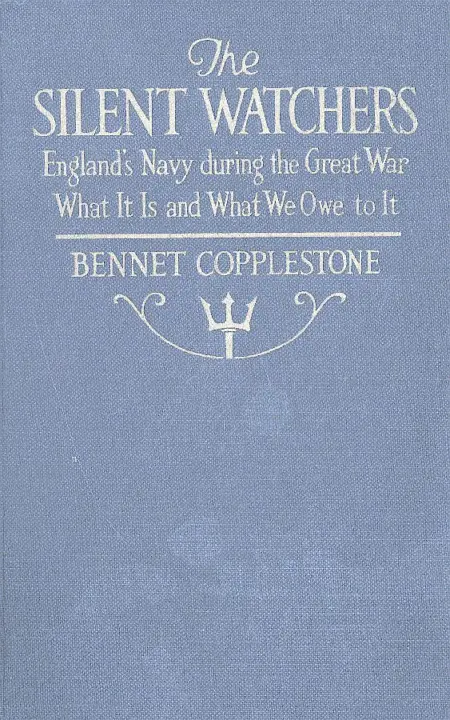
"The Silent Watchers" by Bennet Copplestone is a historical account written in the early 20th century. The book explores the Royal Navy's experiences and contributions during the Great War, emphasizing the concepts of naval tradition, training, and the unique spirit that defines the Navy. It reflects on the individuals within the service, their sacrifices, and the collective strength they possess. The opening of the work introduces readers to the atmosphere among naval officers in June 1916, following the Battle of Jutland, one of the largest naval battles in history. Captured in a candid conversation on a golf course, the officers discuss their experiences during the battle, contrasting the excitement of naval engagement with the monotony encountered during action. They express frustration over public misrepresentation of their victories in the press and discuss the essence of naval discipline, camaraderie, and the importance of capability and valor amongst the crew. The narrative sets a tone that highlights both the challenges faced by the Navy and the intrinsic pride in their service amidst war.
Introduction adapted from the source catalogue; source summaries may be automatically generated.
Free to read · English · 94,912 words · No account needed
MAKE TIME FOR A GOOD BOOK
On by default. Untick to stop anonymous reading totals. Each page counts after 10 seconds in view. How this works.
Anonymous counting is on unless you have switched it off.
On October 31st the Glasgow entered the harbour of Coronel, a large harbour to which there are two entrances, and a rendezvous off the port had been arranged with the rest of the squadron for November 1st. Her arrival was at once notified to von Spee at Valparaiso. The mails and telegrams were collected, and at 9.15 on the 1st the Glasgow backed out cautiously, ready, if the Germans were in force outside, to slip back again into neutral waters and to take the fullest advantage of her twenty-four hours’ law. She emerged seeing nothing, though the enemy wireless was coming loudly, and met the Good Hope, Monmouth, and Otranto at the appointed rendezvous some eighty miles out to sea. Here the mails and telegrams were transferred to Cradock by putting them in a cask and towing it across the Good Hope’s bows. The sea was rough, and this resourceful method was much quicker and less dangerous than the orthodox use of a boat. Cradock spread out his four ships, fifteen miles apart, and steamed to the north-west at ten knots. Smoke became visible to the Glasgow at 4.20 p.m., and as she increased speed to investigate, there appeared two four-funnelled armoured cruisers and one light cruiser with three funnels. Those four-funnelled ships were the Scharnhorst and Gneisenau, and until they were seen at that moment by the Glasgow they were not positively known to have been on the Chilean coast. To this extent the German Admiral had taken his English opponents by surprise. “When we saw those damned four funnels,” said the officers of the Glasgow, “we knew that there was the devil to pay.”
I have already told the story of the Coronel action and I will not tell it again. Von Spee held off so long as the sun behind the English gave them the advantage of light, and did not close in until the sun had set and the yellow afterglow made his opponents stand out like silhouettes. He could see them while they could not see him. During the action, the light cruiser Glasgow, with which I am mainly concerned, had a very unhappy time. The armed liner Otranto cleared off, quite properly, and the Glasgow, third in the line, was exposed for more than an hour to the concentrated fire of the 4.1-inch guns of both the Leipzig and Dresden, and afterwards, when the Good Hope had blown up and the Monmouth been disabled, for about a quarter of an hour to the 8.2-inch guns of the Gneisenau. Her gunnery officers could not see the splashes of their own shells, and could not correct the ranges. When darkness came down it was useless to continue firing blindly, and worse than useless, since her gun flashes gave some guidance to the enemy’s gunners. At the range of about 11,000 yards, a long range for the German 4.1-inch guns, the shells were falling all around very steeply, the surface of the sea was churned into foam, and splinters from bursting shells rained over her. It is a wonderful thing that she suffered so little damage and that not a single man of her company was killed or severely wounded. Four slight wounds from splinters constituted her total tally of casualties. At least 600 shells, great and small, were fired at her, yet she was hit five times only. The most serious damage done was a big hole between wind and water on the port quarter near one of the screws. Yet even this hole did not prevent her from steaming away at twenty-four knots, and from covering several thousand miles before she was properly repaired. I think that the Glasgow must be a lucky ship. After the Good Hope had blown up and the Monmouth, badly hurt, was down by the bows and turning her stern to the seas, the Glasgow hung upon her consort’s port quarter, anxious to give help and deeply reluctant to leave. Yet she could do nothing. The Monmouth was clearly doomed, and it was urgent that the Glasgow should get away to warn the Canopus, then 150 miles away and pressing towards the scene of action, and to report the tragedy and the German concentration to the Admiralty at home. During that anxious waiting time, when the enemy’s shells were still falling thickly about her, the sea, to the Glasgow’s company, looked very, very cold! At last, when the moon was coming up brightly, and further delay might have made escape impossible, the Glasgow sorrowfully turned to the west, towards the wide Pacific spaces, and dashed off at full speed. It was not until half an hour later, when she was twelve miles distant, that she counted the seventy-five flashes of the Nürnberg’s guns which finally destroyed the Monmouth. I am afraid that the story of the cheers from the Monmouth which sped the Glasgow upon her way must be dismissed as a pretty legend. No one in the Glasgow heard them, and no one from the Monmouth survived to tell the tale. Captain Grant and his men of the Canopus must have suffered agonies when they received the Glasgow’s brief message. They had done their utmost to keep up with the Good Hope, and the slowness of their ship had been no fault of theirs. Grant had, I have been told, implored the Admiral to wait for him before risking an engagement.
Your reading position is saved on this browser. Take it to another device with a library code. Reading pages adapt to text, rather than matching a printed edition.
Bennet Copplestone
Bennet Copplestone
BEHIND THE BOOK
This eBook is for the use of anyone anywhere in the United States and most other parts of the world at no cost and with almost no restrictions whatsoever. You may copy it, give it away or re-use it under the terms of the Project Gutenberg License included with this eBook or online at www.gutenberg.org. If you are not located in the United States, you will have to check the laws of the country where you are located before using this eBook. Read the source licence.
The original source file, including credits and licence, is retained by this library. Request an original-format copy at no charge. Please include the book title and Project Gutenberg identifier #48497.
KEEP YOUR CURIOSITY GOING
Cécile Tormay

Moritz Busch
John L. Ransom
Frances Wright
Cécile Tormay

Mabel Potter Daggett