THE CLASSIC COLLECTION✦The Disappearing EyeCLASSIC FREE BOOKS
The Disappearing Eye
Fergus Hume
THE CLASSIC COLLECTION · 1907
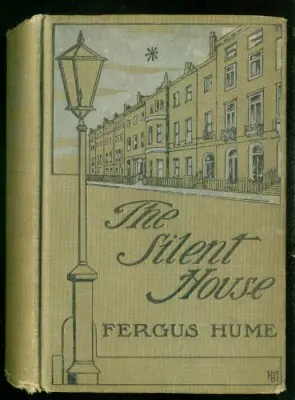
"The Silent House" by Fergus Hume is a mystery novel written in the early 20th century. The narrative revolves around Lucian Denzil, a young barrister who becomes intrigued by the peculiar tenant of a seemingly haunted and abandoned house, known as No. 13, or the Silent House, following a string of mysterious events and a murder. The story combines elements of suspense and intrigue, as Denzil seeks to unravel the enigma surrounding the reclusive Mr. Berwin and the sinister happenings linked to his life. The opening of this narrative sets the stage by introducing Lucian Denzil, who leads a modest life amidst the bustling backdrop of London. On a foggy night, he has a chance encounter with Mr. Berwin, the enigmatic occupant of the Silent House, who reveals a sense of despair and pain. Denzil's curiosity piqued, he learns more about Berwin's lonely existence and the ghostly aura surrounding his abode. As gossip and speculation circulate within the neighborhood, an unsettling incident occurs when Denzil perceives shadows in Berwin's window, suggesting that more is at play than meets the eye. With a determined sense of justice and inquiry, Denzil soon finds himself embroiled in a mystery that delves deep into the darker aspects of human nature.
Introduction adapted from the source catalogue; source summaries may be automatically generated.
Free to read · English · 72,784 words · No account needed
MAKE TIME FOR A GOOD BOOK
On by default. Untick to stop anonymous reading totals. Each page counts after 10 seconds in view. How this works.
Anonymous counting is on unless you have switched it off.
But even after Lucian had been at the manor a fortnight, and daily in the society of Diana, he spoke no word of love. Seeing how beautiful she was, and how dowered with lands and rents and horses, he began to ask himself whether it was not rather a presumption on his part to ask her to share his life. He had only three hundred a year--six pounds a week--and a profession in which, as yet, he had not succeeded; so he could offer her very little in exchange for her beauty, wealth, and position.
The poor lover became quite pale with fruitless longing, and his spirits fell so low that good Miss Priscilla one day drew him aside to ask about his health.
"For," said she, "if you are ill in body, Mr. Denzil, I know of some remedies--old woman's medicines you will call them, no doubt--which, with the blessing of God, may do you good."
"Thank you, Miss Barbar, but I am not ill in body--worse luck!" and
Lucian sighed.
"Why worse luck, Mr. Denzil?" said the old lady severely. "That is an ungrateful speech to Providence."
"I would rather be ill in body than ill in mind," explained Denzil, blushing, for in some ways he was younger than his years.
"And are you ill in mind?" asked Miss Priscilla, with a twinkle in her
eyes.
"Alas! yes. Can you cure me?"
"No. For that cure I shall hand you over to Diana."
"Miss Priscilla!" And Lucian coloured again, this time with vexation.
"Oh, Mr. Denzil," laughed the governess, "because I am old you must not imagine that I am blind. I see that you love Diana."
"Better than my life!" cried the devoted lover with much fervour.
"Of course! That is the usual romantic answer to make. Well, why do you not tell Diana so, with any pretty additions your fancy suggests?"
"She might not listen to me," said this doubting lover dolefully.
"Very true," replied his consoler. "On the other hand, she might. Besides, Mr. Denzil, however much the world may have altered since my youth, I have yet to learn that it is the lady's part to propose to the gentleman."
"But, Miss Barbar, I am poor!"
"What of that? Diana is rich."
"Don't I know it? For that very reason I hesitate to ask her."
"Because you are afraid of being called a fortune-hunter, I suppose," said the old lady drily. "That shows a lack of moral courage which is not worthy of you, Mr. Denzil. Take an old woman's advice, young man, and put your fortunes to the test. Remember Montrose's advice in the song."
Your reading position is saved on this browser. Take it to another device with a library code. Reading pages adapt to text, rather than matching a printed edition.
Fergus Hume

Fergus Hume

Fergus Hume
Fergus Hume
BEHIND THE BOOK
This eBook is for the use of anyone anywhere in the United States and most other parts of the world at no cost and with almost no restrictions whatsoever. You may copy it, give it away or re-use it under the terms of the Project Gutenberg License included with this eBook or online at www.gutenberg.org. If you are not located in the United States, you will have to check the laws of the country where you are located before using this eBook. Read the source licence.
The original source file, including credits and licence, is retained by this library. Request an original-format copy at no charge. Please include the book title and Project Gutenberg identifier #19069.
KEEP YOUR CURIOSITY GOING
Coulson Kernahan

Maurice Baring
Frances Wright
Cécile Tormay

Frederic Jesup Stimson

W. H. P. (William Henry Pope) Jarvis