THE CLASSIC COLLECTION✦The WesternersCLASSIC FREE BOOKS
The Westerners
Stewart Edward White
THE CLASSIC COLLECTION · 1912
"The Sign at Six" by Stewart Edward White is a novel likely written in the early 20th century. The book revolves around the main character, Percy Darrow, a young scientist with a past filled with danger, as he navigates a mysterious and seemingly supernatural series of events in New York City. After a peculiar blackout of electricity and sound envelops the city, Darrow finds himself embroiled in a tangled web of intrigue and potential threats that seem connected to a notorious political figure named McCarthy. At the start of the narrative, Percy Darrow is introduced as he interacts with McCarthy, who is agitated over a mysterious message that threatens his position. The opening sets the stage for a significant upheaval in the city, highlighting Darrow's calm demeanor amidst chaos. As the story unfolds, citizens face an eerie silence and electrical failures, hinting at a greater, unseen power at play. This scenario not only breaths tension into the plot but piques Darrow's curiosity, who is determined to uncover the reality behind these unsettling occurrences. The interplay of science, mystery, and human conflict creates a compelling narrative that invites readers to explore the intrigue that "The Sign at Six" promises.
Introduction adapted from the source catalogue; source summaries may be automatically generated.
Free to read · English · 35,881 words · No account needed
MAKE TIME FOR A GOOD BOOK
On by default. Untick to stop anonymous reading totals. Each page counts after 10 seconds in view. How this works.
Anonymous counting is on unless you have switched it off.
"How's that, Professor?" asked the Morning Register man. "It doesn't get
to me."
"He is evidently a man not only of scientific attainments, but of immense scientific possessions--as is evidenced by these phenomenal results he is able to accomplish. But we are not justified in reasoning according to the doctrine of probabilities. Therefore, we shall proceed methodically. I have already made my preparations."
Eldridge looked about him with an air of triumph.
"I am fortunate enough to have, in the present crisis, unlimited financial backing," he said. "Therefore, I am in a position to carry out the most exhaustive of experiments."
He stretched his hand out for a long roll, which he laid flat upon the table, pinning down the corners.
"Here is a map of the Eastern States," said he. "I have drawn a circle on it with a two-hundred-miles radius. At this moment a private instrument with a full crew to string sending and receiving wires is two hundred miles from here on the New York Central Railroad. It has for its transportation a private train, and it will be given a clear right of way." He turned to Simmons. "Have you found yourself able to communicate with this Monsieur X at any time?"
"Communicate!" echoed Simmons. "Why, he's easier to talk to than a girl who wants an ice-cream soda!"
"Then send this: 'Your messages have been communicated to the people. Be
patient.'"
Simmons touched the key. The spark leaped crashing.
"What do you get?" asked Eldridge, after a moment.
"Oh, a lot of the same sort of dope," answered Simmons wearily. "Do you
want it?"
"No, it is not necessary," replied Eldridge. "But listen for another message from about the same distance when he has finished."
Silence fell on the room. At the end of ten minutes Simmons raised his
head.
"I get 'O K Q' over and over," said he. "Want that?"
"That," replied Eldridge with satisfaction, "indicates that my crew on the special train in the Adirondacks two hundred miles away has heard your message to Monsieur X." He glanced at his watch. "Now, if you would be so good as to afford me a moment's assistance," he requested Simmons, "I wish to disconnect from your battery one of your powerful Leyden jars, and to substitute for it one of weaker voltage. I ventured to instruct my delivery man to leave a few in the outer hall."
"That will weaken the sending power of my instrument," objected Simmons.
"Exactly what I wish to do," replied Eldridge.
"He's clever all right," Darrow murmured admiringly to Jack. "See what
he's up to?"
"Not yet," muttered Jack.
The substitution completed, Eldridge again glanced at his watch.
Your reading position is saved on this browser. Take it to another device with a library code. Reading pages adapt to text, rather than matching a printed edition.
Stewart Edward White
Stewart Edward White
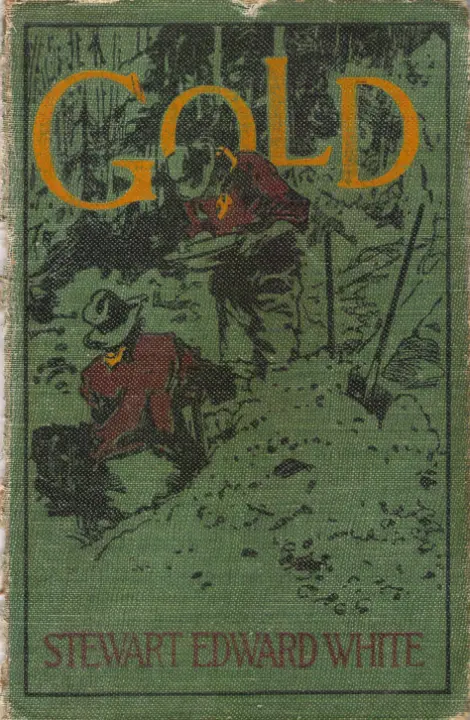
Stewart Edward White
Stewart Edward White
BEHIND THE BOOK
This eBook is for the use of anyone anywhere in the United States and most other parts of the world at no cost and with almost no restrictions whatsoever. You may copy it, give it away or re-use it under the terms of the Project Gutenberg License included with this eBook or online at www.gutenberg.org. If you are not located in the United States, you will have to check the laws of the country where you are located before using this eBook. Read the source licence.
The original source file, including credits and licence, is retained by this library. Request an original-format copy at no charge. Please include the book title and Project Gutenberg identifier #8398.
KEEP YOUR CURIOSITY GOING
Coulson Kernahan

Maurice Baring
Frances Wright
Cécile Tormay

Frederic Jesup Stimson

W. H. P. (William Henry Pope) Jarvis