THE CLASSIC COLLECTION✦The WesternersCLASSIC FREE BOOKS
The Westerners
Stewart Edward White
THE CLASSIC COLLECTION · 1912
"The Sign at Six" by Stewart Edward White is a novel likely written in the early 20th century. The book revolves around the main character, Percy Darrow, a young scientist with a past filled with danger, as he navigates a mysterious and seemingly supernatural series of events in New York City. After a peculiar blackout of electricity and sound envelops the city, Darrow finds himself embroiled in a tangled web of intrigue and potential threats that seem connected to a notorious political figure named McCarthy. At the start of the narrative, Percy Darrow is introduced as he interacts with McCarthy, who is agitated over a mysterious message that threatens his position. The opening sets the stage for a significant upheaval in the city, highlighting Darrow's calm demeanor amidst chaos. As the story unfolds, citizens face an eerie silence and electrical failures, hinting at a greater, unseen power at play. This scenario not only breaths tension into the plot but piques Darrow's curiosity, who is determined to uncover the reality behind these unsettling occurrences. The interplay of science, mystery, and human conflict creates a compelling narrative that invites readers to explore the intrigue that "The Sign at Six" promises.
Introduction adapted from the source catalogue; source summaries may be automatically generated.
Free to read · English · 35,881 words · No account needed
MAKE TIME FOR A GOOD BOOK
On by default. Untick to stop anonymous reading totals. Each page counts after 10 seconds in view. How this works.
Anonymous counting is on unless you have switched it off.
"Father and McCarthy are enemies," she said simply. She arose with an air of weariness. "How dark it's getting!" she said, and pressed the electric button in the wall.
The light did not respond.
"That's queer," she remarked, and pulled the chain that controlled the reading light on the table. That, too, failed to illuminate. "Something must be wrong with those things at the meter--what do you call them?"
"Fuses," suggested Darrow.
"Yes, that's it. I'll ring and have Blake screw in another."
Darrow was staring at a small object he had taken from his pocket. It was the electric flash-light he habitually carried to light his way up the three dark flights at his lodgings.
"Let me call him for you," he suggested, rising.
"I'll ring," said Helen.
But Darrow was already in the hall.
"Blake!" he called down the basement stairway. "Bring lamps--or candles."
The man appeared on the word, carrying a lamp.
"I already had this, sir," he explained. "The lights went out some time
ago."
"Did you look at the--fuses?" asked Helen.
"Yes, miss."
"Well, telephone to the electric company at once. We must have light."
Percy Darrow had taken his place again in the armchair by the fire.
"It is useless," said he, quietly.
"Useless!" echoed Helen. "What do you mean?" Blake stood quietly at
attention.
"You will find your telephone also out of order."
Helen darted from the room, only to return after a moment, laughing.
"You are a true wizard," she said. "Tell me, how did you know? What has
happened?"
"A city," stated Percy didactically, "is like a mollusk; it depends largely for its life and health on the artificial shell it has constructed. Unless I am very much mistaken, this particular mollusk is going to get a chance to try life without its shell."
"I don't understand you," said Helen.
"You will," said Percy Darrow.
Mr. and Mrs. Warford descended soon after. They sat down to dinner by the light of the table candles only. Darrow hardly joined at all in the talk, but sat lost in a brown study, from which he only roused sufficiently to accept or refuse the dishes offered him. At about eight o'clock the telephone bell clicked a single stroke, as though the circuit had been closed. At the sound Darrow started, then reached swiftly into his pocket for his little flash-light. He gravely pressed the button of this; then abruptly rose.
"I must use your telephone," said he, without apology.
He was gone barely a minute; then returned to the table with a clouded brow. Almost immediately after the company had arisen from the board, he excused himself and left.
Your reading position is saved on this browser. Take it to another device with a library code. Reading pages adapt to text, rather than matching a printed edition.
Stewart Edward White
Stewart Edward White
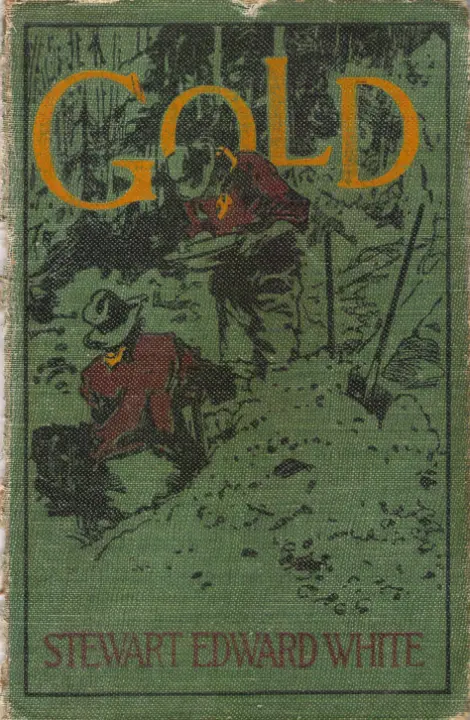
Stewart Edward White
Stewart Edward White
BEHIND THE BOOK
This eBook is for the use of anyone anywhere in the United States and most other parts of the world at no cost and with almost no restrictions whatsoever. You may copy it, give it away or re-use it under the terms of the Project Gutenberg License included with this eBook or online at www.gutenberg.org. If you are not located in the United States, you will have to check the laws of the country where you are located before using this eBook. Read the source licence.
The original source file, including credits and licence, is retained by this library. Request an original-format copy at no charge. Please include the book title and Project Gutenberg identifier #8398.
KEEP YOUR CURIOSITY GOING
Coulson Kernahan

Maurice Baring
Frances Wright
Cécile Tormay

Frederic Jesup Stimson

W. H. P. (William Henry Pope) Jarvis