THE CLASSIC COLLECTION✦My diaries, being a personal narrative of events 1888-1914, Part 2 (1900-1914)CLASSIC FREE BOOKS
My diaries, being a personal narrative of events 1888-1914, Part 2 (1900-1914)
Wilfrid Scawen Blunt
THE CLASSIC COLLECTION · 1864
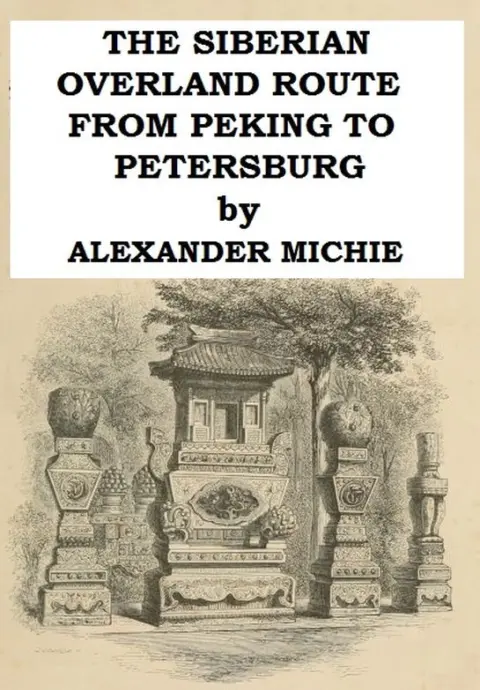
"The Siberian Overland Route from Peking to Petersburg" by Alexander Michie is a historical account written in the mid-19th century. This work presents a firsthand narrative of the author's journey from China to Russia through Mongolia and Siberia, detailing the landscapes, cultures, and experiences encountered along the way. The book aims to shed light on a route that had been largely unexplored and, as suggested in the preface, aims to provide new insights into the regions traversed. The opening of the book introduces Michie's motivation for embarking on this journey, inspired by previous travelers and the desire to experience the mysteries of less-known regions. He contrasts the difficulties and discomforts of the journey by sea with the allure of the northern route through challenging climates and unfamiliar landscapes. Michie describes the societal changes occurring in China at the time, particularly concerning foreign access and the restrictions imposed by the local government, while setting the stage for his travel experiences that follow. The narrative is filled with observations on the geography, local customs, and the dynamics of foreign and native interactions, effectively drawing the reader into the journey's historical context.
Introduction adapted from the source catalogue; source summaries may be automatically generated.
Free to read · English · 132,367 words · No account needed
MAKE TIME FOR A GOOD BOOK
On by default. Untick to stop anonymous reading totals. Each page counts after 10 seconds in view. How this works.
Anonymous counting is on unless you have switched it off.
Having made all necessary arrangements for resuming our journey, and armed ourselves with a pass from the Director-General of Posts for Western Siberia, we started on the 5th November in a post kibitka, with the intention of buying a sledge when we found an opportunity, and snow enough to use it. It was late in the afternoon before we got away from Tomsk, and dark before we emerged from the thick wood into which we plunged on leaving the town. The post-station had been at a village eighteen versts from Tomsk, but on arriving there we learned that it had been removed that very day to a place more convenient for crossing the river Tom, or on the other side of the Tom, for it was hard to deduce any positive conclusion from the various and partially contradictory statements we heard. At all events, be the new station where it might, our yemschiks refused to drive us any further than the old station in the village. To be cast adrift with our baggage in a village where no accredited officer of the government was located, would have consigned us to unknown troubles. We refused, therefore, to let the yemschiks go, but insisted on their proceeding to the next station, wherever it might be. The assistance of the starust, or village elder, was invoked, and he, with a few peasants, piloted us at our request to the river Tom, that we might examine for ourselves the state of the crossing. The ice was good, and apparently strong enough to bear the carriages, but the yemschiks lapsed into a state of mulish obstinacy, and refused to stir. The starust and his satellites, all speaking at once, held forth vigorously on general topics for the edification of the company, and went to bed. As for us, we had simply to keep possession of the carriages, and leave the rest to time. The yemschiks would get hungry, the horses would certainly have to be fed, and we might hope that when they got tired of waiting they would go on. With this idea we committed ourselves to rest in the kibitka. It was sadly deficient in comfort, as compared with our old tarantass. The kibitka is open in front, and rather over-ventilated everywhere. Cold kept sleep from our eyes for a time, while our ears were regaled with spasmodic bursts of indignation from the yemschiks, who now threatened to take us back to Tomsk, bag and baggage. To these attacks we offered nothing but passive resistance, and even the yemschiks wearied of a discussion so entirely one-sided. We were lulled to sleep in time by the chanting of some wild native airs by a Russian family in a neighbouring house. Their songs, many of them very sweet, are mostly, if not all, of the plaintive order. A drunken "brute of a husband," whom his poor wife was trying to decoy homewards, was the only incident that broke in upon the dead stillness of the night scene in the village of Kaltarskaya. There stood our wearied horses in the street that livelong night, bearing their sufferings from cold and hunger with resignation. How the yemschiks bestowed themselves during the night I know not. One at least must have kept awake to watch the horses. As morning approached the cold proved too much for my somnolence, and I was fain to turn out and grope my way into the house that had until the previous day been the post-station. On getting the door of a room open, the warm, fulsome exhalations of closely pent-up human beings that greeted the nostrils were enough to have produced a revolution in a sensitive stomach. The hard breathing of some, and the more sonorous articulations of others, enabled me to ascertain the positions of the heads of most of the sleepers, but still with every care I came into collision with sundry legs and trunks in my voyage across the floor in quest of a clear space where I might stretch myself. At length I discovered an unoccupied bench or table, and yielded to the luxury of sleep till daylight. When I again opened my eyes, my night companions had begun to stir about. Some were engaged in their toilet, which consists in stretching legs and arms, yawning a little, shaking up their clothes, and tightening the scarf which forms their girdle. By stooping low on entering the room I had escaped a broken head from a false ceiling which was used as a sleeping bunk. This is a common arrangement in post-houses, where the family of the post-master and all the yemschiks and hangers-on of the establishment are often jumbled up together, some climbing up to the top of the brick stove to sleep, and others lying on the boarded floor or ceiling which overhangs part of the room like a hay-loft. The Russian houses generally are built on traditional principles, the first thing aimed at being the exclusion of air, and consequently cold. They always feel warm, the temperature during the day being kept up to a pretty uniform scale by the large stoves. At night the fires go out, but the house retains its heat until about daylight in the morning, when it begins to feel a little chilly. There is scarcely one perfectly level floor in the country, and many of the houses, especially the old ones, are tipped up at one end so that the line of the roof makes a very wide angle with the level ground. Some indeed tumble over altogether, where the owners are too poor or too indifferent to take them down before they progress so far towards demolition. This phenomenon is not caused by the sinking of one end from the timbers rotting in the ground, but by the action of frost in the earth, which, unless the uprights are sunk deep enough, expands with cold so much as to heave up the foundations of the houses.
Your reading position is saved on this browser. Take it to another device with a library code. Reading pages adapt to text, rather than matching a printed edition.
BEHIND THE BOOK
This eBook is for the use of anyone anywhere in the United States and most other parts of the world at no cost and with almost no restrictions whatsoever. You may copy it, give it away or re-use it under the terms of the Project Gutenberg License included with this eBook or online at www.gutenberg.org. If you are not located in the United States, you will have to check the laws of the country where you are located before using this eBook. Read the source licence.
The original source file, including credits and licence, is retained by this library. Request an original-format copy at no charge. Please include the book title and Project Gutenberg identifier #45167.
KEEP YOUR CURIOSITY GOING
Wilfrid Scawen Blunt
Wilfrid Scawen Blunt

E. W. (Edgar Watson) Howe
Cécile Tormay

Moritz Busch
John L. Ransom