THE CLASSIC COLLECTION✦My diaries, being a personal narrative of events 1888-1914, Part 2 (1900-1914)CLASSIC FREE BOOKS
My diaries, being a personal narrative of events 1888-1914, Part 2 (1900-1914)
Wilfrid Scawen Blunt
THE CLASSIC COLLECTION · 1864
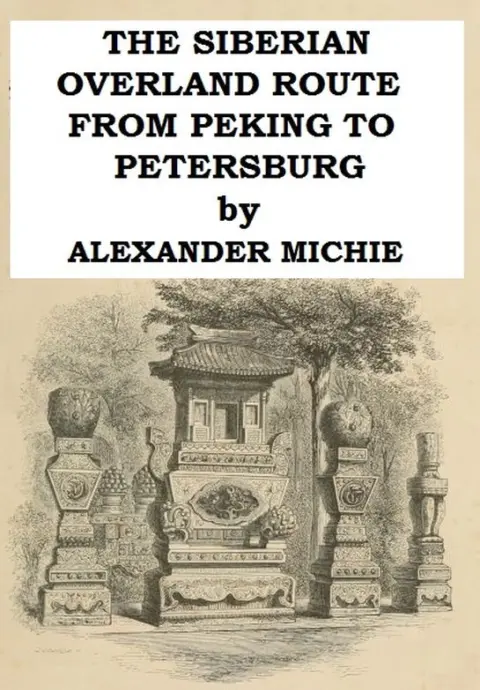
"The Siberian Overland Route from Peking to Petersburg" by Alexander Michie is a historical account written in the mid-19th century. This work presents a firsthand narrative of the author's journey from China to Russia through Mongolia and Siberia, detailing the landscapes, cultures, and experiences encountered along the way. The book aims to shed light on a route that had been largely unexplored and, as suggested in the preface, aims to provide new insights into the regions traversed. The opening of the book introduces Michie's motivation for embarking on this journey, inspired by previous travelers and the desire to experience the mysteries of less-known regions. He contrasts the difficulties and discomforts of the journey by sea with the allure of the northern route through challenging climates and unfamiliar landscapes. Michie describes the societal changes occurring in China at the time, particularly concerning foreign access and the restrictions imposed by the local government, while setting the stage for his travel experiences that follow. The narrative is filled with observations on the geography, local customs, and the dynamics of foreign and native interactions, effectively drawing the reader into the journey's historical context.
Introduction adapted from the source catalogue; source summaries may be automatically generated.
Free to read · English · 132,367 words · No account needed
MAKE TIME FOR A GOOD BOOK
On by default. Untick to stop anonymous reading totals. Each page counts after 10 seconds in view. How this works.
Anonymous counting is on unless you have switched it off.
The Chinese of Maimachin are likewise reputed wealthy, and no doubt they are, to judge by their portly figures. This is considered a sure sign of prosperity in China, where rolling in wealth, and rolling in fat, are often considered synonymous terms. I have, however, known the criterion prove frequently fallacious. The Chinese merchants of Maimachin live there without their families, and consider themselves as mere sojourners, although many of them spend the best part of their lives there. They have an unconquerable aversion to moving their families from the spot where they and their fathers were born; and even within the bounds of their own country they rarely migrate for good from one district to another, unless driven to such a step by some potent cause, such as a visitation from the "rebels."
The Russians and Chinese are peculiarly suited to each other in the commercial, as well as in the diplomatic departments. They have an equal regard for truth, for the Russian, spite of his fair complexion, is at the bottom more than half Asiatic. There is nothing original about this observation, but it serves to explain how it is that the Russians have won their way into China by quiet and peaceable means, while we have always been running our head against a stone wall, and never could get over it without breaking it down. The Russian meets the Chinese as Greek meets Greek: craft is encountered with craft, politeness with politeness, and patience with patience. They understand each other's character thoroughly, because they are so closely alike. If some matter has to be negotiated, it is quite understood that each begins as far from the subject as possible: much conversation takes place on both sides; many pipes are smoked, and many cups of tea sipped, while they are beating about the bush. They receive each other's statements for what they are worth, that is, not as being intended to convey any definite signification, but as merely put in for the purpose of concealing their real purpose and to smooth the way to the object in view. Of course much valuable time is lost by this circumlocution, but it is a matter of apparent indifference to either party whether the negotiation is concluded in one day, or three days, or three weeks. They prefer their own way of dealing, and don't understand any other. When either Russian or Chinese meets a European, say an Englishman, he instinctively recoils from the blunt, straightforward, up-and-down manner of coming to business at once; and the Asiatic either declines a contest which he cannot fight with his own weapons, or, seizing the weak point of his antagonist, he angles with him until he wearies him into acquiescence. As a rule, the Asiatic has the advantage. His patient equanimity, and heedlessness of the waste of time, are too much for the impetuous haste of the European. This characteristic of the Russian trading classes has enabled them to insinuate themselves into the confidence of the Chinese; to fraternise and identify themselves with them, and as it were make common cause with them in their daily life; while the European holds himself aloof, and only comes in contact with the Chinese when business requires it,--for all the rest, a great gulf separates them in thoughts, ideas, and the aims of life. The Russians and Chinese are equally low in their tastes; intellectual and manly recreations are equally foreign to them, while eating and drinking, play-going and gambling, are the congenial amusements of both alike. I have been told that the Russian merchants of Kiachta, when they wish to treat each other to something worthy of a highly cultivated mind, order a Chinese dinner in Maimachin, a feast that most Europeans would rather undergo the incipient stages of starvation than come within the smell of. But in this and other things the Russians pay tribute to the superior civilisation of the Chinese, all the more genuine that it is unconsciously done. That the Chinese are the more civilised of the two, I am thoroughly convinced. Their notions of civilisation certainly run in a different groove from those of Christian nations, but it is a spontaneous growth, and genuine of its kind. But the Russians, after all that they have borrowed from their western neighbours, remain barbarians at bottom; and their living in large houses, and drinking expensive wines, serve merely to exhibit, in more striking colours, the native barbarism of the stock on which these twigs of a higher order of life have been engrafted. This does not, of course, apply to the educated gentlemen of Russia, the nous autres, who constitute a higher caste, and who have been largely leavened with foreign blood, but only to the middle and lower ranks. There is no middle class in Russia, as we understand the term, but there is a pretty large number of merchants who have risen from the condition of serfs, many of them very rich, and who must be taken to represent the middle class, but between whom and the gentlemen in uniform there is as impassable a barrier as between a merchant in Japan and a daimio. The Chinese far outstrip the Russians as a nation of shopkeepers, and in commercial matters generally have more enlarged and liberal ideas. Much of this is due to the non-interference of Government with trade. The restrictions of shops to one locality in Russian towns has its advantages and disadvantages; but the licence fees required for admission to the guilds, and for permission to open a shop in the bazaar, are so onerous as to exclude that class of small shopkeepers who are the life and soul of Chinese cities.
Your reading position is saved on this browser. Take it to another device with a library code. Reading pages adapt to text, rather than matching a printed edition.
BEHIND THE BOOK
This eBook is for the use of anyone anywhere in the United States and most other parts of the world at no cost and with almost no restrictions whatsoever. You may copy it, give it away or re-use it under the terms of the Project Gutenberg License included with this eBook or online at www.gutenberg.org. If you are not located in the United States, you will have to check the laws of the country where you are located before using this eBook. Read the source licence.
The original source file, including credits and licence, is retained by this library. Request an original-format copy at no charge. Please include the book title and Project Gutenberg identifier #45167.
KEEP YOUR CURIOSITY GOING
Wilfrid Scawen Blunt
Wilfrid Scawen Blunt

E. W. (Edgar Watson) Howe
Cécile Tormay

Moritz Busch
John L. Ransom