
The Sheepfold and the Common; Or, Within and Without. Vol. 2 (of 2)
Timothy East
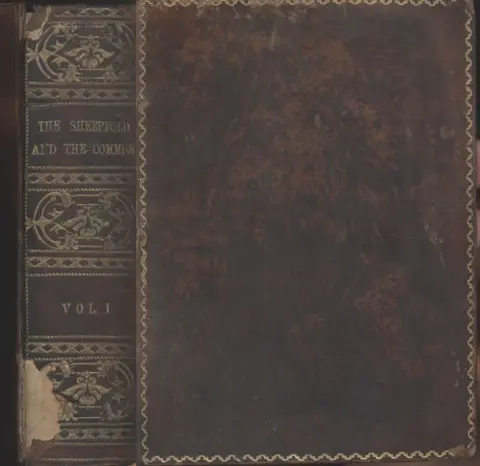
THE CLASSIC COLLECTION · 1859
"The Sheepfold and the Common; Or, Within and Without. Vol. 1 (of 2)" by Timothy East is a religious narrative written in the mid-19th century. This work aims to convey grand truths of the Christian faith through engaging stories derived from everyday life. It particularly focuses on moral and spiritual lessons, often through the lives of its characters, such as George Lewellin, whose journey captures the essence of repentance and redemption. At the start of the work, the narrator encounters a lonely widow and her son, George, during a visit to a beautiful village in England. The widow shares her struggles and faith despite significant losses, and George is portrayed with potential, yet he faces temptations that threaten his well-being. The text delves into the themes of sin, redemption, and the transformative power of grace through George's experiences, setting the stage for his internal battles and the hope for his spiritual awakening. The opening portion establishes a foundation of human struggles entwined with divine truth, captivating readers with the emotional depth and moral dilemmas faced by the characters.
Introduction adapted from the source catalogue; source summaries may be automatically generated.
Free to read · English · 219,665 words · No account needed
MAKE TIME FOR A GOOD BOOK
On by default. Untick to stop anonymous reading totals. Each page counts after 10 seconds in view. How this works.
Anonymous counting is on unless you have switched it off.
Mr. Roscoe.--"Why, in despair. You say he needs a moral change to fit him for heaven; but as that change cannot be produced without baptism--and he has undergone the ceremony, which cannot be repeated--you place him under the ban of reprobation, unless you adopt the only alternative which remains for you, that of admitting him to heaven in his depraved state. Mr. Cole, in his sermon, was very severe on the evangelical clergy for two things; he asserted that, by their awful strain of preaching, they generally destroy the peace of society; and by holding out the hope of salvation to the most guilty, they destroy its virtue. These were certainly heavy charges; but do you not perceive that they are charges which may be brought with strict logical accuracy against the advocates of baptismal regeneration? For, if they follow out their doctrine to its legitimate consequences, they are compelled either to admit a man into heaven in an unregenerated state, who by a relapse into sin forfeits his baptismal rights, or, after his forfeiture, to tell him that he cannot be regenerated, by which he is systematically and inevitably consigned over to despair."
Rev. Mr. Roscoe.--"Well, I confess that the doctrine appears involved in more oppressive difficulties than I ever conceived; and yet, from the quotations which Mr. Cole gave us on Sunday from the Fathers, it appears to have been a doctrine which was received into the church very early and very generally."
Mr. Roscoe.--"Yes, to quote the language of an eloquent writer, 'it is well known that, from a very early period, the most extravagant notions prevailed in the church with respect to the efficacy of baptism, and its absolute necessity in order to attain salvation. The descent of the human mind from the spirit to the letter--from what is vital and intellectual to what is ritual and external in religion--is the true source of idolatry and superstition in all the multifarious forms they have assumed; and as it began early to corrupt the patriarchal religion, so it soon obscured the lustre and destroyed the simplicity of the Christian institute. In proportion as genuine devotion declined, the love of pomp and ceremony increased; the few and simple rites of Christianity were extolled beyond all reasonable bounds; new ones were invented, to which mysterious meanings were attached, till the religion of the New Testament became, in process of time, as insupportable a yoke as the Mosaic law. The first effects of this spirit are discernible in the ideas entertained of the ordinance of baptism. From an erroneous interpretation of the figurative language of a few passages in Scripture, in which the sign is identified with the thing signified, it was universally supposed that baptism was invariably accompanied with a supernatural effect, which totally changed the state and character of the candidate, and constituted him a child of God, and an heir of the kingdom of heaven. Hence it was almost constantly denoted by the terms illumination, regeneration, and others expressive of the highest operations of the Spirit; and as it was believed to obtain the plenary remission of all past sins, it was often, in order to insure that benefit, purposely deferred to the latest period of life. Thus Eusebius informs us that the Emperor Constantine, finding his end fast approaching, judged it a fit season for purifying himself from his offences, and cleansing his soul from that guilt which, in common with other mortals, he had contracted, which he believed was to be effected by the power of mysterious words and the saving laver. "This," said he, addressing the surrounding bishops, "is the period I have so long hoped and prayed for, the period of obtaining the salvation of God." And no sooner was the rite of baptism administered, than he arrayed himself in white garments, and laid aside the imperial purple, in token of his bidding adieu to all secular concerns.' We have here a fair specimen of the sentiments which were generally adopted upon this subject in early times; but if the Articles and Liturgy of our own church are to be submitted to the test of the Scriptures, must not the opinions of the ancients pass through the same ordeal? I would therefore say of all the authorities quoted by Mr. Cole, 'To the law and to the testimony; if they speak not according to this word, it is because there is no light in them.' But you will permit me to add, that if there be such mysterious efficacy accompanying the rite of baptism, and such danger incurred by a relapse into sin after the candidate has submitted to it, I think the ancients discovered more wisdom in having it deferred till the period of their approaching dissolution, than we do in submitting to it while surrounded by all the fascinations of sense and the temptations to evil."
Your reading position is saved on this browser. Take it to another device with a library code. Reading pages adapt to text, rather than matching a printed edition.
BEHIND THE BOOK
This eBook is for the use of anyone anywhere in the United States and most other parts of the world at no cost and with almost no restrictions whatsoever. You may copy it, give it away or re-use it under the terms of the Project Gutenberg License included with this eBook or online at www.gutenberg.org. If you are not located in the United States, you will have to check the laws of the country where you are located before using this eBook. Read the source licence.
The original source file, including credits and licence, is retained by this library. Request an original-format copy at no charge. Please include the book title and Project Gutenberg identifier #44469.
KEEP YOUR CURIOSITY GOING

David Patterson (Spirit) Hatch

David Patterson (Spirit) Hatch

David Patterson (Spirit) Hatch
Coulson Kernahan

Maurice Baring
Frances Wright