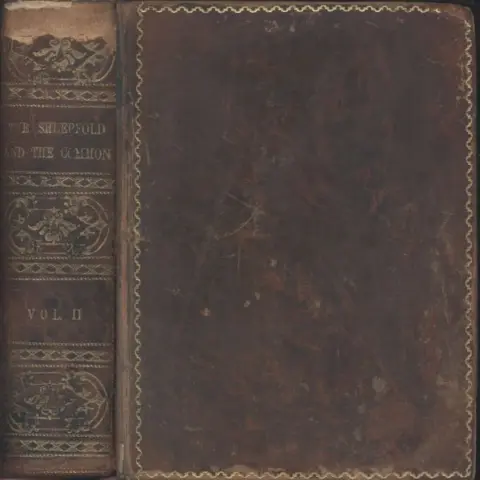
The Sheepfold and the Common; Or, Within and Without. Vol. 2 (of 2)
Timothy East
THE CLASSIC COLLECTION · 1859
"The Sheepfold and the Common; Or, Within and Without. Vol. 1 (of 2)" by Timothy East is a religious narrative written in the mid-19th century. This work aims to convey grand truths of the Christian faith through engaging stories derived from everyday life. It particularly focuses on moral and spiritual lessons, often through the lives of its characters, such as George Lewellin, whose journey captures the essence of repentance and redemption. At the start of the work, the narrator encounters a lonely widow and her son, George, during a visit to a beautiful village in England. The widow shares her struggles and faith despite significant losses, and George is portrayed with potential, yet he faces temptations that threaten his well-being. The text delves into the themes of sin, redemption, and the transformative power of grace through George's experiences, setting the stage for his internal battles and the hope for his spiritual awakening. The opening portion establishes a foundation of human struggles entwined with divine truth, captivating readers with the emotional depth and moral dilemmas faced by the characters.
Introduction adapted from the source catalogue; source summaries may be automatically generated.
Free to read · English · 219,665 words · No account needed
MAKE TIME FOR A GOOD BOOK
On by default. Untick to stop anonymous reading totals. Each page counts after 10 seconds in view. How this works.
Anonymous counting is on unless you have switched it off.
"Well, I will admit that when we come into real, practical life, we are compelled to modify, if not to give up as indefensible, some of our speculative opinions. In fact, the issue of every inquiry, when fearlessly pursued, is uncertainty--painful, distracting uncertainty--and man becomes the sport, if not the victim, of his own speculations and investigations."
"Yes, Sir, when he will not condescend to be taught of God. If we admit the inspiration, and consequent authority of the Bible, we have an infallible teacher on all questions relating to our responsibilities and our final destiny, and the mind settles down into a state of quietude, and feels secure; but if we reject its inspiration and authority as a sham, or a dogma of superstition, we go adrift on the wide expanse of absolute uncertainty, and are left to perish, when, and where, and how we know not, till after the terrible catastrophe has occurred."
There was now a pause in our discussion; and within the space of a few minutes, a little dark cloud, like that which was seen by the prophet's servants from the heights of Carmel, overspread the heavens, and we were compelled to look for a place of refuge from the storm which was coming.
"I am going to see a poor woman, who lives in yon cottage; perhaps you will not object to accompany me; we shall find shelter there."
"Most willingly, and if she be a deserving object, I shall feel most happy to contribute a mite for her relief; for your sake, Sir."
"I thank you. Sir, for the personal compliment; and I doubt not but
she will be thankful for your charitable donation, for she is very
poor."
"To be candid, Sir, I like practical sympathy better than sentimental; the one is a reality, the other a sham or a mawkish emotion, little less than a self-compliment to a refined but useless sensibility--something which excites the sentimentalism of a drawing-room, when we are looking on the print of an hospital or the wreck of a vessel hanging on the wall, but which gives no relief to a rescued sailor, or a discharged incurable."
The poor inmate (Mrs. Allen) was seated in her chair, wrapped in flannel, and supported by pillows, her appearance plainly indicating that she was near death. She smiled on seeing me, but on seeing the stranger she became a little disconcerted, yet, with polite ease, she moved her hands towards two chairs, and said, "Gentlemen, be seated."
"You appear," said Mr. Tennent, "very ill."
"Yes, Sir, but I believe my life of suffering will soon end, and then all will be well--and for ever."
Your reading position is saved on this browser. Take it to another device with a library code. Reading pages adapt to text, rather than matching a printed edition.
BEHIND THE BOOK
This eBook is for the use of anyone anywhere in the United States and most other parts of the world at no cost and with almost no restrictions whatsoever. You may copy it, give it away or re-use it under the terms of the Project Gutenberg License included with this eBook or online at www.gutenberg.org. If you are not located in the United States, you will have to check the laws of the country where you are located before using this eBook. Read the source licence.
The original source file, including credits and licence, is retained by this library. Request an original-format copy at no charge. Please include the book title and Project Gutenberg identifier #44469.
KEEP YOUR CURIOSITY GOING

David Patterson (Spirit) Hatch

David Patterson (Spirit) Hatch

David Patterson (Spirit) Hatch
Coulson Kernahan

Maurice Baring
Frances Wright