THE CLASSIC COLLECTION✦The secrets of stage conjuringCLASSIC FREE BOOKS
The secrets of stage conjuring
Jean-Eugène Robert-Houdin
THE CLASSIC COLLECTION · 1863
"The Sharper Detected and Exposed" by Jean-Eugène Robert-Houdin is a treatise on the art of sleight-of-hand and the detection of gambling cheats, written in the mid-19th century. The book delves into the world of fraudsters referred to as "Greeks," exploring their various schemes and tricks used to dupe unsuspecting players and gamblers. Robert-Houdin aims to educate the public on the deceptions prevalent in gambling, drawing from his own experiences and knowledge gained through years of study and mastery of magical performances. At the start of the book, the author introduces readers to his motivations for writing about the deceptive practices of sharpers. He reflects on his requests from magistrates to investigate cheating cases, revealing the complexities faced by judges who need to understand the intricacies of sleight-of-hand to bring justice. Robert-Houdin expresses his desire to illuminate the tricks of these con artists to protect the public, and he shares anecdotes like his encounter with the cunning sharper Elias Hausheer to illustrate the dangers involved in understanding and confronting such deceitful practices. The narrative goes on to lay the groundwork for further exploration of the different types of sharpers and their methods, setting the stage for a detailed look at the world of gambling deception.
Introduction adapted from the source catalogue; source summaries may be automatically generated.
Free to read · English · 48,975 words · No account needed
MAKE TIME FOR A GOOD BOOK
On by default. Untick to stop anonymous reading totals. Each page counts after 10 seconds in view. How this works.
Anonymous counting is on unless you have switched it off.
A servant in livery, having admitted them, opened the doors of a drawing-room brilliantly illuminated.
Andréas entered first, without apprehension, but he had no sooner done so, than his companion, following the instructions he had received from Béroli, turned round suddenly, and locked the door.
At the same moment, Béroli, and two athletic-looking men, entered from a door on the opposite side of the room.
"You, doubtless, remember me," exclaimed Béroli, in an austere and determined voice. "You must know what it is that brings me here."
"What do you mean, sir," cried Andréas, feigning the greatest indignation. "First of all, answer me. What sort of ambush is this, into which you have entrapped me? Am I in the midst of thieves, or assassins?"
"Do not speak so loud, sir," replied Béroli, "or you may have reason to regret it. The ambush of which you complain is only a favour to you--a step towards an amicable settlement of the business."
"What do you mean by talking to me about favours?" replied Andréas, "and what do you complain of? You offered me ten thousand francs for a ring, and I accepted your offer. Did I not give you the ring?"
"Yes, you did, but you omit to mention, that the stone you gave me was
a false one."
"Ah! Mon Dieu!" coolly replied Andréas. "I am far from denying it. I repeated that to you so often, that you must recollect it. Besides, did you not, when paying me the ten thousand francs, say you knew the stone was false, but that you very much wished to possess it?"
"Do not let us play upon words, sir, but let us come to the point. You are going to give me the ring you cheated me out of."
"To avoid all discussion on the subject, I tell you, once for all, that I have never had any other ring in my possession, than the one I delivered to you."
"If that be the case, you will not mind copying this, and sending it to
your mistress?"
"Let me see what it's about," said Andréas, taking the paper from Béroli. He read as follows:--
"MY DEAREST,--I hope to make some money in the house from which I pen these lines, but I require my diamond ring for the affair. Bring it to me yourself, to the address I enclose, and do not entrust it to any one else. The bearer of this note will give you my keys. At eleven o'clock precisely, I shall be at the door awaiting you. Take a carriage, so as to be punctual.
Your reading position is saved on this browser. Take it to another device with a library code. Reading pages adapt to text, rather than matching a printed edition.
Jean-Eugène Robert-Houdin
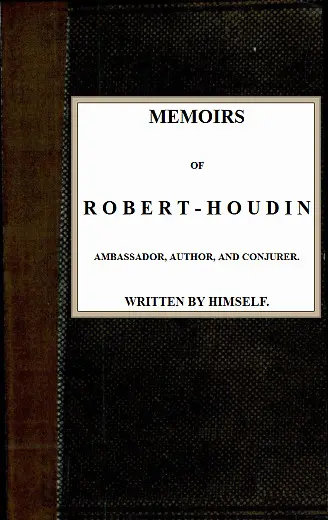
Jean-Eugène Robert-Houdin
BEHIND THE BOOK
This eBook is for the use of anyone anywhere in the United States and most other parts of the world at no cost and with almost no restrictions whatsoever. You may copy it, give it away or re-use it under the terms of the Project Gutenberg License included with this eBook or online at www.gutenberg.org. If you are not located in the United States, you will have to check the laws of the country where you are located before using this eBook. Read the source licence.
The original source file, including credits and licence, is retained by this library. Request an original-format copy at no charge. Please include the book title and Project Gutenberg identifier #46266.
KEEP YOUR CURIOSITY GOING

Charles G. (Charles Griffith) Ross
Hannah Webster Foster

Emily Lawless
Edwin Hamlin Carr

Charles De Lano Hine
Andrew Ure