THE CLASSIC COLLECTION✦The secrets of stage conjuringCLASSIC FREE BOOKS
The secrets of stage conjuring
Jean-Eugène Robert-Houdin
THE CLASSIC COLLECTION · 1863
"The Sharper Detected and Exposed" by Jean-Eugène Robert-Houdin is a treatise on the art of sleight-of-hand and the detection of gambling cheats, written in the mid-19th century. The book delves into the world of fraudsters referred to as "Greeks," exploring their various schemes and tricks used to dupe unsuspecting players and gamblers. Robert-Houdin aims to educate the public on the deceptions prevalent in gambling, drawing from his own experiences and knowledge gained through years of study and mastery of magical performances. At the start of the book, the author introduces readers to his motivations for writing about the deceptive practices of sharpers. He reflects on his requests from magistrates to investigate cheating cases, revealing the complexities faced by judges who need to understand the intricacies of sleight-of-hand to bring justice. Robert-Houdin expresses his desire to illuminate the tricks of these con artists to protect the public, and he shares anecdotes like his encounter with the cunning sharper Elias Hausheer to illustrate the dangers involved in understanding and confronting such deceitful practices. The narrative goes on to lay the groundwork for further exploration of the different types of sharpers and their methods, setting the stage for a detailed look at the world of gambling deception.
Introduction adapted from the source catalogue; source summaries may be automatically generated.
Free to read · English · 48,975 words · No account needed
MAKE TIME FOR A GOOD BOOK
On by default. Untick to stop anonymous reading totals. Each page counts after 10 seconds in view. How this works.
Anonymous counting is on unless you have switched it off.
"When you have paid me your original debt," said he, "I shall have more confidence in you, and will lend you a larger sum."
The dreaded moment arrived; the bill was presented, and of course was not paid. Père Robineau lost no time in adopting such stringent legal measures, that, to escape a prison, Raymond saw himself reduced to live the life of a recluse, never venturing to leave the house.
To crown all their miseries, Brissac, who, by some means more or less honest, always catered for the two, found himself in the same predicament as his friend.
A bill, with his signature attached, in the hands of Robineau, was almost due; but Brissac was not a man to allow himself to be caught. He resolved to free himself by an act of treacherous perfidy.
He went to the money-lender, and frankly told him he was penniless, and that therefore it would be useless to imprison him; but that, on the other hand, his friend was quite solvent; and he offered to get him a bill signed by Raymond, for a thousand francs, in exchange for his own, promising at the same time to assist him to entrap his invisible debtor.
The offer was accepted, and Brissac immediately commenced putting his infamous project into execution.
He made Raymond believe that he had found a more accommodating
money-lender, who had promised to let him have a thousand francs on his
bill.
No sooner does Brissac get possession of the paper, than he hastens to Père Robineau, gives it to him in exchange for his own, and returns to Raymond to carry out his scheme.
"All goes on well," said he to Raymond; "but there is a little formality necessary. Our new banker declines to give the money to any one but yourself. You had better come with me to satisfy him."
"Yes, but," replied Raymond, "I might be recognised, and taken by the bailiffs, on my way there."
"I foresaw this difficulty, and have a carriage at the door with the blinds drawn; so we have nothing to fear."
Unconscious of evil, Raymond starts on his way. The two friends congratulate themselves on their good fortune, and are laughing in their sleeves at the trick they are playing the bailiffs, when, suddenly, at the command of a strange voice, the carriage stops, and a man, in an authoritative tone, after desiring Brissac to get out, takes his place, and orders the coachman to drive to Clichy.
"Adieu! Raymond," cried out his perfidious friend as the carriage drove off, "adieu! Keep up your courage. Adieu!"
Your reading position is saved on this browser. Take it to another device with a library code. Reading pages adapt to text, rather than matching a printed edition.
Jean-Eugène Robert-Houdin
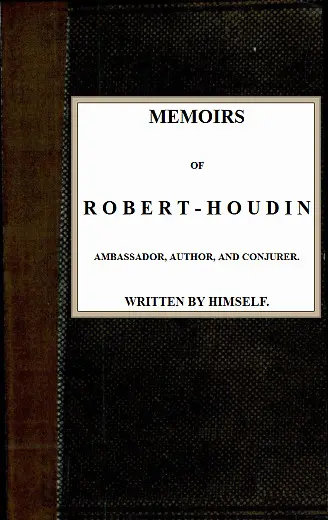
Jean-Eugène Robert-Houdin
BEHIND THE BOOK
This eBook is for the use of anyone anywhere in the United States and most other parts of the world at no cost and with almost no restrictions whatsoever. You may copy it, give it away or re-use it under the terms of the Project Gutenberg License included with this eBook or online at www.gutenberg.org. If you are not located in the United States, you will have to check the laws of the country where you are located before using this eBook. Read the source licence.
The original source file, including credits and licence, is retained by this library. Request an original-format copy at no charge. Please include the book title and Project Gutenberg identifier #46266.
KEEP YOUR CURIOSITY GOING

Charles G. (Charles Griffith) Ross
Hannah Webster Foster

Emily Lawless
Edwin Hamlin Carr

Charles De Lano Hine
Andrew Ure