THE CLASSIC COLLECTION✦The secrets of stage conjuringCLASSIC FREE BOOKS
The secrets of stage conjuring
Jean-Eugène Robert-Houdin
THE CLASSIC COLLECTION · 1863
"The Sharper Detected and Exposed" by Jean-Eugène Robert-Houdin is a treatise on the art of sleight-of-hand and the detection of gambling cheats, written in the mid-19th century. The book delves into the world of fraudsters referred to as "Greeks," exploring their various schemes and tricks used to dupe unsuspecting players and gamblers. Robert-Houdin aims to educate the public on the deceptions prevalent in gambling, drawing from his own experiences and knowledge gained through years of study and mastery of magical performances. At the start of the book, the author introduces readers to his motivations for writing about the deceptive practices of sharpers. He reflects on his requests from magistrates to investigate cheating cases, revealing the complexities faced by judges who need to understand the intricacies of sleight-of-hand to bring justice. Robert-Houdin expresses his desire to illuminate the tricks of these con artists to protect the public, and he shares anecdotes like his encounter with the cunning sharper Elias Hausheer to illustrate the dangers involved in understanding and confronting such deceitful practices. The narrative goes on to lay the groundwork for further exploration of the different types of sharpers and their methods, setting the stage for a detailed look at the world of gambling deception.
Introduction adapted from the source catalogue; source summaries may be automatically generated.
Free to read · English · 48,975 words · No account needed
MAKE TIME FOR A GOOD BOOK
On by default. Untick to stop anonymous reading totals. Each page counts after 10 seconds in view. How this works.
Anonymous counting is on unless you have switched it off.
"9th. Never try a chance until it is ripe, or has arrived at its maturity. This system will often oblige a novice to remain inactive; but practice will enable him to play every time, as he will know how to profit by all the chances attached to the combinations of the game.
"10th. If the calculations, founded upon your luck, or upon probabilities, are disappointed, cease playing at once, to try your luck again at a more favourable opportunity.
"Obstinacy in playing is ruin.
"11th. Never play for more than two hours; beyond that time, brain and fortune become weary of being kept too long on the rack.
"12th. To acquire the sort of impassibility I advocate, hide, in the recesses of your own heart, any and all emotions, which the fact of winning may produce, be the sum ever so considerable. Remember that your good luck ought never to make you rejoice too much, for, though Dame Fortune may shower her favours upon you, she as often takes her revenge on the imprudent whom success intoxicates."
I had paid the greatest attention to the explanation afforded me by M. Raymond. His system appeared to me, if not infallible, at least a very ingenious one; still I could not persuade myself, that it was possible to command success. I wished, however, to show him that I had perfectly understood him.
"All your precepts are very clear," said I, with an appearance of conviction, "and may be summed up as follows:--
"Before risking money at play, consider whether you are in a lucky vein, and study the probabilities of the game, or, as you call it, the maturity of chances."
"Just so," rejoined M. Raymond. "This system is so sure and certain, that I have latterly applied it most successfully.
"This morning I felt that it was one of my lucky days, those days so rare in the life of a gambler.
"This feeling was so strong in me, that I felt instinctively that something good would happen to me.
"On arriving at the table, I, however, at first only made a few trifling experiments at rouge-et-noir.
"My success confirmed my impressions.
"It would not have been prudent to exhaust the vein of my good luck, so I stopped, and, taking a card, began to study the maturity of the chances before making my great coup.
"After an hour spent in making observations, I thought the favourable moment had arrived, I placed ten francs on No. 33. I lost: one must expect that; but, confident in my successful vein, even more than in the No. 33, the maturity of which had not come to its full, I martingaled four times running.[F]
Your reading position is saved on this browser. Take it to another device with a library code. Reading pages adapt to text, rather than matching a printed edition.
Jean-Eugène Robert-Houdin
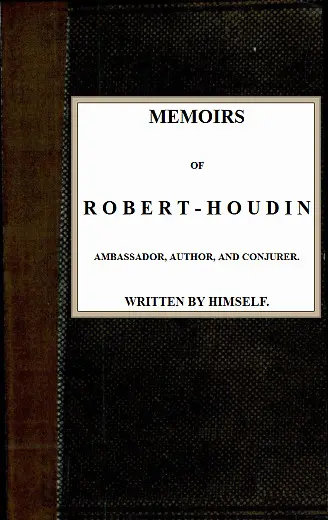
Jean-Eugène Robert-Houdin
BEHIND THE BOOK
This eBook is for the use of anyone anywhere in the United States and most other parts of the world at no cost and with almost no restrictions whatsoever. You may copy it, give it away or re-use it under the terms of the Project Gutenberg License included with this eBook or online at www.gutenberg.org. If you are not located in the United States, you will have to check the laws of the country where you are located before using this eBook. Read the source licence.
The original source file, including credits and licence, is retained by this library. Request an original-format copy at no charge. Please include the book title and Project Gutenberg identifier #46266.
KEEP YOUR CURIOSITY GOING

Charles G. (Charles Griffith) Ross
Hannah Webster Foster

Emily Lawless
Edwin Hamlin Carr

Charles De Lano Hine
Andrew Ure