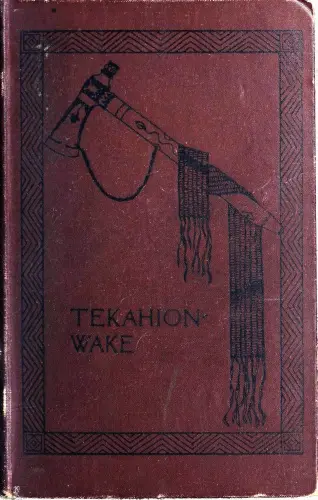
The White Wampum
E. Pauline Johnson
THE CLASSIC COLLECTION · 1913
"The Shagganappi" by E. Pauline Johnson is a fictional narrative that likely captures the late 19th-century experience of Indigenous peoples in North America, intertwining themes of identity, heritage, and resilience. The novel centers around Fire-Flint Larocque, a half-Cree boy who navigates the complexities of his mixed heritage and finds a sense of belonging among peers at an Eastern college. The narrative reflects on the struggles between Indigenous and colonial cultures and highlights the importance of recognizing one’s roots and the valor of the Indigenous spirit. At the start of the story, readers are introduced to Fire-Flint Larocque, who grapples with his identity as a "half-breed." His first pivotal moment comes during an encounter with the Governor-General of Canada, where he learns to embrace his unique heritage. The opening chapters establish the contrasting worlds that Fire-Flint inhabits—his Indigenous background and the academic setting of the college. Throughout the narrative, he will possibly confront prejudice from his peers, yet he is also shown moments of acceptance, such as through a budding friendship with Hal Bennington, a kind-hearted boy from wealth. This rich backdrop sets the stage for a compelling exploration of personal and collective identity within the complexities of racial and cultural dynamics.
Introduction adapted from the source catalogue; source summaries may be automatically generated.
Free to read · English · 79,648 words · No account needed
MAKE TIME FOR A GOOD BOOK
On by default. Untick to stop anonymous reading totals. Each page counts after 10 seconds in view. How this works.
Anonymous counting is on unless you have switched it off.
"I'm glad, too," answered his cousin, "but I'll be 'gladder' if you will tell me where I can get some togs like yours. I declare, but I like that outfit," and he looked enviously at Banty's leather chaps, blue flannel shirt, scarlet silk neckerchief and cowboy hat.
"These duds?" questioned Banty. "Oh, you can get them anywhere. They'd hardly suit you, though." And he measured the stranger with a critical eye.
"Suit or not, I'm going to have them," said "Con"--as his genial father called him. "Let's go right to the shops and get an outfit now."
So Banty tied up the horses, stowed the luggage away in the afterpart of the trap, and led the way to the trader's.
When they started for the ranch, Con had, in addition to his English bags, boxes, shawl-straps and portmanteaus, a most beautiful outfit of typical Western finery, a handsome Mexican saddle, a crop, a quirt, fringed gauntlet gloves, chaps, Stetson hat, silk handkerchief, ties, and three pairs of sporting and riding boots.
"We'll put these patent leathers gently into the river, or on a shelf, until I face the East again," he said, half apologetically. Then with a quick burst of English simplicity, he said: "Oh, Banty, I want to be one of you!"
"And you're going to be one of us," said that sturdy young Westerner. "In fact, Con--well, you just are one of us," he added.
The lanky, pink-faced boy grew pinker.
"I know I'm an awful length and all that," he said, "but I'm only
sixteen, don't you know!"
Banty grinned. The "Don't you know," which at first horrified him, was, oddly enough, growing to be almost fascinating. Banty would have felt himself an awful owl were he to say it, but it somehow suited the tall, pink boy, and did not sound one particle "dudish," or offensive, and during the ten-mile drive across the Kamloops Hills Banty decided that Con was a first-rate fellow, notwithstanding his abominable clothes and "swagger" English accent. At the ranch house door they were greeted by Banty's parents and a couple of range riders, and Eena, who, Indian-like, never revealed the fact by word or look that he had observed the patent leather shoes, and the wonderful high collar; who, also Indian-like, in spite of these drawbacks, liked the stranger without cause, a peculiar instinct of liking that came when the young King Georgeman shook hands with him, a wholesome British "shake" that engendered confidence.
"You will be tired, Constantine," said Mrs. Clark, with motherly care, "and not accustomed to this extreme heat. Come at once and rest. I have made a great jug of lemonade. Do come in at once."
Your reading position is saved on this browser. Take it to another device with a library code. Reading pages adapt to text, rather than matching a printed edition.
E. Pauline Johnson
E. Pauline Johnson
E. Pauline Johnson
E. Pauline Johnson
BEHIND THE BOOK
This eBook is for the use of anyone anywhere in the United States and most other parts of the world at no cost and with almost no restrictions whatsoever. You may copy it, give it away or re-use it under the terms of the Project Gutenberg License included with this eBook or online at www.gutenberg.org. If you are not located in the United States, you will have to check the laws of the country where you are located before using this eBook. Read the source licence.
The original source file, including credits and licence, is retained by this library. Request an original-format copy at no charge. Please include the book title and Project Gutenberg identifier #5769.
KEEP YOUR CURIOSITY GOING
Coulson Kernahan

Maurice Baring
Frances Wright
Cécile Tormay

Frederic Jesup Stimson

W. H. P. (William Henry Pope) Jarvis