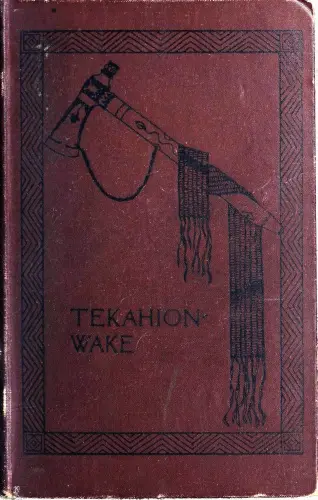
The White Wampum
E. Pauline Johnson
THE CLASSIC COLLECTION · 1913
"The Shagganappi" by E. Pauline Johnson is a fictional narrative that likely captures the late 19th-century experience of Indigenous peoples in North America, intertwining themes of identity, heritage, and resilience. The novel centers around Fire-Flint Larocque, a half-Cree boy who navigates the complexities of his mixed heritage and finds a sense of belonging among peers at an Eastern college. The narrative reflects on the struggles between Indigenous and colonial cultures and highlights the importance of recognizing one’s roots and the valor of the Indigenous spirit. At the start of the story, readers are introduced to Fire-Flint Larocque, who grapples with his identity as a "half-breed." His first pivotal moment comes during an encounter with the Governor-General of Canada, where he learns to embrace his unique heritage. The opening chapters establish the contrasting worlds that Fire-Flint inhabits—his Indigenous background and the academic setting of the college. Throughout the narrative, he will possibly confront prejudice from his peers, yet he is also shown moments of acceptance, such as through a budding friendship with Hal Bennington, a kind-hearted boy from wealth. This rich backdrop sets the stage for a compelling exploration of personal and collective identity within the complexities of racial and cultural dynamics.
Introduction adapted from the source catalogue; source summaries may be automatically generated.
Free to read · English · 79,648 words · No account needed
MAKE TIME FOR A GOOD BOOK
On by default. Untick to stop anonymous reading totals. Each page counts after 10 seconds in view. How this works.
Anonymous counting is on unless you have switched it off.
"He must be a great care and anxiety to you," said the caller.
Archie shuddered at the words.
"Only a sweet care," said his mother. "I am always hoping he will
outgrow his delicate health."
Archie groaned. How horribly like a girl it was to be "delicate."
"I think," went on the caller, raspingly, "that a frail boy is a care. One depends so on one's sons to be a strength to one in old age; to help in their father's business, and things like that--unless, of course, one has money."
The harsh voice ceased, and Archie felt in his soul that the speaker was glancing meaningly about the bare little parlor of his father's house. He could have hugged his mother as he heard her say: "Oh, well, Trig and Dudley will help their father; and none of us grudge Archie his inability to help, or his music lessons either."
"I should think his violin and his books and lessons would be a great expense to you," proceeded the caller.
"Nothing is an expense that fills his life and helps him to forget he is shut away from the other boys and their jolly sports, just because he is not strong enough to participate in them," replied his mother, with a slight chill in her voice at her visitor's impertinence.
Presently the caller left, and Mrs. Anderson, slipping through the folding doors, saw Archie outstretched on the pillows. She bent over him with great concern; her eyes read every expression of his face, every attitude of his languid body.
"Archie, you didn't hear?" she asked, pleadingly.
"I'm afraid I did, motherette," he said, springing up with unusual
spirit.
He stood before her, a head taller than herself, his thin form frail as a flower, his long, slim fingers twitching, his wonderful, wistful eyes and sensitive mouth revealing all the artist nature of a man of thirty, instead of a boy of fourteen. He was on the point of flaring out with indignation against the visitor, but his lack of physical strength seemed to crowd upon him just at that moment. He sank upon the lounge again, and with his face against Mrs. Anderson's arm, said: "Thank you, motherette, for fighting for me. Perhaps even with all this miserable ill-health of mine I can fight for you some day."
"Of course you will, dear," she replied cheerily. "Don't you mind what they say; you know 'Hock' always stands by you, and he's as good as your mother to fight for you."
"Dear old 'Hock!' Decent old 'Hock!'" he said admiringly. "He's the best boy in the world, but he is not you, motherette."
Your reading position is saved on this browser. Take it to another device with a library code. Reading pages adapt to text, rather than matching a printed edition.
E. Pauline Johnson
E. Pauline Johnson
E. Pauline Johnson
E. Pauline Johnson
BEHIND THE BOOK
This eBook is for the use of anyone anywhere in the United States and most other parts of the world at no cost and with almost no restrictions whatsoever. You may copy it, give it away or re-use it under the terms of the Project Gutenberg License included with this eBook or online at www.gutenberg.org. If you are not located in the United States, you will have to check the laws of the country where you are located before using this eBook. Read the source licence.
The original source file, including credits and licence, is retained by this library. Request an original-format copy at no charge. Please include the book title and Project Gutenberg identifier #5769.
KEEP YOUR CURIOSITY GOING
Coulson Kernahan

Maurice Baring
Frances Wright
Cécile Tormay

Frederic Jesup Stimson

W. H. P. (William Henry Pope) Jarvis