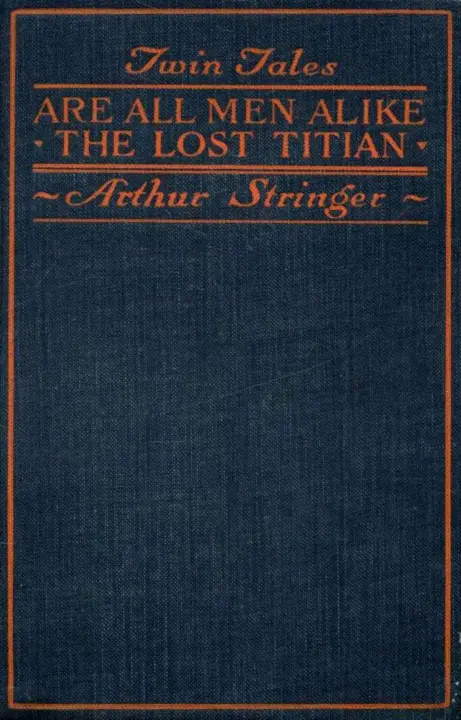
Twin Tales: Are All Men Alike, and, The Lost Titian
Arthur Stringer
THE CLASSIC COLLECTION · 1913
"The Shadow" by Arthur Stringer is a novel written in the early 20th century. The story introduces the readers to Jim Blake, the Second Deputy Commissioner of Police, who is deeply embroiled in the investigation of a notorious criminal named Connie Binhart. The novel explores themes of law, morality, and the complexities of human relationships, particularly through the dynamic between Blake and a woman named Elsie. At the start of the book, Jim Blake receives a visit from Elsie Verriner, a woman with a mysterious past, who has been linked to various crimes. Their conversation reveals both tension and a complicated past, marked by instances where Blake has had to confront her involvement in criminal activities. As he navigates his duties within the police force and his complex feelings for Elsie, Blake learns about Connie Binhart's whereabouts, leading to a tense negotiation of trust and manipulation. The opening sets the stage for an intriguing interplay of crime and personal relationships, hinting at Blake's determination to capture Binhart and his complicated feelings for Elsie, who may still be entangled with the criminal world.
Introduction adapted from the source catalogue; source summaries may be automatically generated.
Free to read · English · 50,449 words · No account needed
MAKE TIME FOR A GOOD BOOK
On by default. Untick to stop anonymous reading totals. Each page counts after 10 seconds in view. How this works.
Anonymous counting is on unless you have switched it off.
He shifted a little in his chair. But he met her gaze without a wince.
“This is business, Elsie, and you can’t mix business and—and other things,” he tailed off at last, dropping his eyes.
“I’m sorry you put it that way,” she said. “I hoped we’d be better friends than that!”
“I’m not counting on friendship in this!” he retorted.
“But it might have been better, even in this!” she said. And the artful look of pity on her face angered him.
“Well, we’ll begin on something nearer home!” he cried.
He reached down into his pocket and produced a small tinted oblong of paper. He held it, face out, between his thumb and forefinger, so that she could read it.
“This Steinert check’ll do the trick. Take a closer look at the
signature. Do you get it?”
“What about it?” she asked, without a tremor.
He restored the check to his wallet and the wallet to his pocket. She would find it impossible to outdo him in the matter of impassivity.
“I may or I may not know who forged that check. I don’t want to know. And when you tell me where Binhart is, I won’t know.”
“That check wasn’t forged,” contended the quiet-eyed woman.
“Steinert will swear it was,” declared the Second Deputy.
She sat without speaking, apparently in deep study. Her intent face showed no fear, no bewilderment, no actual emotion of any kind.
“You’ve got ’o face it,” said Blake, sitting back and waiting for her to speak. His attitude was that of a physician at a bedside, awaiting the prescribed opiate to produce its prescribed effect.
“Will I be dragged into this case, in any way, if Binhart is rounded up?” the woman finally asked.
“Not once,” he asserted.
“You promise me that?”
“Of course,” answered the Second Deputy.
“And you’ll let me alone on—on the other things?” she calmly exacted.
“Yes,” he promptly acknowledged. “I’ll see that you’re let alone.”
Again she looked at him with her veiled and judicial eyes. Then she dropped her hands into her lap. The gesture seemed one of resignation.
“Binhart’s in Montreal,” she said.
Blake, keeping his face well under control, waited for her to go on.
“He’s been in Montreal for weeks now. You’ll find him at 381 King Edward Avenue, in Westmount. He’s there, posing as an expert accountant.”
She saw the quick shadow of doubt, the eye-flash of indecision. So she reached quietly down and opened her pocket-book, rummaging through its contents for a moment or two. Then she handed Blake a folded envelope.
Your reading position is saved on this browser. Take it to another device with a library code. Reading pages adapt to text, rather than matching a printed edition.
Arthur Stringer
Arthur Stringer
Arthur Stringer
Arthur Stringer
BEHIND THE BOOK
This eBook is for the use of anyone anywhere in the United States and most other parts of the world at no cost and with almost no restrictions whatsoever. You may copy it, give it away or re-use it under the terms of the Project Gutenberg License included with this eBook or online at www.gutenberg.org. If you are not located in the United States, you will have to check the laws of the country where you are located before using this eBook. Read the source licence.
The original source file, including credits and licence, is retained by this library. Request an original-format copy at no charge. Please include the book title and Project Gutenberg identifier #44336.
KEEP YOUR CURIOSITY GOING
Coulson Kernahan

Maurice Baring
Frances Wright
Cécile Tormay

Frederic Jesup Stimson

W. H. P. (William Henry Pope) Jarvis